Unlock the Editor’s Digest for free
Roula Khalaf, Editor of the FT, selects her favourite stories in this weekly newsletter.
China’s military has escalated its campaign of pressure against Taiwan by violating the island nation’s airspace with a drone for the first time.
A Chinese surveillance drone entered the airspace of Pratas, a Taiwan-controlled island in the South China Sea also known as Dongsha, for four minutes on Saturday.
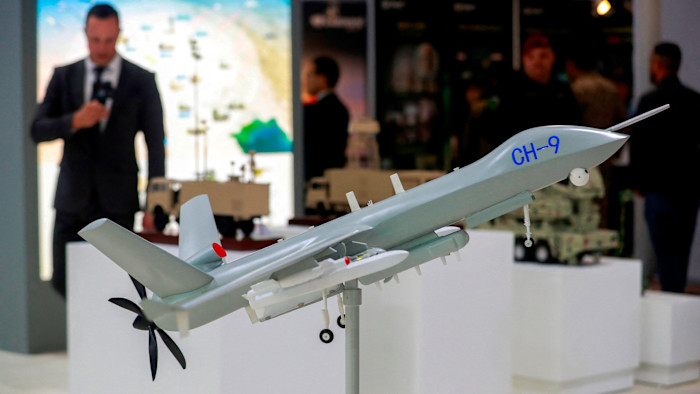
The unmanned aerial vehicle was a WZ-7 known as ‘Soaring Dragon’ according to a Taiwanese national security official. It flew at an “altitude outside the range of our air defence weapons and left following warnings Taipei broadcast via international radio channels”, Taiwan’s defence ministry said in a statement.
Analysts said the move highlighted Taiwan’s difficulties in countering China’s high-end drone capabilities and allowed Beijing to further undermine the country’s sovereignty.
“China has found another soft spot,” said Kitsch Liao, an associate director at the Atlantic Council’s Global China Hub. “They can repeat this to demonstrate that they can enter Taiwan airspace with impunity. And what do you do if they start flying lower and lower? If you decide to shoot the drone down when it comes into range, China can blame Taiwan because it didn’t do anything before.”
Beijing claims Taiwan as part of its territory and threatens to annex it by force if Taipei refuses indefinitely to submit to its control.
China’s People’s Liberation Army has in recent years held large-scale military exercises with the declared goal of intimidating Taiwan. It has also launched increasingly frequent naval and air patrols which are growing in scale and gradually moving closer to Taiwan.
Increasingly often China also harasses Taiwan’s outlying islands with its coastguard and maritime militia — armed fishing vessels that carry out paramilitary missions.
Pratas has become a preferred target for those operations over the past year. On Wednesday, Taiwan’s coastguard published footage of two Chinese coastguard ships approaching the atoll.
It is located about 420km from southern Taiwan, in waters both US and Chinese submarines would have to pass through in a potential future conflict.
US and Taiwanese government officials believe that, while the US might help defend Taiwan in the case of a Chinese attack, it would not intervene over Pratas, which is part of Tapei’s disputed claim to sovereignty over the South China Sea as a legacy of the Republic of China.
Under US domestic law, Washington is required to provide Taiwan with the weapons needed to defend itself and to maintain the capacity of the US to resist any force or coercion that would jeopardise Taiwan’s security.
“China could severely weaken Taiwan’s morale and confidence in defending itself if it got away with seizing Pratas,” said a foreign military official in Asia.
Taiwan’s defence minister Wellington Koo told lawmakers in 2024 that the country’s armed forces would view the unauthorised entry of any Chinese military aircraft, ship or other asset into Taiwan’s territorial airspace or waters as a “first strike” against which Taiwan could order a counterstrike in self-defence.
But according to Taiwan’s latest quadrennial defence review published last March, the military is still working on rules which would spell out under what circumstances frontline officers would be empowered to order such a move.
Two Taiwanese officials said Taipei would exercise “extreme caution” to avoid any incident at Pratas sparking a broader conflict. “We would consult with our ally,” one of the officials said, referring to the US.
For several years Taipei had only a coastguard stationed on the islet. Although a contingent of Marines was deployed there in 2024, it still has only minimal defences.
The defence ministry declined to say what air defence weapons the Pratas garrison had, but military experts said that at best it was believed to have self-propelled AN/TWQ-1 Avenger mobile surface-to-air missile systems and shoulder-launched Stinger missiles. Those weapons have a range of under 4,000 metres while the WZ-7 reaches a cruising altitude of about 18,000 metres.
The PLA’s Southern Theatre Command said on Saturday it had held “normal drone flight exercises” at what it called “China’s Dongsha Island”. “These are completely just and legal,” it said.