Unlock the White House Watch newsletter for free
Your guide to what Trump’s second term means for Washington, business and the world
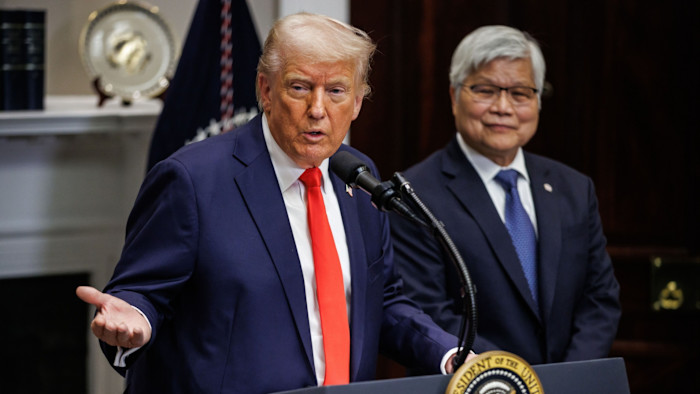
The US has announced a trade agreement with Taiwan that would slash tariffs on goods from the island to 15 per cent as Washington moves to secure chip supply chains and pushes companies to invest in American manufacturing.
Donald Trump’s administration said it would reduce its levies on most goods from Taiwan from 20 per cent to 15 per cent and waive tariffs on generic drugs, aerospace parts and natural resources unavailable in the US.
Under the terms of the deal Taiwanese semiconductor and technology companies would make “new, direct investments” in the US totalling $250bn to expand its chip, energy and AI production and innovation capacity.
The agreement marks a warming of relations between Washington and Taipei after the White House last year threatened an unprecedented 100 per cent tariff on semiconductors unless foreign companies invested in US manufacturing.
The deal also sets out quotas for tariff-free imports of chips from Taiwan, where most of the world’s most advanced semiconductors are made by the Taiwan Semiconductor Manufacturing Company.
Companies investing in manufacturing in the US would be allowed to import 2.5 times their planned semiconductor production capacity free of so-called national security tariffs over the construction period, according to the US commerce department.
Taiwanese companies that had already built chip manufacturing sites in the US would be able to import 1.5 times their production capacity tariff-free.
Washington delayed imposing levies on semiconductors when President Trump forced sweeping “reciprocal” tariffs on much of the world last year, instead launching a national security probe, known as a Section 232 investigation, in April to assess how they might best be applied.
TSMC, which produces about 90 per cent of the world’s advanced semiconductors, has already pledged to invest $165bn in the US to build chip fabrication and processing plants, along with a research and development facility in Arizona, where it is producing chips for the likes of Nvidia and Apple.
TSMC did not immediately respond to a request for comment.
The US government said Taipei would provide credit guarantees of at least $250bn to facilitate additional investments by Taiwanese companies.
The Asian nation dominates global chip production after decades of industrial policy geared towards establishing the country as a critical hub for the global electronics industry.
The 2022 US Chips Act introduced billions of dollars in federal grants aimed at bringing chip manufacturing to the US, which entailed TSMC as well as South Korea’s Samsung and SK Hynix committing to build new facilities.
But earlier this year, Taiwan found itself in the crosshairs of Trump’s steep reciprocal tariffs, and was one of the handful of US allies unable to clinch a deal to avert the highest rates ahead of the president’s August deadline.
The White House meanwhile took a 10 per cent stake in Intel in August as the troubled chipmaker tries to re-establish itself as a leading manufacturer.
Intel’s poaching of a top TSMC executive triggered a bitter legal fight between the two companies and an official trade secrets probe from Taiwanese authorities last year, underscoring the sensitivity of semiconductors in US-Taiwan relations.
Wu Cheng-wen, who oversees Taiwan’s National Science and Technology Council, told the FT late last year that while Taipei would support the US in building out its chip industry, it would not allow its domestic production to be hollowed out.
Taiwan’s global importance to the chip industry is believed to support the country’s security, making the US or other countries more likely to try to prevent an attack by China.