Unlock the Editor’s Digest for free
Roula Khalaf, Editor of the FT, selects her favourite stories in this weekly newsletter.
The world’s second-largest container shipping line is looking at boosting the use of ethanol as a green fuel for its vessels, which could reduce its dependence on China and soften Donald Trump’s resistance to decarbonisation.
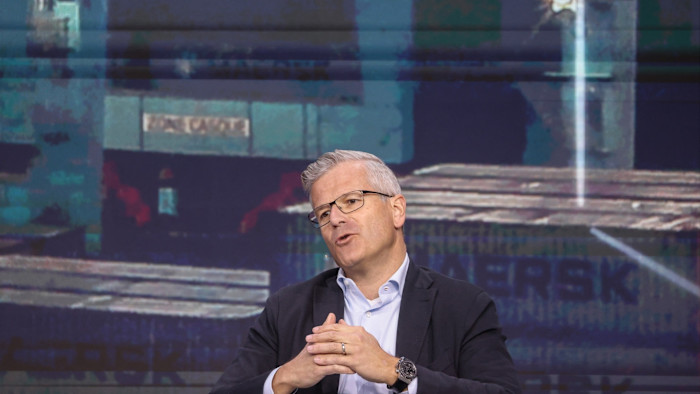
China dominates the market for clean energy fuels such as “green” methanol, and Denmark’s AP Møller-Maersk wants to use more ethanol — of which the US and Brazil are the top two producers — to diversify supplies, said Vincent Clerc, chief executive.
“If all the upside is only in China, then some countries will object,” Clerc told the Financial Times. “But if the upside is more evenly distributed, then more countries will support it . . . It will make the green transition something that more countries can see an upside to.”
The comments by Clerc come as shipping, one of the most polluting industries but the backbone of global trade, grapples with how to decarbonise. The US blocked efforts in October to agree a climate deal for the shipping sector.
Executives hope the importance of ethanol to US farmers and big agricultural businesses, big constituencies for the president, could help overcome Trump’s scepticism of decarbonisation efforts.
Maersk has started testing ethanol as a fuel for its Laura Maersk container ship. It began with a blend of 10 per cent ethanol and 90 per cent methanol in October, before moving to a 50-50 mix in December. It hopes to trial 100 per cent ethanol eventually.
Clerc, who took the top job in January 2023, said ethanol had the benefit of being able to scale rapidly and without much of a green premium to be paid. However, he added that some issues involved in production and certification remained.
“It is an industry that is in overcapacity both in the US and in Brazil, and therefore could offer some immediate scale and positive impact on the carbon footprint,” he said.
Green fuel production outside of China has been slow. Ørsted, the Danish renewable energy company, scrapped a big project for e-methanol in Sweden in 2024.
“In general it is a concern if there is only one country that can produce the energy of the future. Today, it looks like China is by far the most competitive producer of green methanol. Not all of our ships go to China, not all of our ships can depend on energy from China,” Clerc said.
The Maersk boss added that diversification “might help over time break the deadlock” at the International Maritime Organization over climate rules.
Container shipping has enjoyed a robust year as the strength of Chinese exports balanced Trump’s tariffs imposed on many countries.
Clerc said he was monitoring whether US tariffs would have spillover effects on the global economy but, so far in December, “the strength that we have seen in markets shows no sign of abating”.
Maersk has long warned of an impending overcapacity of container ships after rivals used a boom during the pandemic to order large numbers of new vessels.
Clerc said that while he expected oversupply in 2026 after six years of undersupply, “it is not necessarily going to be very protracted or extremely impactful . . . but you could have some level of pressure”.