Unlock the Editor’s Digest for free
Roula Khalaf, Editor of the FT, selects her favourite stories in this weekly newsletter.
In central Beijing, the shelves of Greatroam Burial Garments are lined with luxury goods — from intricately marbled Wagyu beef rolls and fine blends of oolong tea to Prada bags and Rolex watches.
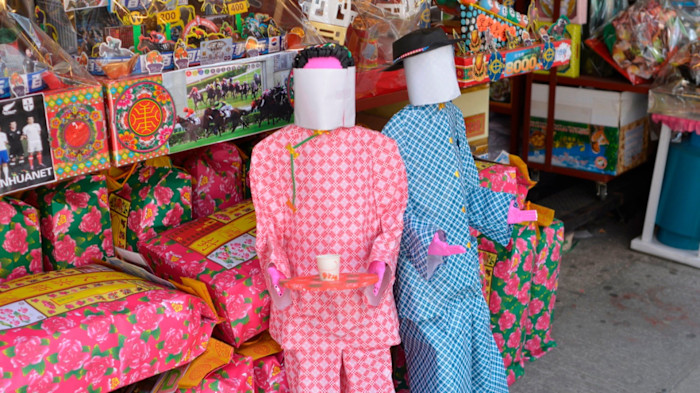
On closer inspection, however, it is clear that these are not indulgences for the here and now. Instead, they are exquisitely made replicas intended for use in the afterlife.
As part of Taoist funeral traditions in China, relatives often burn paper versions of everyday items to assist the souls of their loved ones in their onward journey.
The replicas in this shop represent the evolving tastes of China’s increasingly sophisticated upper-middle classes — fake cartons of organic whole milk have replaced furniture, cows and TVs.
Greatroam is doing something rarely attempted in mainland China — modernising death rituals that have become exploited by the country’s hyper-competitive funeral industry.
In the process it is encouraging people to confront one of China’s central taboos. In a society where the mere utterance of the word “death” is thought to bring misfortune, it is trying to teach people not only to accept the concept of mortality but also to prepare for it and celebrate the lives of the deceased.
“For most Chinese people, discussing death or even thinking about all the related issues — before and after it — is considered highly taboo and thought to bring bad luck,” said Gao Guqi, founder of Greatroam. He added that this “often leads to a chaotic and disorganised situation during a person’s final moments”.
The outbreak of the Covid-19 pandemic in mainland China forced many families to confront death head-on as relatives, particularly the elderly, died in large numbers.
This was the case for Gao, who lost his father during Covid and his mother soon after. A furniture entrepreneur, he was appalled at the traditional funeral industry, with operators using unnecessary rules and complexity to extract more money from the bereaved.
He is not the only one to notice the poor condition of the industry, whose mortuaries and cremation services are state-run. In October last year, the Communist party’s dreaded anti-corruption body, the Central Commission for Discipline Inspection, joined a campaign to root out dishonesty in the business.
“Addressing corruption and irregularities in the funeral sector is essential for strengthening the party’s close bond with the people,” a statement declared.
Chinese funeral customs combine elements from Confucianism, Taoism and Buddhism.
Traditional practices, such as requiring the deceased to wear an odd number of clothes for luck, can be used as an excuse to persuade the bereaved to buy excessive garments, according to Gao. In another custom, companies insist relatives buy and scatter coins at every road intersection during a funeral procession, adding to costs.
“The things the operators talk about are not genuinely important parts of traditional Chinese culture,” said Gao. “These are pseudo-traditions.”
He noticed that existing operators did not seem concerned about superstitions. “They don’t believe in things like ghosts and spirits — they tell clients about such things to create a sense of urgency and persuade them to purchase products or services,” he said, adding that many “are even atheists”.
He and his staff began to offer different sorts of paper effigies. The average modern Chinese person would not know how to slaughter a cow to eat in the afterlife. More useful are things like pets. “We’ve made two: a bird and a dog,” he said.
Even more important are services to help people deal with mortality. The company has started to hold “salons”, where people can talk openly.
At one of these, attended by about 40 people, he realised that this was radically new for most people.
“When participants talked about their experiences, they were very eager to share — some were almost unstoppable,” he said. “They rarely have other spaces in which to talk about these things.”
With additional contributions from Wenjie Ding in Beijing