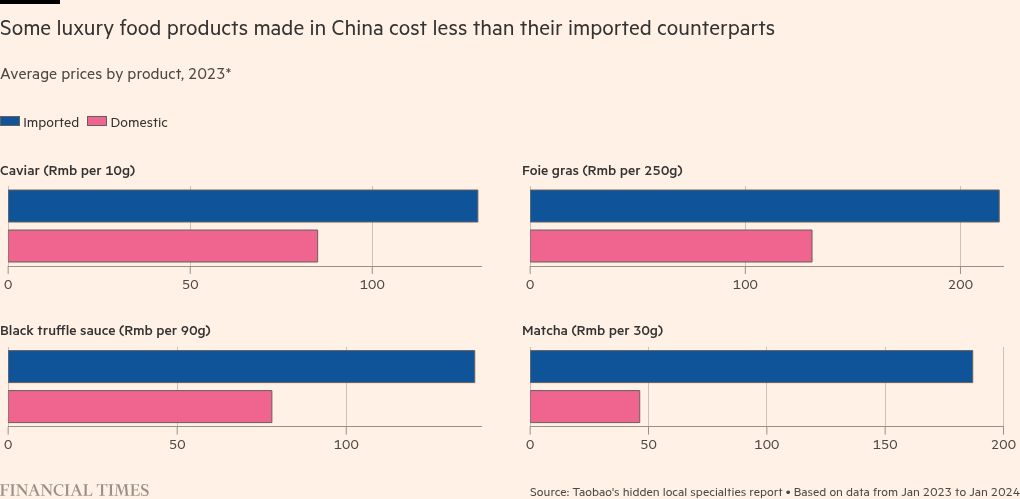
China is becoming an increasingly powerful producer of luxury foods, supplying domestic consumers with once-rare delicacies and in some cases breaking into overseas markets.
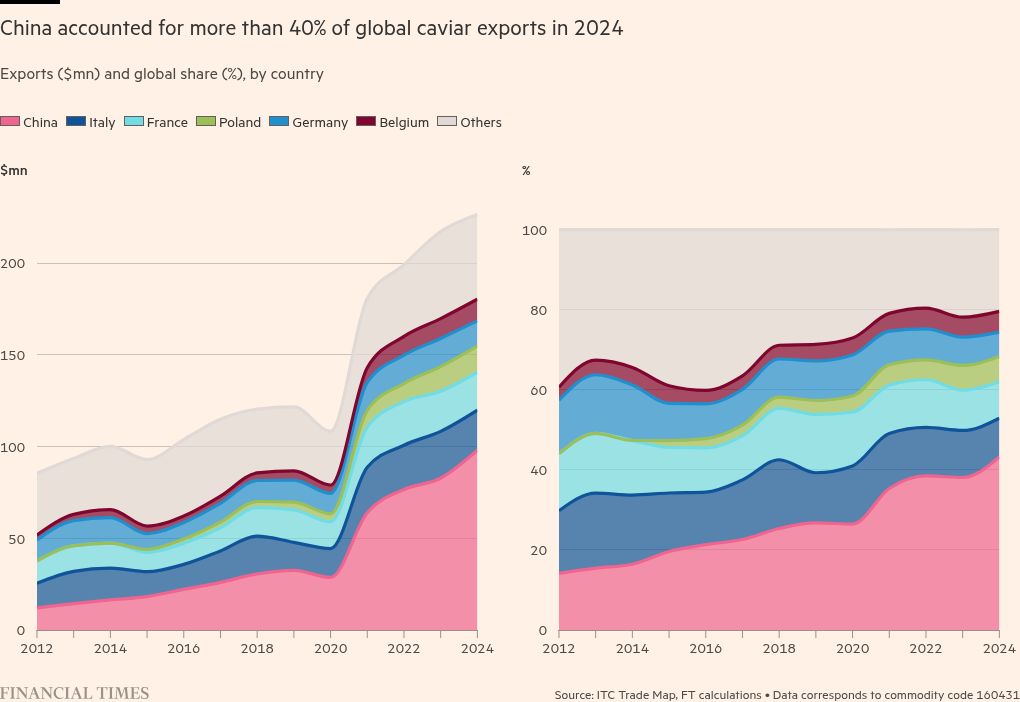
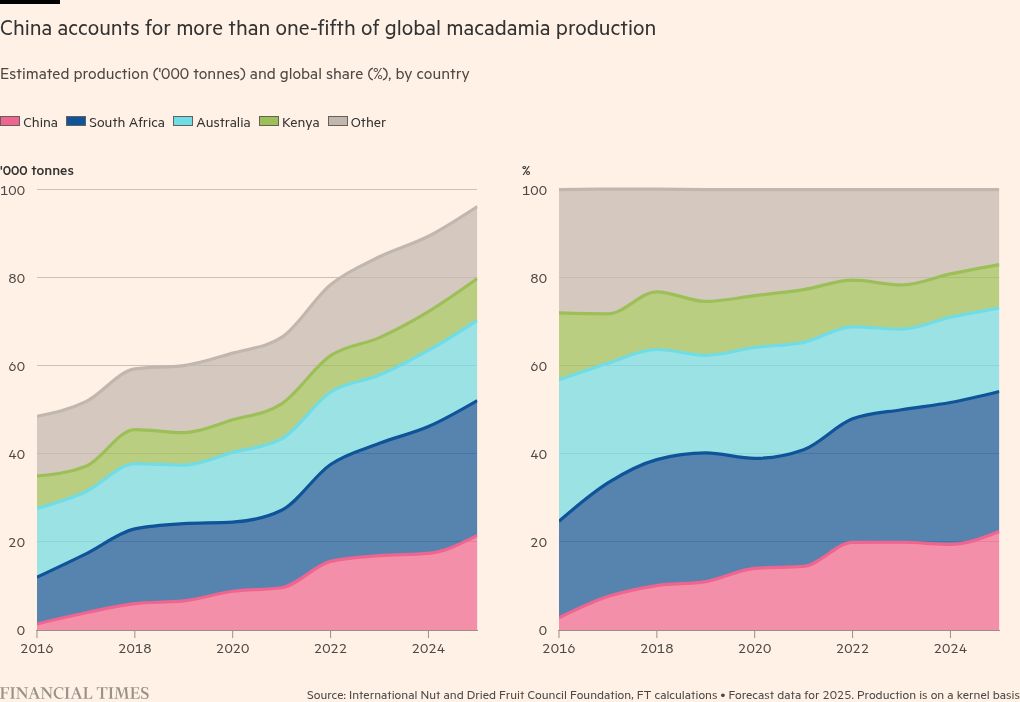
The world’s second-largest economy now accounts for the majority of global production and exports of caviar. It has surpassed Australia, from whom it originally imported macadamia trees, to become the second-biggest producer of macadamia nuts.
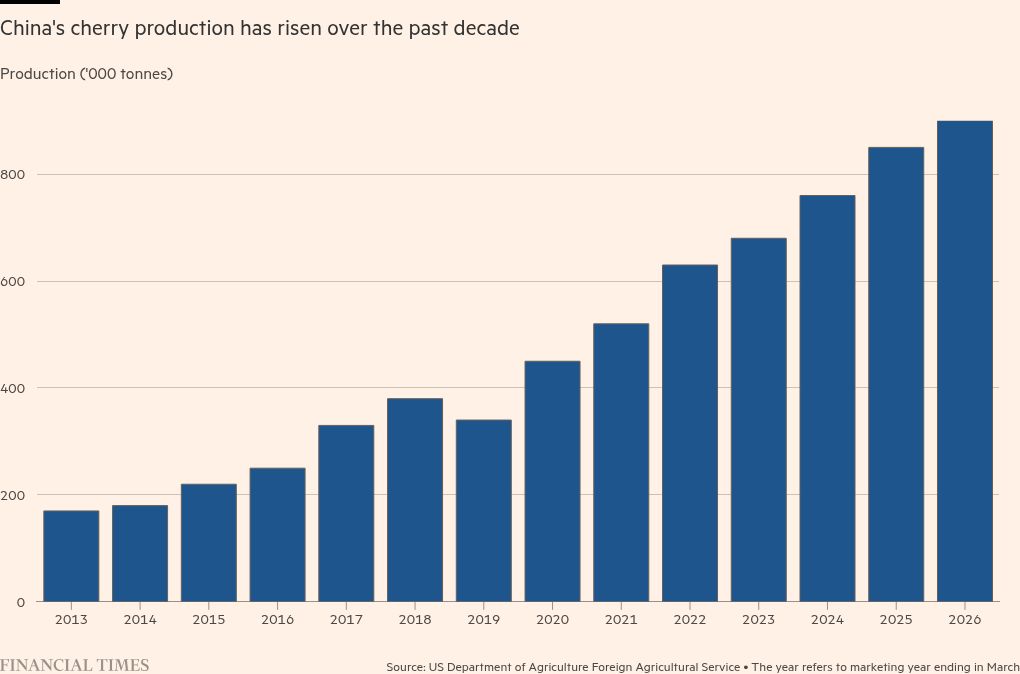
China is also stepping up the farming of cherries and sale of wild truffles and produces thousands of tonnes of foie gras a year.
“[Previously], many consumers who could afford it didn’t know about it, or didn’t know it was in China or Huoqiu county,” said Li Fengshan, a farmer in the central province of Anhui who produces about 100 tonnes of foie gras a year mainly for the domestic market. “Now, many know”.
“More people are eating it now,” he added.
The availability of such products, which were previously largely imported, has increased dramatically in China in the past two decades.
The change in part reflects strong support from provincial governments in agriculturally rich regions such as south-western Yunnan, eastern Shandong and central Anhui, which have encouraged farmers to switch to higher-value crops.
<div data-o-component="o-expander" class="o-expander o-expander__info-box" data-o-expander-shrink-to="hidden" data-trackable="clip-info-box" data-o-expander-collapsed-toggle-text="Show video info” data-o-expander-expanded-toggle-text=”Hide video info“>
While largely driven by swelling domestic appetite, the luxury food boom poses yet another challenge to trading partners of China, which recorded a record goods trade surplus of more than $1tn in the first 11 months of 2025.
The impact is most evident in the case of caviar, where rapidly expanding production in China since the 1990s has reshaped global trade in the delicacy produced by salt-curing sturgeon roe.
Kaluga Queen, a caviar brand developed by experts working for China’s agriculture ministry, is today the world’s largest supplier, producing 260 tonnes of the fish eggs in 2024 — 35 per cent of the global total.
In 2012, China exported about $12mn worth of caviar, accounting for roughly 14 per cent of global exports. By 2024 — after Moscow’s full-scale invasion of Ukraine disrupted Russia’s trade — Chinese exports were worth $98mn, about 43 per cent of the global total, according to International Trade Centre data.
Caviar exports grew amid mounting pressure on demand in China as a property slowdown squeezed discretionary spending and crackdowns on official dining — part of President Xi Jinping’s long-running anti-corruption campaign — damped consumption of luxury foods.
“High-end food production is closely tied to government consumption,” said Ian Lahiffe, a consultant specialising in Chinese agriculture. “Domestic demand was hit after restrictions were put on government banquets, and producers suddenly found themselves sitting on stock they had to sell overseas.”
Lahiffe said Chinese producers had been able to grow rapidly and undercut rivals because of advantages that included cheaper labour, looser animal welfare requirements and faster production cycles and supply chains.
Other producers, such as farmer Li in Huoqiu, remain focused on China’s vast domestic market, despite weak overall consumer confidence in recent years.
“Domestic consumption is improving year by year,” said Li, though he also exports some of his 100g tins of foie gras to the Middle East.
The growth of China’s macadamia nut industry highlights how local governments have supported the development of premium foods. In Mangshi, a city in Yunnan close to China’s border with Myanmar, vast tracts of land are lined with macadamia trees, the results of an effort that began in the 1990s after their nuts were identified as a high-value crop that could lift rural incomes.
Earlier efforts to grow the trees in coastal provinces such as Guangdong and Hainan had been set back by typhoons that toppled the shallow-rooted trees. In Yunnan, authorities offered subsidies, fertilisers, irrigation assistance and training to encourage smallholders to devote land to a crop then little consumed in China.
“Once the farmers saw there was money to be made, they followed the competition,” said Hu Mingming, deputy general manager of Yunnan Discovery Group Macadamia Company.
Beijing’s emphasis on food security has shaped how and where the nuts are grown. Large areas of Yunnan’s flatter, more fertile land are reserved for staples such as rice and corn — a policy sharpened by trade tensions with the US, a big exporter of agricultural commodities to China. Macadamia growers are relegated to hillsides, where yields are lower and harvesting is slower.
Despite these hurdles, Chinese growers have dramatically expanded harvests. Between 2016 and 2024, Yunnan’s share of global macadamia production rose to roughly 20 per cent from about 3 per cent. In 2023, China overtook Australia as the world’s second-largest producer and is now looking to surpass South Africa.
Most of Yunnan Discovery’s output is sold domestically, with about 70 per cent of sales concentrated around the lunar new year gifting season, and Hu said there was ample room for growth as the nut becomes more affordable.
“There’s a joke that whatever expensive fruit exists in the world, Yunnan will import it, research it, cultivate it — and bring down the price,” he said.
China is the world’s largest consumer of cherries and is projected to eat about 1.5mn tonnes this year, 900,000 tonnes grown domestically and the rest imported largely from Chile.
Shandong emerged as China’s largest cherry-growing province after local authorities identified the fruit as a strategic growth sector and encouraged apple farmers to switch.
Chinese cherries do not compete directly with the Chile imports, which arrive in the country during the local growing season. However, traders say the abundance of cheaper domestic fruit has reset consumer price expectations.
Yunnan is not well known for cherry production, but Faraz Maani, an Iranian American who previously sold Chilean cherries in Asia, now produces the fruit at Sol Farm in Midu county in the south-western province.
Growing cherries in temperate Midu has required both private ingenuity and state-built infrastructure. To replicate the cold winters that enable the trees to enter dormancy, Maani transports them into industrial cold storage. The facilities, which house about 10,000 trees, are powered by cheap electricity from a nearby wind farm. Local authorities also built pipelines to supply water.
“We used to have droughts, and then there was a huge project to bring water in through pipes in the mountains,” Maani said. “That’s the beauty of what this country is capable of through centralisation.”
“We’re growing cherries in a place that shouldn’t be growing cherries,” he added.
With contributions from Wang Xueqiao and Wenjie Ding