Unlock the White House Watch newsletter for free
Your guide to what Trump’s second term means for Washington, business and the world
Mexico has approved tariffs of up to 50 per cent on Chinese cars and other goods, aligning with US President Donald Trump’s protectionist policies, as it seeks to preserve a pivotal free trade deal with its neighbour next year.
The Mexican Senate voted late on Wednesday to confirm the levy, proposed in September, that will apply to about 1,400 goods imported from China and other Asian countries with which Mexico has no trade deal.
While it will affect goods, ranging from trainers to microwaves, Chinese cars will be hit the hardest.
The tariff move comes after Trump pressured Mexico’s President Claudia Sheinbaum to curb Beijing’s growing influence in her nation’s economy and to support his migration and security policies. Mexico is the US’s top trading partner and its imports from China — worth almost $130bn last year — have grown more than 75 per cent since 2020.
“This fundamentally has to do with the United States and the revision of the USMCA [US-Mexico-Canada free trade deal], which is approaching [and] Mexico’s negotiations to get reductions and extensions to tariffs to access the US market,” Oscar Ocampo, economic development director at the Mexican Institute for Competitiveness think-tank, told the Associated Press, adding that it could stoke inflation.
A review of the trade pact, agreed during Trump’s first term, is due next year. The Office of the US Trade Representative is set to outline its position on whether to extend the USMCA agreement by another 16 years in a report to Congress by early January.
Mexico’s new 50 per cent levy — more than double the current 15 to 20 per cent tariff — was the maximum allowed under World Trade Organization rules. Mexico is one of the countries most vulnerable to Trump’s overturning of the global economy.
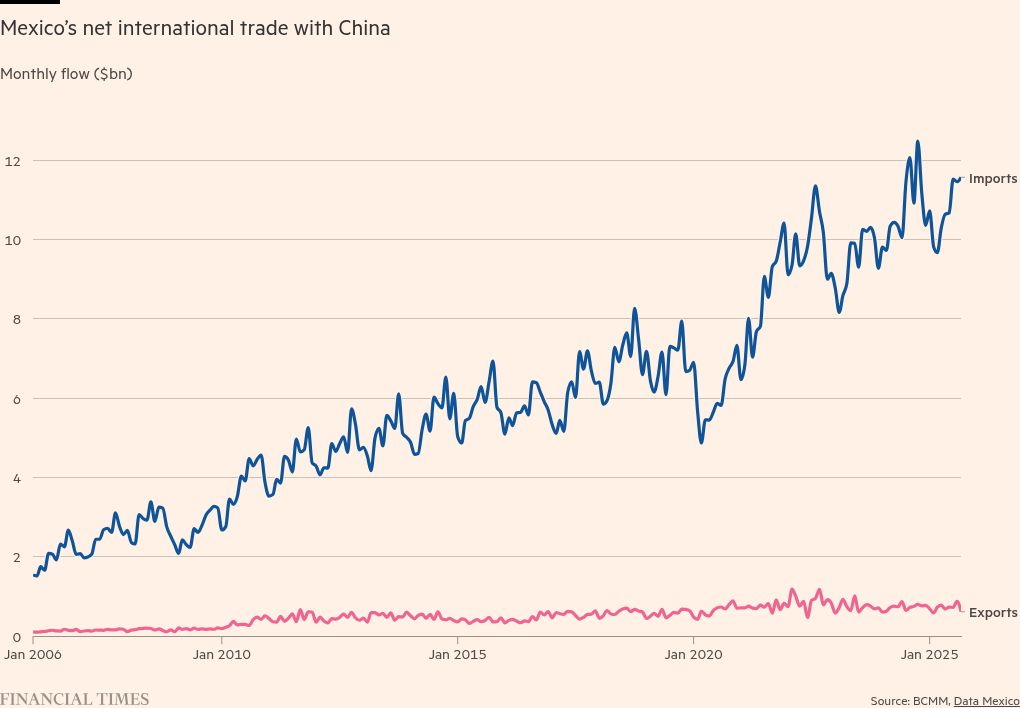
Chinese imports make up a fifth of Mexican imports, official statistics show, and in November, 20 per cent of cars sold in Mexico were imported from China, according to the Mexican Association of Automotive Distributors. Mexico was the world’s biggest buyer of Chinese-made cars in the first half of this year, according to Shanghai consultancy Automobility.
China’s ministry of commerce said the latest Mexican measures would ‘‘still substantially harm the interests of relevant trading partners, including China”, even though some of the measures had been adjusted and ‘‘moderately reduced’’ since September.
It said China opposed “unilateral tariff increases” and had launched an investigation into trade and investment barriers in Mexico, which was still under way.
There was no immediate reaction from the US.
The tariffs, which the government expects will bring in more than $2.5bn in extra revenue next year, will take effect from January and will also apply to metals, auto parts, textiles, footwear and electronics. As well as China, they will affect imports from India, South Korea, Thailand, the Philippines and Indonesia.
The move was approved by lawmakers in Mexico’s upper chamber by 76 to five, with 35 abstentions, in a fast-track process.
Analysts fear the tariff move could be viewed as Mexico giving way under pressure from the unpredictable US president. The tariff move has fuelled hopes that, in return, punishing US tariffs on Mexican steel and aluminium could be eased.
The USMCA, which covers a trade bloc encompassing 500mn people and accounting for 30 per cent of global GDP, gives Mexico privileged access to the US. Almost 90 per cent of its exports to the US are at present tariff-free, which is a competitive advantage Sheinbaum is determined to preserve.
The US has accused China of using Mexico as a “back door” for goods to circumvent high US tariffs.
Trump has made tariffs a centrepiece of his economic and foreign policy. He imposed a tariff of 25 per cent on Mexican exports to the US, but goods covered by the USMCA were waived.
This week, the US president threatened Mexico with a new 5 per cent tariff, alleging that the country was violating a water supply treaty from the 1940s. Sheinbaum says Mexico has not met the terms because there has been insufficient rain, and is negotiating with the US to find a solution.
Additional reporting by Cheng Leng and Joe Leahy. Data visualisation by Anna Marie Alcantara