Unlock the Editor’s Digest for free
Roula Khalaf, Editor of the FT, selects her favourite stories in this weekly newsletter.
Globalisation is facing renewed pressure as US President Donald Trump pushes ahead with his trade agenda.
From new tariffs and trade agreements to rising tensions between countries, global supply chains are being disrupted. What might a more protectionist US mean for businesses and the global economy?
The FT’s Alan Beattie, writer of the Trade Secrets newsletter and columnist, and EU trade correspondent Andy Bounds, answered your questions on global trade, US economic policy and the future of globalisation.
The session is took place here and you can read the full Q&A below.
Question asked by: MontjeIR468
Question: Todd Buchholz suggests that economies grow stronger when they confront structural weaknesses directly. Do you see Trump’s trade confrontations with China as aligned with that philosophy?
Answered by: Alan Beattie
Answer: I think Trump thinks they are, but if I were looking at the US economy I’d be concerned about the problems in big service sectors like higher education, healthcare and insurance rather than export manufacturing. For someone from the services industry surrounded by tech people he’s very resistant to taking services seriously.
Question asked by: Saltibarsciai
Question: How likely are Trump’s decoupling policies from China actually contributing to its rise? What indicators can we look for in the next 12 months?
Answered by: Alan Beattie
Answer: Clearly the US’s semiconductor restrictions and so on don’t exactly help China directly, but they do encourage it to develop its own capacity, which strengthens it at least relative to the US in the longer run. In the next 12 months I’d look to see how Chinese exports hold up and particularly can they continue to find other markets if the US is closed off.
Question asked by: Leon K.
Question: Is Trump’s trade policy driven by economic rationality, or do ideational factors override?
Answered by: Alan Beattie
Answer: He thinks some of it is do with economics (eg closing the trade deficit), but since he’s wrong about that it’s visually indistinguishable from doing it by instinct.
Question asked by: Anonymous
Question: While many of your opinion pieces focus on the economics of trade, how should we understand the political economy of globalisation when cultural identity, rather than economic distributive effects, has a large impact on the coalition for protectionism in the US?
Answered by: Alan Beattie
Answer: This is a really interesting and very complex point. There’s some very good work by Marcus Noland at the Peterson Institute in Washington showing that support for Trump correlates with authoritarianism, which manifests itself in trade policy in lashing out at perceived rivals. (Hence it’s not necessarily anti-China so much as just anti anyone who looks like a threat.) I have no idea how you address this except to try to appeal to different instincts or different people.
Question asked by: Lucrezia M
Question: Do you think the post-WWII trade system built around the WTO is fundamentally broken, or is it still salvageable with reform, if so, what would that reform look like? Is there any chance of a viable solution in creating a trading institution without US involvement?
Answered by: Andy Bounds
Answer: I don’t think the US is the only problem the WTO has, as Alan said earlier. India is unconstructive. It is not good at preventing Chinese subsidisation and non market practices. The protectionist measures put in place around the world will be hard to reverse for a while.
Question asked by: Ane Burke
Question: Do you see Trump as a driver of de-globalisation, or more as a symptom of deeper structural failures in the liberal global order that were already eroding globalisation from within?
Answered by: Andy Bounds
Answer: The joke about development policy is it is poor people in rich countries giving money to rich people in poor countries. A critic of globalisation would say it is average people in rich countries giving jobs to poor people in poor countries and money to rich people in rich countries. Of course cheaper goods and services have bought huge benefits to the lifestyles of everyone in developed world. But the perception now is of vulnerable jobs, hollowed out towns and empty shops. I am not sure how that changes without the kind of tax and spend policies that are very difficult to afford or deliver politically. Try taking £100 a year off a comfortable British pensioner to put into say, university education.
Question asked by: Mister mister
Question: Where does US trade policy go from here? In a few years Trump will be gone and Asia will make up a larger share of global trade. Will this force the US to continue down a protectionist path irrespective of 2028, or will the US rewrite global trade rules with the new leading Asian economies?
Answered by: Alan Beattie
Answer: I can’t really see the latter happening because it would mean the US cooking up a new arrangement with China, and I think the hostility to China will continue whoever is in the White House. Nor can I see the other big Asian economies wanting to enrage China by starting a whole new set of rules with what after all has proved a fickle trading partner. The only region-wide trade rules game in town in the Asia-Pacific is the CPTPP, and the US isn’t going to join that as long as there’s a possibility China also will. China has already applied, of course.
Question asked by: JR-W
Question: Assuming DT stands down at the next presidential election, as per the constitution, and a more regular president takes office, do you think the world will return to a more stable and relatively normal state?
Answered by: Alan Beattie
Answer: Let’s say it’s someone with a trade policy like Joe Biden. I think there will be fewer outbursts and random use of tariffs for coercion, so I wouldn’t think we’d see a repeat of the so-called “reciprocal” tariffs. But Biden was already well down the path of extensively using restrictions to protect particular industries and in particular to cut off trade with China where he thought it was of strategic interest. I suspect a future president would follow a similar path.
Question asked by: GRH Boston
Question: While tariffs elicit the most talk, the most consequential Trumpian impetus is to destroy institutions. Namely, the multilateral institutions of global progress. COP is only the latest. Can we survive this, and bring things back?
Answered by: Alan Beattie
Answer: I’m sad to say I think the answer is “no”, or not bring them back to where they were. The US isn’t the other big country to subvert COP – India and China, the big emitters, have been doing it for years. Ditto in the WTO: India blocks negotiations for fun, not just ones it’s involved in but it also tries to prevent other countries making plurilateral deals between themselves, being what my dad would call “a dog in a manger”. India flat-out refuses to discuss any environmental issues in the WTO. BTW this isn’t just a reaction to Trump – it’s been doing it for decades.
Question asked by: Logoidal
Question: How can South Africa realistically plan a minerals-led growth and energy-transition strategy when the US seeks secure access to its critical minerals yet repeatedly under-delivers on promised multilateral energy and climate-finance commitments?
Answered by: Andy Bounds
Answer: Work with the EU? it also needs those minerals and has just signed a Clean Trade and Investment Partnership (whatever that is). It has development money, and cares about decarbonisation.
Question asked by: Sara Nagpal
Question: How is Donald Trump balancing the interests of different interest groups in the electorate through his trade policy?
Answered by: Alan Beattie
Answer: I certainly don’t think he’s doing so systematically – he’s just reacting to the last person he talked to or the last lobby to make enough of a fuss or to do him a favour. As an example, he was supposed to be all about the US producers, and if that meant American children could only have two dolls each, so be it. Now he’s suddenly noticed that consumer prices are rising so he’s rushing to cut tariffs – in this case food tariffs – to bring prices down. In doing so of course he’s hitting the farmers he was supposed to be helping, some of whom are already suffering from the effect of Chinese boycotts on US exports. I don’t think Trump really thinks of the economy as a dynamic system with linkages and feedback- just a set of groups to placate, or have them placate him.Another example; he’s obviously very close with the tech sector, but he still didn’t really seem to get the effect of immigration restrictions on their need for high-skilled workers.
Question asked by: Ben
Question: The narrative on trade is moving away from tariff liberalisation and market acces to a more defensive stance aimed at ensuring resilience and economic security. Will we go to a world of regional blocks that are based friend-shoring and shorter/ secure supply chains, or is this simply not possible?
Answered by: Andy Bounds
Answer: On supply chains I defer to Alan. But at least in manufacturing companies will go to the most competitive location. That may change thanks to policy decisions. But the FT recently ran a story about surging EU investment into China with business leaders say if you do not have a plant there you simply cannot keep up with the latest techniques, rather like being in the UK/Germany/France/Belgium in the industrial revolution.
Question asked by: Anonymous
Question: Given that effective protectionism and industry protection has been achieved – such as in South Korea and Taiwan, to what extent do you think increased protectionism can benefit the US if done effectively, especially considering their post-manufacturing, hegemonic status in the global economy?
Answered by: Alan Beattie
Answer: Well, I think the clue is in your last clause. The east Asian tigers, as they used to be called (anyone remember that name?) did use protection but they were also outward-facing and export-oriented. Hence Korean exporters might have been protected and subsidised but they were still competing in a world economy. Trump’s not particularly bothered about exports or competitiveness – he mainly wants to block imports. Also, and here’s where your last point comes in, those countries were at a totally different stage of development, rapidly industrialising. The US is a service sector economy. Tariffs are totally beside the point.
Question asked by: Anonymous
Question: Do you think the EU’s economic security doctrine will be effective in decreasing its dependencies and make it less vulnerable to external weaponization of trade? Has the EU, besides anti-coercion instrument (which wil never be used by MS) any other means of projecting deterrent power for the EU?
Answered by: Andy Bounds
Answer: Not really. The doctrine published yesterday was a murky word soup. I guess if identifying the problem is the first step to solving it, it is better than nothing. But most economic security powers are in the hands of member states. And they are not keen to hand them over.
Question asked by: PAULASTYA SACHDEV
Question: Whats your view on a potential trade deal with India?
Answered by: Alan Beattie
Answer: With regard to the EU I’d be a bit more sceptical than Andy. The deal won’t actually have much effect economically, and it will undermine the EU’s longstanding policy of not signing weak trade deals for the sake of it. India has been offering round a pretty weak deal for years and countries with a political need to sign a deal, any deal, have taken it (initially the UAE, Australia and the UK). I think the EU looks a bit desperate if it does the same.
Answered by: Andy Bounds
Answer: For the EU and India it would be a fine thing. It is likely to happen but it will be limited. Questions of labour rights, climate, non tariff barriers and the like will not be addressed. If the New Zealand deal was the high water mark of modern EU “clean trade” policy the India deal will be low tide. But it could get deeper in future.
Question asked by: Anonymous
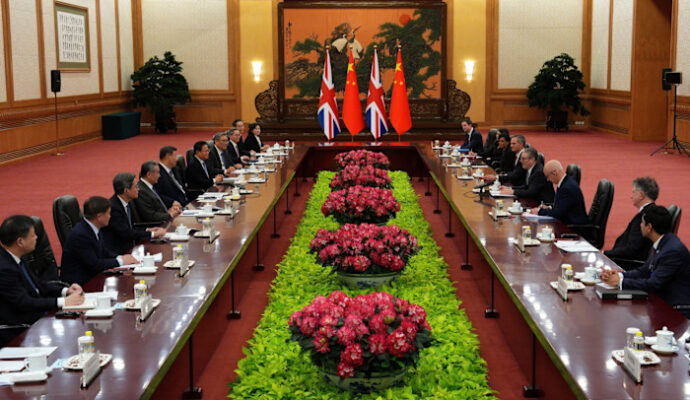
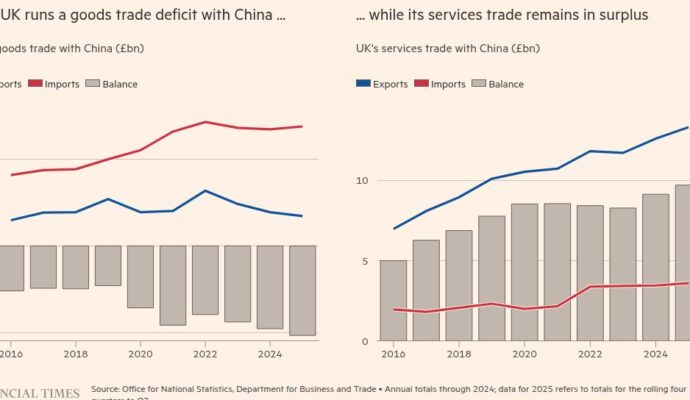
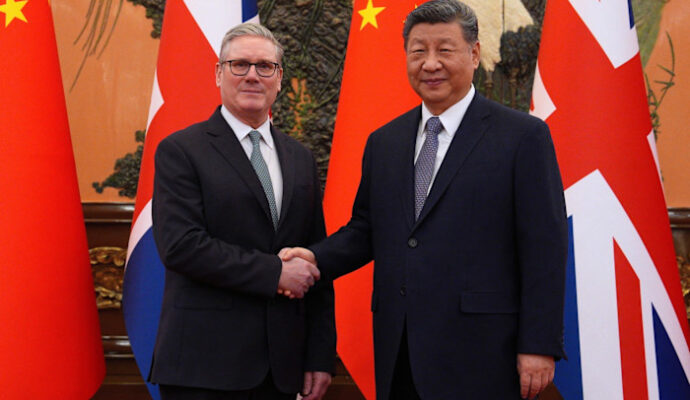
Question: How does the UK realistically navigate the ongoing US-China tension from a trade perspective? With growing pressure to “pick a side” what would be your advice to the PM in the near term?
Answered by: Alan Beattie
Answer: You’re suggesting Keir Starmer needs advice? But he’s doing so well! 😉 I’d say the same to the UK as to all medium-size trading economies (and big ones too): do your utmost to avoid picking one side and sticking with it, as you’re liable to be beaten up by the other. To some extent the UK is already doing this – unlike the EU it has allowed in Chinese EVs without antisubsidy duties, because it would rather have widespread EV adoption than spend years and years desperately trying to build an endogenous EV industry. At the same time it just did a deal last week with Trump where it allowed pharma prices to rise in return for zero tariffs on pharma exports. I’m not convinced it really had to give that much away, but anyway you see the point about doing deals with both.Of course you’d expect someone from the diehard Remainer FT to say this, but the main thing it should be doing is realigning with the EU – not so much so it can be part of a European geoeconomic bloc but just because that’s where the trade is.
Question asked by: Gjalt Huppes
Question: The surplus in the Chinese current account is mirrored in their net capital acquisition abroad; they buy main stakes everywhere, and fund the USA shortage.
What level of appreciation would be needed to roughly come to an equilibrium?
The suggestion of 50% by Weijian Shan in FT seems way too high?
Answered by: Alan Beattie
Answer: Not sure about way too high, but that was certainly a big number. The problem is it is so difficult estimating fair values, which is why the IMF tends to give a range of estimates based on different methodologies (also so it doesn’t get dragged into misalignment disputes between the US and China). That goes double when you have an economy like China with capital controls and other distortions. Rather than try to pin the valuation tail on the donkey, I’d take a step back and say China has clearly shifted back to an export-driven model, which isn’t a good thing for the world economy, and the current value of the RMB is part of this but not the main part.
Question asked by: Palmer21
Question: Are the risks around Xi Jiping’s focus on One China/One Community/Digital Silk Road and strategic investment in the global South as material as Trump and a mod protectionist US trade policy? Which would you rate as more globally disruptive and where is the EU lefty in such a landscape. Sonya Branch
Answered by: Andy Bounds
Answer: EU companies are being squeezed out of export markets by competition from China and the rest of Asia. The US wants to buy less from them too. So they are caught in the middle. And the EU is not really set up to be a muscular economic power. it operates by consensus which moves slowly. It relies on the rule of law and international institutions to enforce its will. It does not have the private/public partnership of Japan which can coral businesses into a national effort to derisk. Nor does it have speed of action of Australia or the US.
Question asked by: Anonymous
Question: What now for the future of the WTO and its leadership? The rules based order is clearly being undermined and fear the organisation is losing its sense of purpose. Does it simply ride out the storm? How can it prevent being sidelined further?
Answered by: Alan Beattie
Answer: That said, as she will say herself, most trade still happens on WTO most-favoured nation terms, so existing agreements haven’t been completely trashed even if they can’t agree new ones.
Answered by: Alan Beattie
Answer: It’s an almost impossible task for the WTO because apart from the dispute settlement branch, which the US has obviously withdrawn from, it just doesn’t have much power to do anything and never has except convene discussions. To give the current DG Ngozi Okonjo-Iweala , she’s tried pretty much everything she could – tried to get non-traditional negotiations like fishery subsidies done, tried to put the WTO in the centre of issues like carbon pricing and so on. But fundamentally when you have one big member (the US) blocking the judicial branch and another (India) the negotiating branch there’s only so much you can do. I always say that if a proper heavy-hitting policymaker like Okonjo-Iweala can’t pull the WTO back to the centre of trade policymaking, no one can.
Question asked by: mia.mikic
Question: Will the conversion of “public goods” that the US have been providing in the post WWII (to the allies in Cold War I but also more broadly) into “public bads” that we see most clearly with Trump II, end if there is a new administration after 2028? What are the odds of this status quo lingering?
Answered by: Andy Bounds
Answer: We have had a number of questions on the role of the US after Trump. It’s clear that the Biden administration had a similar concern with restricting Chinese technological progress, treated some allies with disdain (for example the Section 232 tariffs on steel were not lifted against New Zealand). It also blanked the WTO. Future presidents will still need to win those mid-West swing states and that means following similar policies. Even if they may do it with more predictability and less gratuitous offence.
Question asked by: Eugenio Bregolat
Question: If on January 1 of the year 2000,everybody,except the blind,knew that the energy transition would be a mainstay of the conomy of the XXI century, why the US and Europe slept,allowing China to achieve an enormous advantage?
Answered by: Alan Beattie
Answer: Very very good question. In the US’s case I think there is sufficient amounts of climate change denial, and of course shale coming on stream, that they thought it wasn’t necessary. Obama came pretty close to getting cap-and-trade through, which would at least have tilted prices in the way of supporting the green transition, but couldn’t quite get it done. In the EU case they did create the emissions trading scheme and tried to do it through a market mechanism but it wasn’t strong enough. And the industries that should have been leading the charge like the German car industries concentrated on squeezing more productivity gains out of ICE and concentrated their lobbying on that (and of course cheated through Dieselgate).
Question asked by: Michael Power, Cape Town
Question: Perhaps the world is not simply ‘reshaping’ but ‘reorienting’ (pun intended)? Is Donald Trump accelerating this shift, even inadvertently? Is the definition of ‘Globalization’ as commonly used an anachronism in the sense that it is built around a system that is centered on a Western vision?
Answered by: Andy Bounds
Answer: I think you are right. However, globalisation has lifted billions out of poverty outside the west. So what replaces it may not be to their advantage. Clientilism? Oligarchy?
Question asked by: Anonymous
Question: Is it in the US long-term interest to defy, weaken and dismantle the international legal order, which it co-created maybe esp. for the other countries, if the US will not be no. 1 at some point?
Answered by: Alan Beattie
Answer: Hi Lothar! I would say no, and I think the US has occupied the same place in the trading order that France does within the EU (that will get me into trouble in Paris!) – it has largely run the show while being convinced it is being ripped off. The problem is that the world has changed a great deal since the WTO was created in 1995, and the US going it alone won’t mean it can dominate. It’s still no. 1 but if it ever had proper hegemon status it has lost it. I fear they will have to learn this the hard way.
Answered by: Andy Bounds
Answer: It indeed reminds me of A Man for All Seasons when Roper wants to cut corners to convict criminals. “William Roper: “So, now you give the Devil the benefit of law!”Sir Thomas More: “Yes! What would you do? Cut a great road through the law to get after the Devil?”William Roper: “Yes, I’d cut down every law in England to do that!”Sir Thomas More: “Oh? And when the last law was down, and the Devil turned ’round on you, where would you hide, Roper, the laws all being flat? This country is planted thick with laws, from coast to coast, Man’s laws, not God’s! And if you cut them down, and you’re just the man to do it, do you really think you could stand upright in the winds that would blow then? Yes, I’d give the Devil benefit of law, for my own safety’s sake!”― Robert Bolt, A Man for All Seasons: A Play in Two Acts
Question asked by: CJ_SS2025
Question: How will the post-MAGA Western world look like in terms of migratory, economic cohesion and growth and overall diplomacy, especially with the rise of the populism right in Europe. Will Western politics ever pendulum back towards centrism or always have a tang of radicalism in the near future?
Answered by: Andy Bounds
Answer: I think the pendulum will not swing back for a while. The danger is that along with some arguably sensible policies to preserve freedom of action (a national defence industry, avoiding selling companies with key technology to strategic rivals) it goes too far. Western businesses become less competitive by being protected, consumers pay more for things and standards of living drop, feeding the discontent driving people to vote for populists.
Question asked by: MontjeIR468
Question: Trump’s first term showed tariffs can be used as negotiation tools with allies. However, does this transactional approach to allied trade create more uncertainty than the gains are worth, especially when competitors like China benefit from Western division?
Answered by: Alan Beattie
Answer: I’d definitely say so, especially because you just can’t trust Trump to keep his side of a deal. I’ve heard several ministers from countries normally aligned with the US say that China is a very tough and manipulative competitor, given to distorting trade in all sorts of ways, but it’s more reliable than Trump.
Question asked by: 24/7/365
Question: After the 2024 election, you suggested Democrats should have prioritised consumer interests over labor unions. Does Trump’s trade policy represent a triumph of producer interests over consumers, and if so, why did it succeed politically?
Answered by: Alan Beattie
Answer: To be honest most trade policy represents a triumph of producer interests, or at least that’s the way it’s sold. Biden was all about producer interests as well, his famous (or infamous) worker-centred trade policy, protection for steel and autos etc. I’m not sure trade policy had a lot to do with Trump winning so much as inflation and other things.
Question asked by: Guy Erb
Question: Domestic opposition to Trump’s tariffs is rising and some countries have made deals that have led to some lower tariffs. Is the disruption likely to be as large as initially estimated?
Answered by: Alan Beattie
Answer: I think not. If anything we might actually have approached “peak tariff” (as opposed to tariff peaks, a different thing). Countries have traded around the tariffs and with each other rather than the US. The US just isn’t as big in the world trading system as Trump thinks it is – the OECD estimates 17 per cent and perhaps lower.
Question asked by: River Thompson
Question: Is Trump’s main goal still about “Bringing manufacturing jobs back to America” or has it turned into something else entirely?
Answered by: Alan Beattie
Answer: Trump has always had a whole bunch of different things his tariffs are supposed to do, including raising revenue, coercing partners into aligning politically with the US and closing the trade deficit. I’ve counted eight but there may be more. A lot of these contradict each other (you can’t protect sectors AND raise revenue, because if you stop imports coming in they won’t be paying any duties), which is why it’s been such a shambles. I suspect he will keep leaping from one to another.
Question asked by: Anonymous
Question: Models estimate the impact of the tariffs on the US’s partners to be a fraction of a percentage point of GDP – less than a minor recession. Yet all came to the table for a deal. How much of this is for fear of the US withdrawing from security cooperation? Or are the models missing something?
Answered by: Alan Beattie
Answer: I think in many cases they are overreacting, responding to particular sectors like steel which are very sensitive. (This is why the UK moved first and quickly.) And we’ve seen with the EU deal that supposed security guarantees, in this case over Ukraine, aren’t actually binding.
Question asked by: Logoidal
Question: and follow to earlier question: what specific mechanisms would you propose to rebalance the South Africa–US relationship on more reciprocal terms?
Answered by: Alan Beattie
Answer: SA is not at all my specialism, but I would say that having a public fight with Trump over the G20 looked a bit unwise.
Question asked by: Tehan Devinuwara
Question: How long will Trump’s new movement of trade last? We had the Bretton Woods era, then moved into the Neoliberal world order, and since his 2016 term protectionist policies have been on the rise. Do you think will this continue after his term ends?
Answered by: Alan Beattie
Answer: I’m not convinced there is such a thing as a Trump new movement of trade. Of course there is protection of particular sectors like steel and now EVs and worries about particular strategic materials like rare earths, but I don’t see enthusiasm for blanket tariffs on the Trump model. Most countries continue to trade between themselves and sign new trade deals.
Question asked by: Anonymous
Question: That’s all we have time for. Thanks FT readers for your questions and Andy and Alan for your thoughtful responses. We’ll be back with another Ask an Expert soon. Visit www.ft.com/ask-an-expert.
Answered by: Alan Beattie
Answer: Many thanks to Lucy for organising, to Andy for joining and to all who sent in questions and read the answers. Alan