Unlock the White House Watch newsletter for free
Your guide to what Trump’s second term means for Washington, business and the world
Donald Trump triggered a new bout of global trade turmoil on Friday, as his administration cleared the way for new tariffs on China and the US president lashed out at Canada, a day after having cut off talks with his country’s northern neighbour.
The US trade representative’s office began a probe that could lead the way to further duties on imports from China, an announcement that came just before Trump’s scheduled departure for high-stakes negotiations in Asia — including a summit with Chinese President Xi Jinping.
The US administration said it was looking into whether Beijing had complied with a trade deal struck during Trump’s first term — an investigation that risks increasing tension between the world’s two largest economies in the run-up to next Thursday’s US-China summit.
The probe could allow Trump to impose new tariffs on Chinese imports even if the Supreme Court strikes down levies he imposed on Beijing this year based on emergency powers.
The USTR said it would examine “whether China has fully implemented its commitments . . . and what action, if any, should be taken in response”.
Trump is due to arrive in Malaysia at the weekend to hold talks with Washington’s Pacific allies, before heading to Japan on Monday and Korea later in the week.
The trip comes in the aftermath of his decision to freeze talks with Canada — another huge US trading partner — after taking offence at a television advertisement.
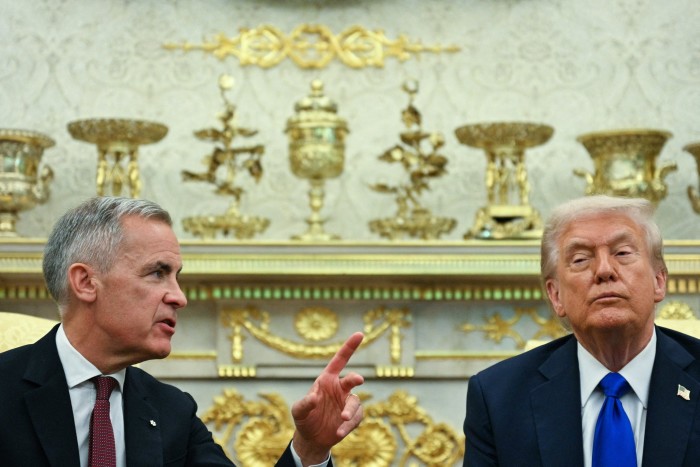
On Friday Trump stepped up his accusations that Canada had “long cheated” on tariffs, adding: “Now they, and other countries, can’t take advantage of the U.S. any longer.”
His move to halt the trade talks, in response to an advertising campaign mounted by the province of Ottawa, triggered alarm at the US president’s volatile approach.
“We’re dealing here with the problem of trade policy being run by one man with no constraints,” said Edward Alden, a senior fellow at the Council on Foreign Relations think-tank.
“He gets annoyed, he says: ‘I’m mad, we’re not talking any more.’ Nations aren’t supposed to behave towards each other like angry couples do.”
Trump’s sudden move on the negotiations came after Canadian Prime Minister Mark Carney had sought to steady ties with the White House in recent months.
“We can’t control the trade policy of the United States; we recognise that that policy has fundamentally changed,” Carney told reporters in Ottawa on Friday.
He added that Canadian officials were ready to build on progress in trade talks “when the Americans are ready to have those discussions”, emphasising that in the meantime Ottawa would focus on “partnerships and opportunities including with the economic giants of Asia”.
But Kevin Hassett, the director of the White House National Economic Council, said on Friday that Canada had been “very difficult to negotiate with” and that Trump had become frustrated with the talks.
The US president announced his move to halt the Canada negotiations on Thursday night, complaining that the advertisement aired in the US featured the voice of former Republican president Ronald Reagan “speaking negatively about tariffs”.
The Ronald Reagan Presidential Foundation, said the Ontario ad “misrepresents” the former president’s audio address, and complained that the province did not “seek nor receive permission” to use the remarks. The organisation added that it was “reviewing its legal options in this matter”.
On Friday Trump also credited his trade policy for the gains the US stock market has registered under his presidency — more than 15 per cent for the year to date.
“THE STOCK MARKET IS STRONGER THAN EVER BEFORE BECAUSE OF TARIFFS!” he posted on his Truth Social network.
Many analysts contend that US shares only recovered from a battering they took in April because Trump reined in his most aggressive tariff plans.
US inflation has also risen in the tariffs’ wake — although less than some economists feared — hitting 3 per cent in September, the highest rate since Trump returned to office in January.
Trump has imposed 35 per cent tariffs on Canadian goods excluded from the US, Mexico and Canada free trade agreement. He also put duties of up to 50 per cent on steel and aluminium as well as anti-dumping levies and tariffs on softwood lumber.
Mexican President Claudia Sheinbaum said she was closely monitoring developments between the US and Canada, as her government seeks to move ahead in its own trade talks with Washington.
“We are going to wait”, she said, adding that Mexico was “very far along” in its own trade talks with the US.