Watching the carnage playing out in China’s car industry, the nation’s most powerful man and its biggest electric vehicle maker have come to similar conclusions: the bloodbath has to stop.
Chinese President Xi Jinping in July gave his clearest warning yet against “involution” — extreme price competition stemming from industrial overcapacity — when he pointed to reckless investment plans and questioned whether every province needed EV factories.
Stella Li, the executive vice-president of BYD, China’s dominant EV maker, last week said Beijing’s crackdown on aggressive discounting could see as many as 100 carmakers out of more than 120 being “pushed out”. She was speaking on the sidelines of the Munich motor show.
In recent months, carmakers have responded to the government’s so-called anti-involution campaign by accelerating payments to suppliers and moderating some of their most extreme retail discounts.
But there are few signs of a deeper U-turn under way as the companies, which see themselves as pioneers of an energy transition, fear falling behind on scale and technology and are willing to sacrifice short-term profitability.
“It’s a game of chicken,” said Bill Russo, the former head of Chrysler in Asia and founder of Shanghai-based consultancy Automobility. “If succeeding requires scale and getting scale requires discount pricing, scale is more important than profits.”
Beijing is worried that involution is feeding deflationary pressures in the world’s second-largest economy and fuelling trade tensions with the west, as carmakers in a saturated domestic market look abroad for sales.
Paul Gong, who leads UBS’s China car sector analysis, said price wars had “slightly eased” since July. Average discounts for EVs tempered from about 8 per cent in late June to 6.7 per cent in the first half of August, Citi data showed.
Yet Gong played down the chances of an industry-wide consolidation in the near term, as deep financial support from provincial governments and capital markets for lossmaking groups stand in the way.
“We won’t see this happening in weeks or months,” he said, “but in years.”
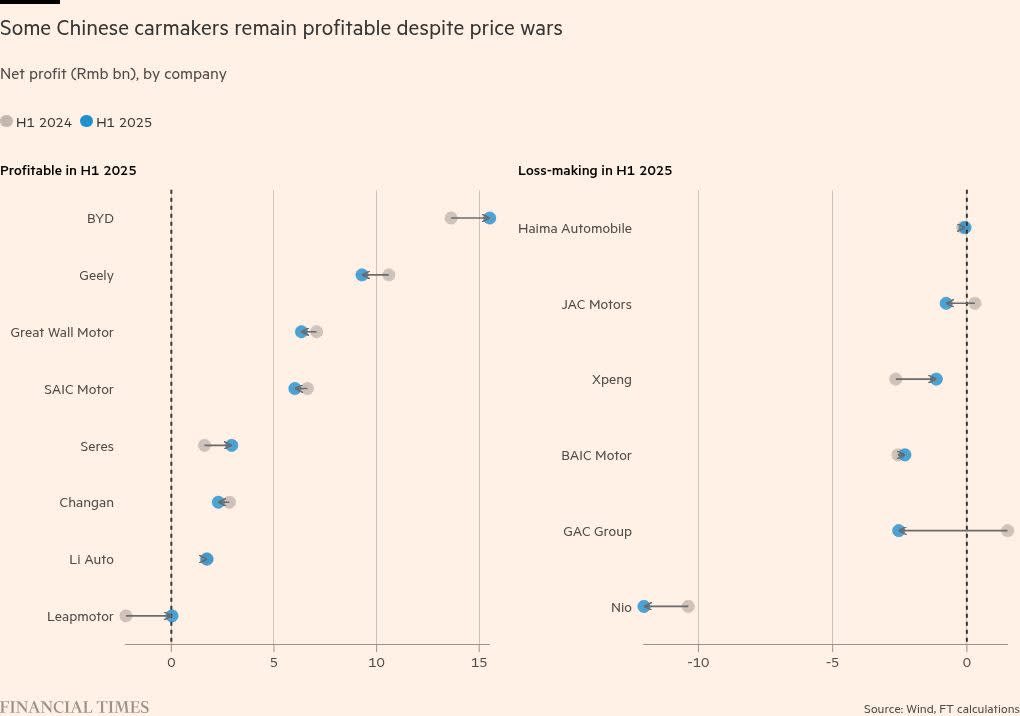
Shanghai-based Nio, which reported first-half losses of $1.7bn, said on Wednesday it had raised $1bn through a share sale to fund its research and development and battery swapping network.
Analysts do not expect Beijing to be heavy-handed against companies, given broad policy support for the EV transition, which is expected to benefit China in the long term.
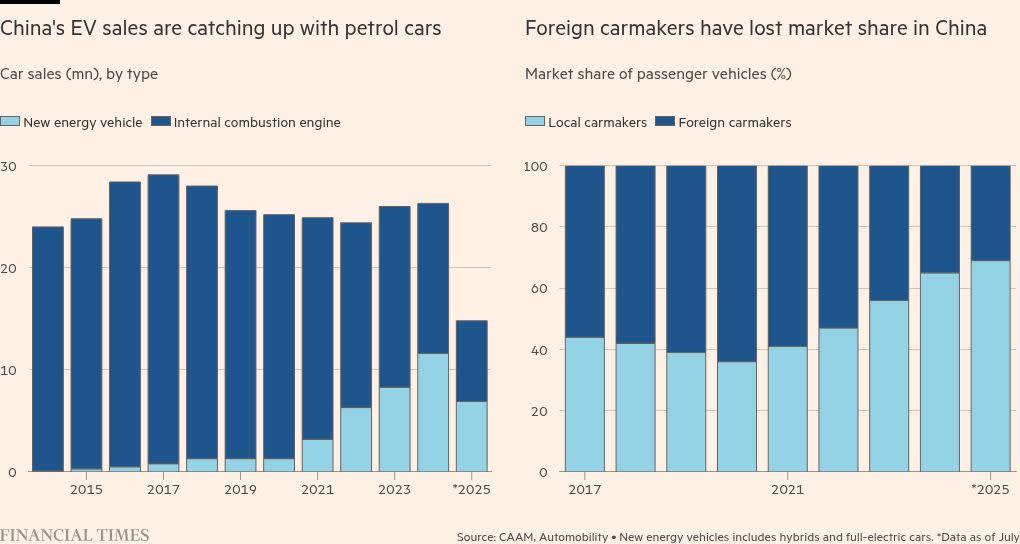
Nor will the anti-involution campaign change the fortunes of foreign brands in China, said analysts. Their market share has fallen to 30 per cent, from 60 per cent in 2020, as Chinese consumers switch from foreign brands’ petrol-powered cars to high-tech, lower-cost Chinese-made EVs.
Gong added that, while there had been “some chaos” from vicious price wars and carmakers squeezing suppliers, “the fact that consumers can enjoy better models at lower prices today is itself a result of technological progress” brought on by market competition.
Analysts described the campaign as “classic Chinese policymaking” in which Beijing signals it expects more discipline from industry but leaves it to companies and investors to determine where officials’ red lines are.
BYD’s Li said she believed Beijing “will not allow” a price war to continue, but if “we compete on who has the best innovation, who is best on technology . . . this will help us to be stronger”.
Thomas Schemera, global chief operating officer for Chinese state-owned carmaker GAC Motor, said he believed a consolidation process was already under way as part of “normal competition”.
Still, the anti-involution campaign complicates the outlook for a clutch of China’s EV champions, including BYD, which competes with Elon Musk’s Tesla for the crown of world’s biggest EV maker.
Before Xi made his comments, regulators had deployed a series of softer measures including guidelines for local governments to cut excessive subsidies and tax incentives.
One concrete measure came in June, when carmakers were forced to pay suppliers within 60 days. The industry had grown increasingly reliant on practices such as delaying bill settlements, demanding lower parts prices as a condition for faster payments and issuing promissory notes instead of cash.
The accelerated payments contributed to BYD’s net income and revenues falling short of analysts’ expectations in the second quarter and gross margin dropping more than 2 percentage points.
Last week, Beijing also announced a three-month campaign targeting exaggerated or false advertising of cars.
With dual pressures from sector competition and tougher government scrutiny, Chinese groups are expected to double down on exports.
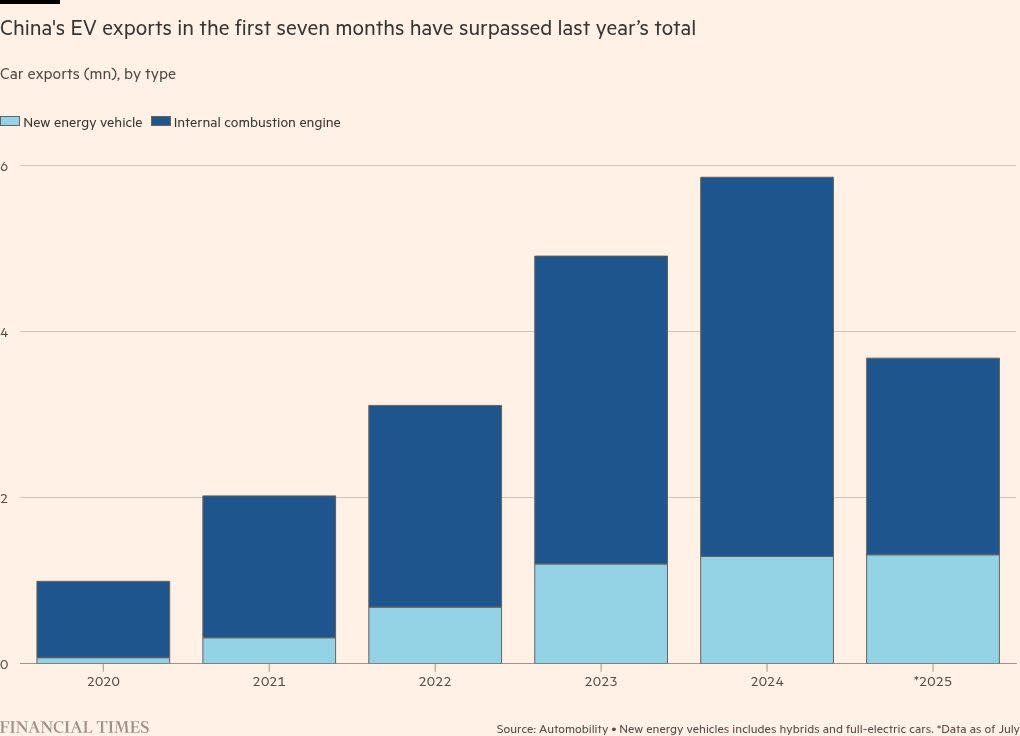
In the first eight months of the year, 4.3mn cars were exported from China, including 1.5mn EVs, up from less than 1mn for all of 2020, up from less than 1mn in the whole of 2020, in a shift for an industry long dominated by Europe, Japan and the US.
The charge has been led by BYD, whose overseas sales more than doubled to more than 630,000 cars in the first eight months of the year. The company recently said it was confident it could sell 940,000 cars by the end of the year, up from an initial target of 800,000 set by chair Wang Chuanfu.
Goldman Sachs analysts said they expected the industry’s supply-demand balance to improve, in part because of rising exports. They forecast EV factory use to rise from 61 per cent in 2024 to as high as 81 per cent next year.
However, the surge in exports has also garnered criticism from western officials, who accuse China’s carmakers of exporting their way out of overcapacity issues.
The anti-involution campaign is “Beijing’s way of signalling that destructive price wars and unchecked capacity expansion are threatening the long-term sustainability of an important sector”, said Russo of Automobility.
“While the government may act to tap the brakes here, it doesn’t want to change the direction of the industry.”