Meanwhile, the producer price index (PPI), which reflects the prices that factories charge wholesalers for products, fell by 4.4 per cent in July, year on year, narrowing from the fall of 5.4 per cent in June.
This was in line with expectations by Wind, marking the 10th consecutive month of contraction.
The CPI deflation may put more pressure on the government to consider additional fiscal stimulus to mitigate the challenge
“Both CPI and PPI are in deflation territory. The economic momentum continues to weaken due to lacklustre domestic demand,” said Zhang Zhiwei, president and chief economist at Pinpoint Asset Management.
Advertisement
“It is not clear at this stage if the policies announced recently can turn around the economic momentum soon.
“The CPI deflation may put more pressure on the government to consider additional fiscal stimulus to mitigate the challenge.”
Deflation refers to three consecutive monthly declines in prices, and the NBS said that the drop in CPI will only be temporary. It added that the index is expected to pick up gradually as the economy recovers and market demand continues to expand steadily, while the impact of the high base from the same period last year will also fade.
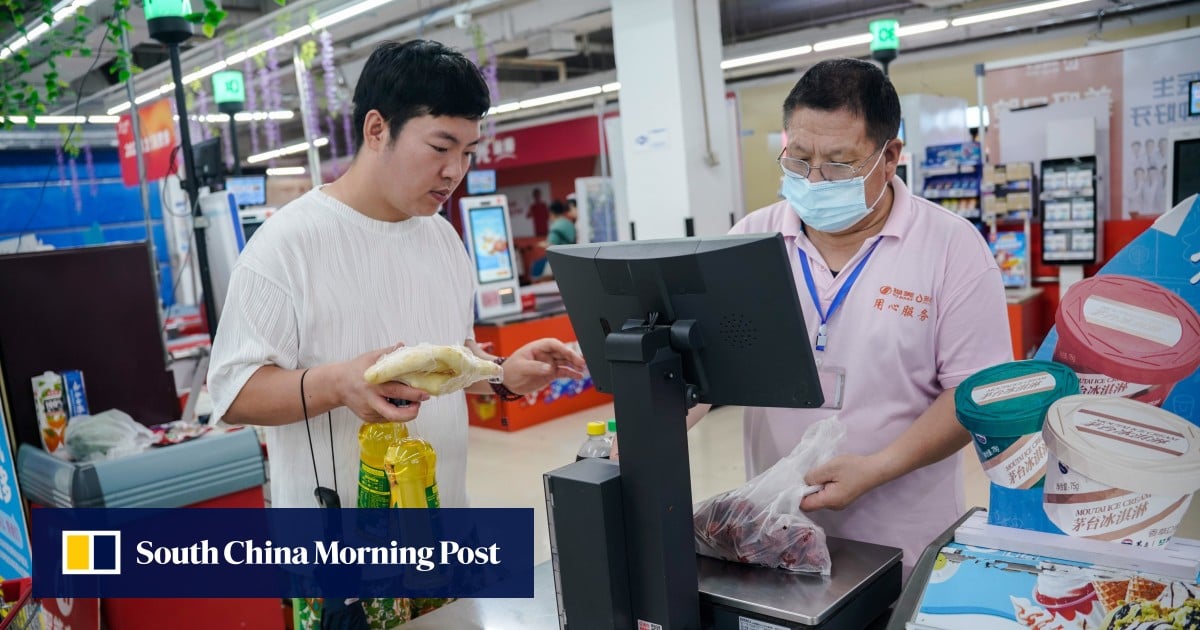
Within the CPI, food prices fell by 1.7 per cent from a year earlier in July, compared to a rise of 2.3 per cent growth in June, while non-food prices remained unchanged last month, year on year, up from a fall of 0.6 per cent growth in June.
China’s core consumer inflation rate, excluding the volatile prices of food and energy, rose by 0.8 per cent in July compared with a year earlier, up from 0.4 per cent growth in June.
Advertisement
Analysts have argued that reforms and more policy support are necessary to turn the economic situation around, including an increase in public spending, interest rate and tax cuts, as well as a more well-rounded social security net to promote consumption.
Authorities have conceded previously that the CPI was likely to drop in July, as a result from last year’s high base, when the inflation pressures were at a two-year high.
Managing low inflation could be more difficult than managing high inflation, full attention should be paid to potential risks resulting from a low inflation environment,
A rebound is expected to start in August, bringing CPI up to close to 1 per cent at the end of the year, but it is still far from the “around 3 per cent” official CPI target set for 2023.
Advertisement
Analysts have pointed out that despite the year-on-year slump, the monthly relative growth has improved thanks to the summer spending boom, with travelling, entertainment and hospitality revenues all at high levels.
The China Finance 40 (CF40) Forum, a leading economic think-tank, warned against the vicious circle between slow economic growth and low inflation and said China should avoid stepping into the “low inflation traps”, which might erode company profits and inflate their actual debt levels.
“Managing low inflation could be more difficult than managing high inflation, full attention should be paid to potential risks resulting from a low inflation environment,” the CF40 Forum said in a report last week.
Advertisement