“I think we all believe that countries should base their maritime claims in international law, that maritime disputes should be resolved peacefully, that all countries should enjoy freedom of navigation and freedom of overflight and unimpeded commerce,” the senior envoy added.
Founded in 1967, Asean comprises Brunei, Cambodia, Indonesia, Laos, Malaysia, Myanmar, the Philippines, Singapore, Thailand, and Vietnam. The intergovernmental organisation collectively represents 650 million people, who together rank as the world’s fifth-largest economy.
Despite successfully promoting economic integration among members, Asean has struggled to coordinate a response to China’s territorial claims in the South China Sea, which oppose those of Indonesia, Malaysia, the Philippines and Vietnam.
Last month, Philippine Foreign Affairs Secretary Enrique Manalo during his visit to New Delhi said negotiations among the claimants to establish a code of conduct for the South China Sea had been under way over the past four to five years.
“We may not be seeing light at the end of the tunnel, but we see the tunnel and that’s where we are,” he said of the effort.
On Friday, the Philippine military’s western command said 48 Chinese fishing vessels were seen “swarming” a reef south of Recto Bank in the South China Sea during an air patrol at the end of June. Two Chinese naval vessels and three Chinese coastguard ships “are regularly loitering” a nearby shoal, the military added.
Recto Bank holds “immense potential for the country’s energy security and economic growth” and has been a focal point in “rising concern over China’s recent behaviour”, the Philippine military’s western command said on its Facebook page.
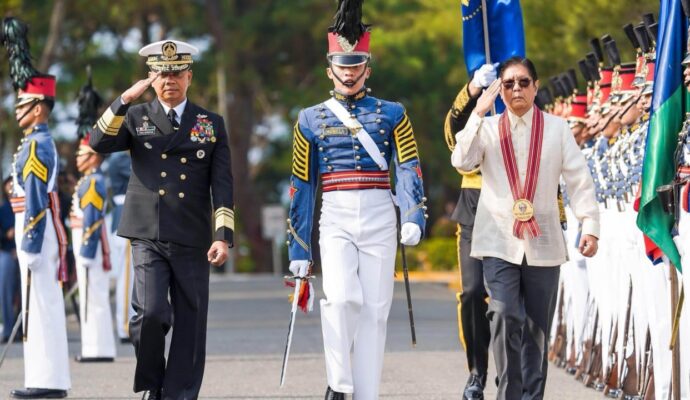
Philippine Foreign Affairs Secretary Enrique Manalo (centre) says negotiations to establish a code of conduct for the South China Sea have been under way over the past four to five years. Photo: AFP
The South China Sea contains about 11 billion barrels of untapped oil and 190 trillion cubic feet (3.1 billion cubic metres) of natural gas reserves, according to an estimate by the US Energy Information Administration.
US Defence Secretary Lloyd Austin in a readout released on Thursday after a call with his Philippine counterpart, Gilberto Teodoro, called Beijing’s conduct in the sea “coercive and risky”.
Earlier this week, the Philippine coastguard said its vessels were “constantly followed, harassed and obstructed” late last month by bigger Chinese ships in the South China Sea. China’s foreign ministry responded by saying its ships’ manoeuvres were “professional and restrained”.
Chinese and Philippine ships nearly collided in the disputed waters in April, with each side accusing the other of intrusion and provocation.
While Washington, a mutual defence treaty ally of Manila, does not have any territorial claims in the region, it asserts the right to innocent passage under the freedom of navigation. Beijing says US actions violate international law due to the use of military ships and aircraft.
Lately the region has become a geopolitical battleground for the US and China. Since becoming president, Biden has made significant efforts to deepen ties with Asean countries to counter China’s widening influence.
In May last year, the American president hosted a first-ever US-Asean special summit at his official residence in Washington. But he failed to reach consensus with Asean leaders on countering what his administration has called China’s growing assertiveness.
However, seven Asean countries – Brunei, Indonesia, Malaysia, the Philippines, Singapore, Thailand, and Vietnam – decided to participate in the Washington-led, 14- member Indo-Pacific Economic Framework, an initiative aimed at reducing dependency on China for strategic supply chains.
In May, the group announced its first-ever deal to build sustainable and resilient supply chains focused on strategic items including critical minerals and semiconductors.
The deal does not cover expanding market access or free-trade agreements.
China has been Asean’s largest trading partner since 2009, while the group became Beijing’s largest trading partner for the first time in 2020.
In Jakarta, Blinken will emphasise Washington’s commitment to Asean “centrality and support” for its partnership with the US, according to a State Department statement on Friday.
Blinken will also take part in the second US-Indonesia strategic dialogue alongside his Indonesian counterpart, Retno Marsudi.
Indonesia, which is Asean’s current president in the group’s rotating leadership, is home to the world’s largest reserves of nickel, a key raw material used in making batteries for electric vehicles.
In April, Indonesia’s minister for maritime affairs and investment, Luhut Pandjaitan, said Jakarta would propose a “limited” free-trade agreement for some minerals shipped to the US. However, many Chinese companies have invested in refining facilities since 2020, when Indonesia banned exports of nickel ore.