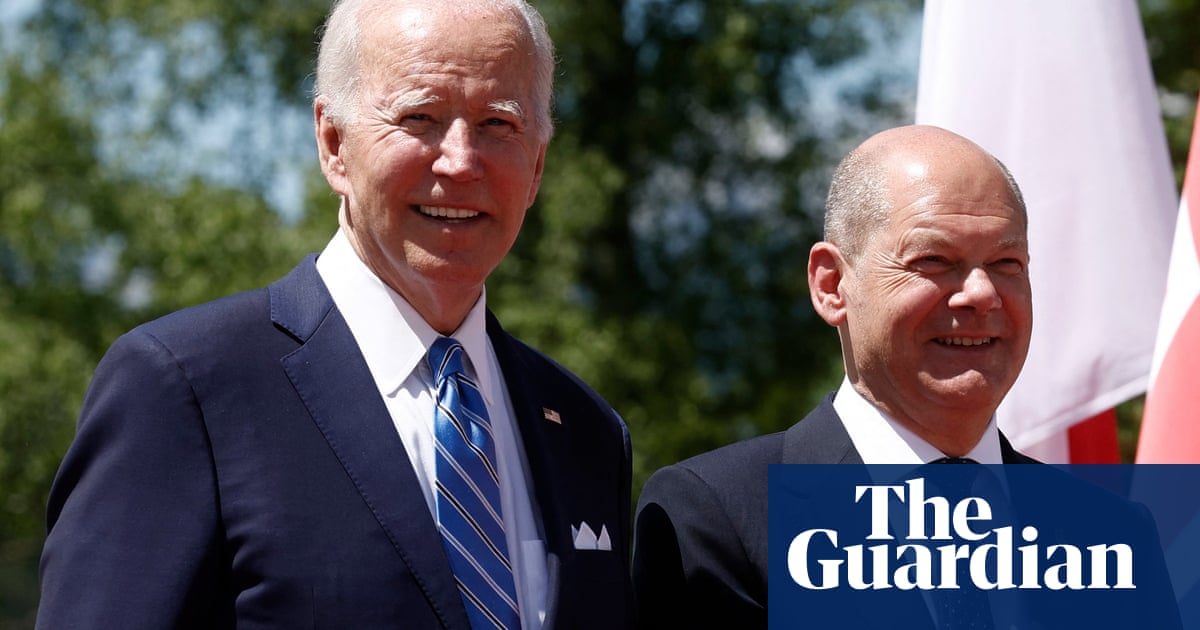
Joe Biden is due to meet the German chancellor as part of continuing efforts to keep the US and Europe aligned in their defence of Ukraine.
It will be a working visit to the White House for Olaf Scholz, stripped of any pomp or protocol. No press conference has been planned for the meeting on Friday afternoon and the chancellor will reportedly not be bringing press with him. A senior administration official predicted it would be short but intense.
“We’re expecting it to be a one-hour meeting or so,” the official said, adding that the “bulk of the meeting” would be about Ukraine. “There will likely be a significant one-on-one component, which I think is a reflection of the close relationship between the two leaders and the opportunity for the two of them to be able to have in-depth and face-to-face conversations.”
Part of the US president’s message will be gratitude for Scholz’s agreement to allow the delivery of armoured vehicles, anti-aircraft systems and 18 German-made Leopard tanks to Ukraine, though in a recent interview the US national security adviser, Jake Sullivan, made clear that the White House had to agree to ship US Abrams tanks too in order to convince Scholz to act, a characterisation that Berlin disputes. Washington has also voiced admiration for how quickly Germany has reduced its dependence on Russian gas.
“The transatlantic relationship, especially the relations between the US and Germany, are as good as it hasn’t been for many years,” Scholz said on Friday morning. “The basis for this is trust, that one keeps talking to each other. And this is what we are going to do.”
Before the meeting, the US signalled its willingness to continue backing Ukraine, announcing a new package of military aid, including mobile bridges mounted on armoured vehicles that would be critical to any Ukrainian counteroffensive, as well as more Himars, multiple rocket launchers. Biden will be looking for continuing parallel commitments from Germany and Europe in what is likely to be a pivotal few months in the conflict.
“Without question, they’re going to talk about the kinds of capabilities that Ukraine continues to need in the weeks and months ahead,” the US national security council spokesperson, John Kirby, said.
The administration acknowledges that Scholz has gone a long way to move Germany from a position of pacifist neutrality to providing significant military aid to Kyiv to resist the Russian invasion, but it is also aware he faces considerable resistance inside Germany. Scholz’s chief of staff has cited budgetary constraints as the reason that Germany will not expand its military spending as fast as promised.
“It’s really an opportunity to take stock of the war, to examine future scenarios and also think about how leaders on both sides of the Atlantic can sustain momentum as well as support for Ukraine, because electorates are getting war-weary,” said Sudha David-Wilp, a Berlin-based senior fellow at the German Marshall Fund thinktank.
In his remarks before the meeting, Kirby noted that Biden and Scholz had recently met Ukraine’s president, Volodymyr Zelenskiy, and said they would want to discuss those meetings. Washington is anxious that Ukraine and its backers stay on the same page in turns of war aims and strategy, in advance of a Nato summit in Lithuania in July.
Another item high up the agenda, according to US officials, is China, which Washington believes is on the cusp of breaking precedent and supplying weapons to Russia to help Vladimir Putin sustain the invasion. The US has passed sanctions on some Chinese companies for supplying dual-use items, and has threatened far tougher measures if Beijing starts sending arms. If that happens, Biden would like European support in following suit, and Germany’s response would be critical in raising the costs to China of throwing more support behind Putin.
“So far, we haven’t seen that China has provided lethal aid to Russia, but obviously it’s very much a situation that we’re tracking,” the senior US official said. “Russia’s war in Ukraine has put China in a difficult position, and every step that China takes toward Russia makes it harder for China with Europe and with others around the world. It’s a distraction for China and a potential blow to their international relationships that they don’t need or want.”
Scholz has publicly warned China about arming Russia, but David-Wilp said imposing broad sanctions “will not be an easy proposition for the Europeans, especially Germany because China is a top trading partner”.
She added: “But there is also a growing realisation in Germany that it can’t be business as usual with China. This turning point for Germany has made clear that they can’t necessarily just follow this idea of ‘change through trade’ and not think about the hard power issues involved with trading with autocratic powers.”


