Even before Donald Trump returned to the White House, Vietnam’s military planners were already busy preparing for a possible second invasion by the United States and its allies. In the “Second US Invasion Plan”, secretly issued in August 2024, the Vietnamese military rejected playing any part in America’s China containment strategy in the Asia-Pacific.
Rather, it sees the US promotion of “freedom and democracy” as a cynical ploy to maintain hegemony in the region. The document, released in February by the human rights group Project88, said that “due to the US’s belligerent nature, we need to be vigilant to prevent the US and its allies from ‘creating a pretext’ to launch a war of aggression against our country. The US and its allies could fully exploit the geographic and natural features of Vietnam’s vast seas and long coastlines, with the superior strength of its navy, to conduct military operations against our country.”
Trump’s imperialistic foreign policy can only have reinforced Hanoi’s alarm. Even Canada, which shares the world’s longest undefended border with the US, has prepared – for the first time in a century – a military plan to counter an invasion from its southern neighbour.
Advertisement
While Hanoi has outwardly elevated its relations with Washington to the highest diplomatic level, it is decisively tilting towards Beijing.
In a significant diplomatic move, Vietnamese President To Lam, who is also the Communist Party general secretary, visited his Chinese counterpart Xi Jinping in Beijing, creating what Hanoi has called “new momentum”.
Advertisement
For the Vietnamese, it is a no-brainer. Last month, the Chinese and Vietnamese militaries conducted a joint naval patrol and training exercise in the Gulf of Tonkin, which also included medical and cultural exchanges.
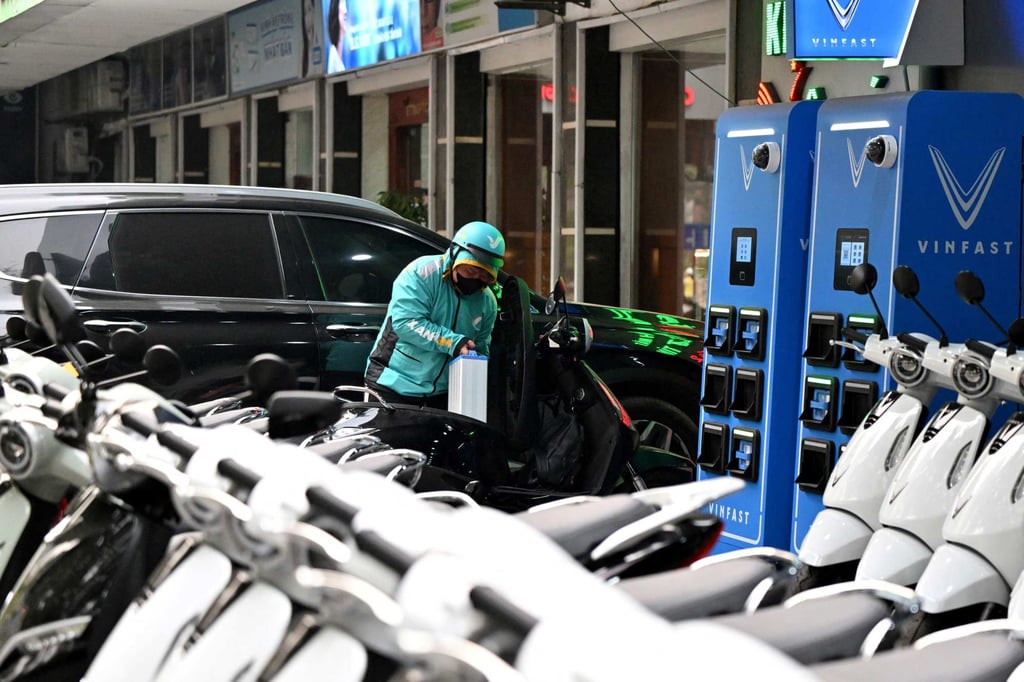
A rider swaps batteries at a VinFast station in Hanoi on April 11. Electric vehicle sales have jumped in Vietnam as buyers try to dodge the fuel price spikes driven by the Middle East war – and the US’ foreign policy. Photo: AFP