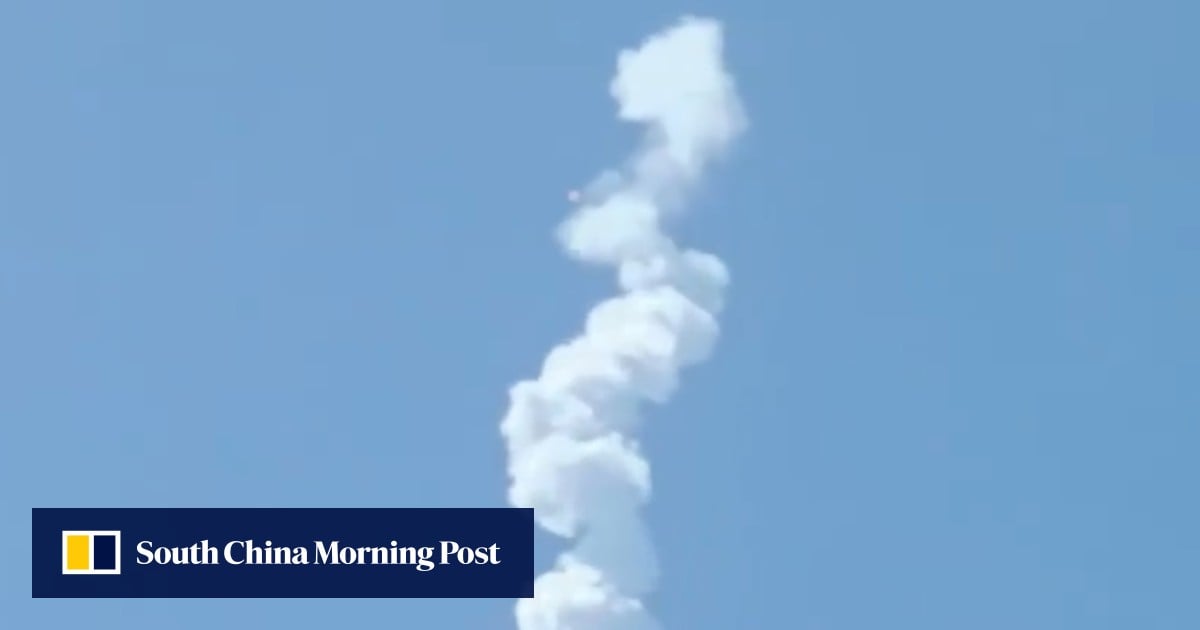
China’s attempt to launch its most powerful privately developed rocket failed on Friday after the vehicle suffered a flight anomaly.
The Tianlong-3 rocket is being developed in hopes of breaking a key bottleneck in the country’s roll-out of internet satellite megaconstellations to compete with SpaceX’s Starlink.
The Tianlong-3, built by Beijing-based start-up Space Pioneer and seen as China’s answer to the US company’s workhorse reusable Falcon 9, lifted off from the Jiuquan satellite launch centre in the Gobi desert at 12.17pm on Friday, according to state-owned financial news outlet Cailian Press.
Advertisement
An anomaly occurred during the flight, resulting in a launch failure. The mission team will conduct a comprehensive evaluation of the mission and carry out improvement work, it said.
The 72-metre (236 feet) tall, 3.8-metre (12ft 6in) wide rocket, capable of delivering up to 22 tonnes to low Earth orbit, is designed to carry 36 satellites for the Qianfan broadband megaconstellation.
Advertisement
Previously, 108 Qianfan satellites have been launched in to orbit – a fraction of its target of roughly 1,300 orbiting satellites by the end of next year and not much closer to the longer-term goal of more than 15,000 by 2030.
Like the Falcon 9, which has launched thousands of Starlink broadband satellites, Tianlong-3 uses liquid oxygen and kerosene. They also have a comparable capacity to low Earth orbit.