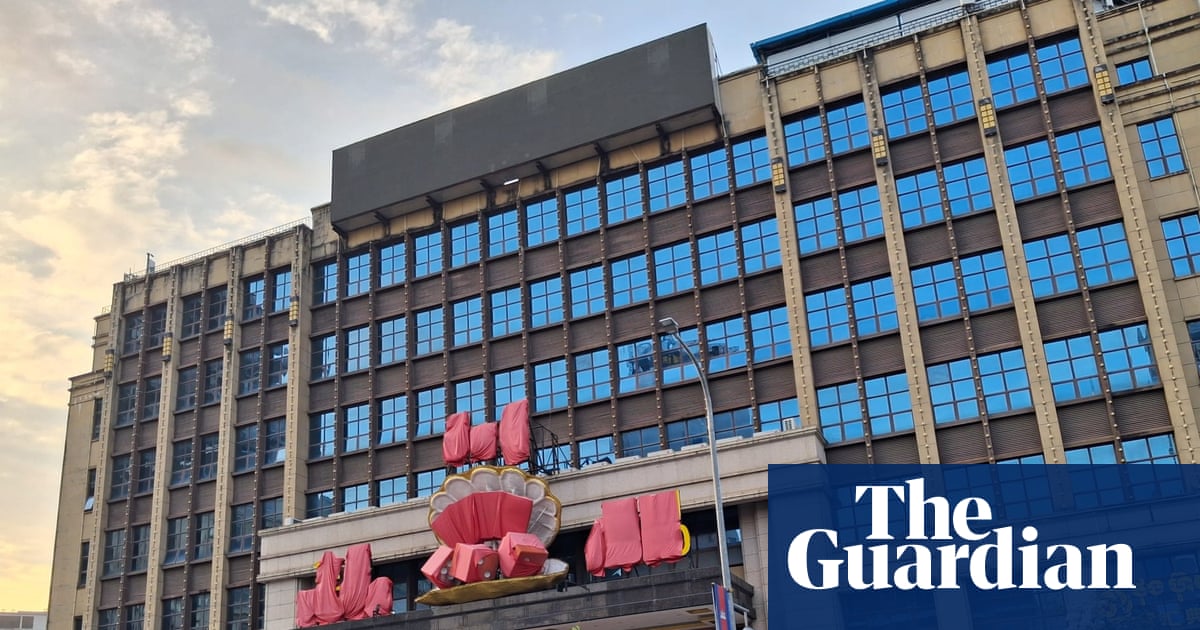
A giant golden clam shell, illuminated by lurid neon lights and filled with playing cards and red dice, once glowed nightly on the facade of Sihanoukville’s Jin Bei casino. Today, the casino’s gaudy signage is covered by sheets, and its doorway blocked by a Chinese sign that reads “under renovation”.
The casino in the Cambodian resort city was once emblazoned with the name Jin Bei, a company US prosecutors have accused of running scam compounds on behalf Prince Group, which an October indictment alleged was one of Asia’s largest transnational criminal organisations.
The shuttering of the casino underlines the rise and fall of Prince Group and its founder Chen Zhi, a Chinese-born businessman who established one of Cambodia’s biggest conglomerates. Chen’s arrest this January in Cambodia has raised awkward questions about the scam industry’s alleged ties to the country’s political elite, and about the integrity of a crackdown on compounds predicated on human trafficking, forced labour and violence.
Contacted for comment, the Prince Group says it “categorically rejects that it or its founder, Chen Zhi, has engaged in any unlawful activity”.
“The recent allegations are baseless and appear aimed at justifying the unlawful seizure of assets worth billions of dollars. Nonetheless, these unfounded allegations, amplified by media reports repeating these and other unverified claims, have caused undue harm to thousands of innocent employees, partners, and communities who the Group serves,” it said in a statement.
“The Group remains committed to integrity, responsible investment, and sustainable economic growth across the region,” it said, adding: “We are confident that when the facts come out, the Prince Group and its chairman will be fully exonerated.
The makings of Prince Group
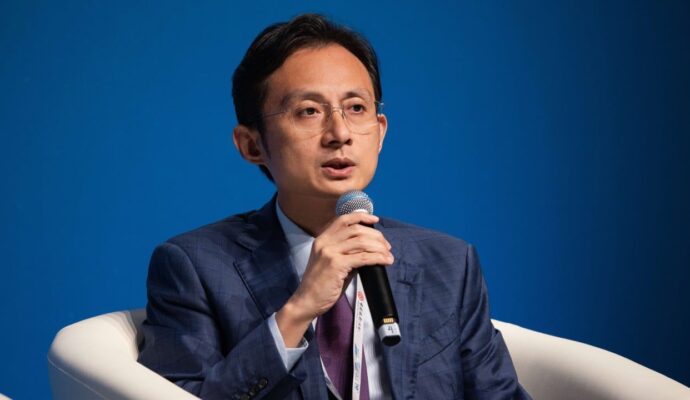
Chen, 38, grew up in Fujian province in south-eastern China but reportedly moved to Cambodia about 15 years ago. He founded Prince Group in 2015, investing in Sihanoukville real estate at a time when the once sleepy coastal town was being transformed into a city of casinos and skyscrapers, fuelled by Chinese investment.
The boom in real estate came crashing down in 2019, when the government introduced a ban on online and arcade gambling in response to what it said was rising crime and safety concerns, a change exacerbated by the pandemic. Many abandoned the city, leaving its roads dotted with towering, half-built construction projects.
Prince Group, however, continued its expansion, unveiling luxury apartments and retail complexes, and even commencing work on a US$16bn eco-cityoff the coast of Sihanoukville, known as the Bay of Lights.
During the period 2015 to 2025, prosecutors allege Prince Group was behind a network of illegal operations and scam compounds in Sihanoukville, concealed by real estate and other businesses.
Throughout this period Chen, and others linked to Prince Group, lived a life of increasing extravagance. They splashed out on designer watches, yachts, private jets and rare artwork, including a Picasso painting. Chen and his network owned multiple properties in high-end areas of London, which have since been seized, according to the British government. Such luxuries were funded not by legitimate businesses, but by a litany of transnational crime, according to US authorities.
Chen became a Cambodian citizen in 2014, and as his wealth grew, quickly developed links to the highest levels of government. In 2020, he was made an official adviser to Hun Sen, who is widely viewed as the country’s de facto ruler, even after he stepped down from his near four-decade-reign. He also acted as an adviser to Hun Sen’s son, Hun Manet, who is the country’s current prime minister. The same year Chen was bestowed the honorific “Neak Oknha”, which is similar in meaning to nobleman, by Cambodia’s king, at the request of Hun Sen. The title is granted to citizens who give at least $500,000 to the government.
Cambodia has acted as a welcome destination for many criminal actors, thanks to its rampant corruption, and the ease with which wealthy individuals have been able to obtain citizenship, claimed Jason Tower, senior expert at the Global Initiative Against Transnational Organized Crime.
But no one has been able to exploit the country’s political climate as well as Chen, he said.
Chen was both a mastermind in setting up front companies, and building illicit business partnerships, Tower alleged. “Chen Zhi and his Prince Group seem to have systematically co-opted the entire system.”
At the same time, the group’s philanthropic arm, the Prince Foundation, helped create a benevolent image for the company, donating care packages to flood victims, and creating scholarships. During the pandemic, then prime minister Hun Sen wrote to Chen expressing his “deepest appreciation” after the tycoon donated $3m to purchase vaccines, according to Khmer Times, a state-aligned outlet.
When Cambodia hosted the meeting of the regional bloc of Southeast Asian countries, world leaders were given luxury, limited edition watches – designed by a prestigious horology school established by Prince Group, where students learn the intricate craft from Swiss-trained instructors. The company’s wealth helped enhance the image of Cambodia and its leaders on the international stage – until it became a major liability.
As Prince Group grew, the legitimate economy was pushed out, said Tower, and Cambodia became even more reliant on Chen.
Chen’s downfall now raises uncomfortable questions for Cambodia.
Sanctioned by both Washington and London in October, the US justice department said at the time that it had also seized $15bn in bitcoin linked to Chen, the largest forfeiture in its history. Separately, Singapore has seized S$500m ($393.25m) in assets and illicit funds allegedly relating to Prince Group, while Taiwan has seized more than T$5.5bn ($172.4m).
Cambodia handed over Chen to China in January in response to intensifying international pressure – especially from its ally, Beijing, which likely did not want “to see Prince’s dirty laundry aired in US courts,” said Jacob Sims, visiting fellow at Harvard University’s Asia Center.
The Cambodian government did not respond to questions about Hun Sen and Hun Manet’s relationship with Chen. However, Hun Manet, whose government has promised to eradicate scam centres, told AFP in February that the Cambodian government had been unaware of Chen’s illegal activities, saying he was “just a businessman, contributing to the economy”. He denied the government had benefited from the scam industry, saying “most of the proceeds do not go into the government of Cambodia”. Chen’s Cambodian citizenship was revoked earlier this year because it had been “irregularly obtained”, a government spokesperson said at the time, adding that this demonstrated the government’s commitment to rule of law.
Hun Sen has also promised tough action against scammers, warning that Cambodia is “not a safe haven, but a hell for criminals” in comments reported by the Khmer Times.
Chen is the most high-profile alleged kingpin to be targeted since the scam compounds have rapidly mushroomed across South east Asia in recent years.
His arrest sent shock waves through the cyber scam industry. In Sihanoukville, and elsewhere in Cambodia, thousands of foreign workers have been released from compounds over recent weeks, including from sites unrelated to Prince Group’s alleged network. Workers, including suspected victims of human trafficking, some of whom report being subjected to violence, have been forced to sleep on the streets and outside embassies because they lack the money or documents to return home.
Inside the scam centres
After years of accusations the billion-dollar industry has flourished in countries such as Cambodia, the government has promised to eliminate scamming by April. The government reported in mid-February that since July 2025, 200 locationshave been shuttered. It did not respond to a request to share a breakdown of the compounds’ names and locations, or for updated data on sites that have been closed.
Observers like Sims, say the recent compound closures are far more significant than any past crackdowns. But they question whether the authorities will really stamp out an industry that, according to estimates cited by the US-based non-profit, United States Institute of Peace, has been allowed to grow so large it accounts for almost half the country’s formal GDP.
For a start, the role of police remains unclear. In January, Amnesty International, said that of 35 interviewees who had recently escaped or had been released from compounds, all reported no police or military presence at the time they left.
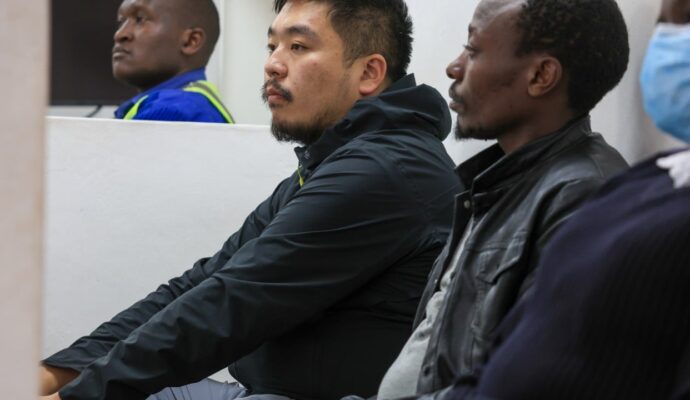
A Ugandan national, who asked not to be named, gave the Guardian a similar account. “Our boss came and said: pick your phones don’t take anything else,” he said.
There were no police present when his compound was emptied out. Rather, workers were told to form lines and follow their Chinese bosses. “That’s when I saw people carrying their suitcases, running up and down. Things were like chaos everywhere,” he said.
The Ugandan national said he became trapped in a compound after applying for a data optimisation job. Inside, he was set a target to steal £30,000 per month from British victims.
The US Trafficking in Persons Report for 2024 has previously alleged that links between officials and scam compounds have hampered law enforcement.
The Cambodian government did not respond when asked about such claims, or about allegations that scam centre bosses have been tipped off by police, or claims that journalists reporting on the issue have faced harassment.
In a statement last month, it said 173 senior crime figures have been arrested, and 11,000 workers deported. The government did not provide updated data on the number of arrests.
Besides Chen, no other senior figures from Prince Group have been detained. No government officials have faced investigation, despite frequent allegations of state complicity.
In an initial court filing lawyers acting for Prince Group said the US allegations were “seriously misguided”. Prince Group has “operated lawfully” throughout Asia for more than a decade, and “contributed in important ways to the development of the region.”
The Guardian visited multiple compounds that had apparently been shut down in Sihanoukville, but witnessed several sites that appeared to be operating as normal in Poipet, a casino city near the Thai border. “Even if it’s illegal, for local people, it’s business,” one tuk tuk driver said.
“This is very likely a $100bn industry annually in the [South-east Asia] region. That dwarfs the synthetic drug trade,” said John Wojcik, senior threat researcher at Infoblox, an IT security company.
The scale of this is too big for prosecutors to keep up with and even if Prince Group, in its current form, is over this will create a vacuum, he said. “There is ample opportunity to pick up the remaining market share,” said Wojcik. “It’s a game of whack-a-mole.”