Good morning. India will unveil GDP data for this quarter later today. The figures will be calculated using a revised national account series with 2022-23 as the new base year (from 2011-12), as India looks to overhaul its calculations of real GDP growth. This follows the revision of the consumer price index, which earlier this month adopted 2024 as its new base year for calculating inflation. We will be keeping an eye on the developments.
Join us this evening at 5.30pm IST for our Ask an Expert event. My colleague Andres Schipani and I will be answering your questions about India’s trade deal with the US, geopolitical tensions and the economy. Send us your questions here.
India’s business process outsourcing industry is yet again at an inflection point. The sector started as a spin-off from the IT services business in the 1990s, offering call centre and other services to multinational companies. India’s large mass of English speakers, who did the work at a fraction of the cost of their western peers, helped India become “the world’s back office”. The sector’s rapid growth also accelerated urbanisation, raising incomes and opportunities for the country’s middle class. In the years since, even as it has fallen out of newspaper headlines, the industry has gone through its own churn. But at the end of the day, the model is still one of cost arbitrage.
WNS, part of Capgemini (as it is now called), was one of the early successes in the sector, starting out as a contact centre for British Airways before striking out on its own. In 2006, the company went public, listing on the New York Stock Exchange. In October last year, WNS was acquired by Capgemini for $3.3bn. I sat down with chief executive Keshav Murugesh in London to understand how the industry has grown — and whether agentic AI will wipe it out.
Note: This interview has been edited for length and clarity.
The BPO industry began as a “bodies in seats” model. Let’s set the scene by tracking how it has evolved in the past couple of decades.
It’s been an interesting journey, and I’d break it down to five phases. The first was the early days when companies in the US and UK started moving some of their non-core operations to India. We had a growing number of English speakers and these processes were relatively simple enough to be managed from a distance. The second phase was one of rapid growth, as the proof of concept was established. The industry became a big employer, changing the socio-economic dynamics in India. Employees in the sector contributed significantly to the growth of retail banking in India, urban housing demand etc. In the third phase, the industry moved into the area of data analytics, after which came RPA — robotic process automation. As you can see, we have been consistently climbing up the value chain in terms of the complexity of the processes we were taking on. And now we are in phase five, which is definitely the AI phase.
What are client expectations from service organisations like yourselves, and how has that changed in the past five years?
What clients need, first and foremost, is a safe pair of hands. You must realise that the service we offer our clients is extremely disruptive for them. We go to a CFO and tell them, “look, we’ve understood all the core functions that you do. We think only this should lie inside your house, and the rest should be taken out.” Initially, clients are worried about their loss of control. But over a period of time, when we show them that we are governing this process well, and the lines of communicating with and reporting to the clients are clear, they begin to see us as an extension of their enterprise. The second benefit is cost savings. And the third, over a period of time, as they get used to running this process with us, they start to look to move from a fixed-cost model to a variable one.
But now technology is altering the business landscape for the industry. How does this fundamentally change the business model?
This is not new. Even in the past, clients have tried to understand and own emerging technologies. For example, in the last phase of digitisation, when the great RPA — robotic process automation — companies came to the fore, clients were tempted to invest in them. These are basically sophisticated algorithms. It took a whole year for them to realise that while they can buy the licences for RPAs, they cannot implement them without the help of someone who knows the process well. So they began directing the RPA companies our way. Over the years, we have become the biggest partners of RPA players.
The other part of your question is disruption. If you look back, every disruption — Y2K, the 2008 financial crisis, Brexit, Covid, any new technology — was seen as an opportunity to call the death knell of the industry. But we have learned how to quickly convert a headwind to a tailwind. With each crisis, the industry has only grown.
But what about AI, which is a more sweeping advancement in technology? Both GenAI and agentic AI have high potential in the areas you work in.
AI is not new to WNS, we have been leveraging it for years, but it is now becoming mainstream across industries. The real shift is toward agentic AI at the core of intelligent operations, where domain expertise, technology, data-driven insight, and new commercial models come together to deliver outcomes that are far beyond the traditional proposition of cost leadership. This is about measurable business value and agility, not just efficiency. While much of the market debate frames AI as a job destroyer, history shows that technology has consistently created new categories of work and expanded the opportunity.
My biggest mistake
I’d say it was not doing enough due diligence on one or two hires. The business was impacted, we lost time, and the recruit also was impacted because I made the wrong choice. That’s a big regret for a corporate leader.
So does that mean that you will be hiring fewer people?
No, I think it will potentially lead to more job creation. The technology will create a model that is different from the one we run today. With agentic AI, we will be able to go to clients with a completely different engagement model. It will allow us to take over entirely large components of their business so they can focus on their end customers.
As a CEO, my responsibility is to ensure all stakeholders, including our employees, are well taken care of. I am convinced that this combination represents the right long-term opportunity for our people as this new market unfolds.
The outsourcing industry in India seems to have now come a full circle. The trend in the last couple of years is for companies to set up their in-house centres through global capability centres (GCCs). If BPO is doing well, what explains the rise of GCCs?
GCCs primarily come up because customers understand that talent is available in India at scale. But for many of them, this has not stopped their third-party relationships in outsourcing. We are now talking about a fundamental shift in business models, and the more innovative companies are questioning the GCC model because of the level of investment that is required in implementing agentic AI etc. Should an American bank, for example, waste its time thinking about attrition rates in India?
My sense is that technology changes will first take out the smaller GCCs; they will not be able to compete with this model. Some of the larger ones, if they are very innovative, will manage to do a decent job. Still, it is difficult because culturally, they are a bank or whatever, not a technology or outsourcing company. I won’t be surprised if, in the next five years, many of those centres come up for sale.
What about geopolitical and cultural blowback, especially of the kind we are seeing in the US now, where the current political climate is hostile to work being moved offshore?
Political agenda and CEO agenda are very different. Nobody’s going to give a CEO in the US or Europe a free pass if they don’t deliver results every quarter. They just have to navigate this uncertainty. As long as you give them the right solution, with the right impact, CEOs will find it attractive to keep their outsourcing contracts going.
What are the challenges to the industry currently?
I don’t think there is a challenge in terms of volume, but there’s a problem with talent. This is where countries need to work together — education systems need to be revamped and updated. People’s hunger to create a new DNA for themselves in the future is going to be important. Young people are asking why they need to spend five years on an engineering degree, with all these new tools that are available now. Why can’t they finish it in two years?
The other question is, are we producing people who understand technology better, who understand a business domain in great depth, who are articulate and have commercial acumen? These are the kind of people we have to generate in the future. And that’s a challenge because most colleges have a cookie-cutter kind of approach to education.
After hours
We travel a lot. I love sporting activities, enjoy watching cricket. We also try to be socially responsible. My family foundation, KSMT, has partnered with Akshaya Patra to set up their first community kitchen in Chennai. We are also the founding members of the Museum of Art and Photography, Bengaluru. We are highly family oriented, and we have a lot of fun.
Recommended stories
How Trump is pushing India to hedge its geopolitical bets.
Nvidia stock is downbeat despite a blockbuster quarter.
Iran threatens escalation if the US attacks.
Lloyd Blankfein’s memoir of his turbulent time at Goldman Sachs.
So you lift weights. Should they be heavier?
Buzzer round
What connects the Raffles Hotel, Manhattan Club, Trader Vic’s and Harry’s Bar?
Send your answer to indiabrief@ft.com and check Tuesday’s newsletter to see if you were the first one to get it right.
Quick answer
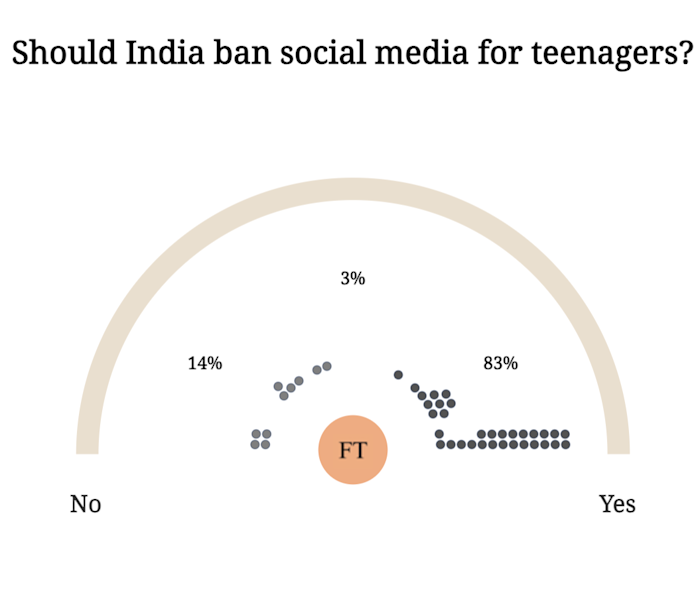
On Tuesday, we asked if India should ban social media for teenagers. Here are the results. More than 80 per cent of you think it should.
Thank you for reading. India Business Briefing is edited by Tee Zhuo. Please send feedback, suggestions (and gossip) to indiabrief@ft.com.