Unlock the Editor’s Digest for free
Roula Khalaf, Editor of the FT, selects her favourite stories in this weekly newsletter.
North Korea has closed out its ruling party’s five-yearly congress with a monumental military parade as leader Kim Jong Un, accompanied by his leather jacket-clad daughter, projected defiance over his nuclear arsenal.
The government had “permanently and irreversibly solidified” North Korea’s status as a nuclear power, the state-run Chosun Sinbo newspaper said at the conclusion of the ninth Workers’ Party congress. Pyongyang pledged to “increase the number of nuclear weapons and expand the means and space for nuclear operation and use”, it added.
Despite the defiant tone, Kim left the door open to talks with Washington, provided the US “withdraws its policy of confrontation by respecting our country’s current status”, a reference to North Korea’s nuclear stockpile.
The Stockholm International Peace Research Institute estimates North Korea has about 50 warheads, with enough fissile material to produce another 40.
Kim met Donald Trump three times during the US president’s first term, and has repeatedly expressed interest in a reunion after their last summit in Hanoi in 2019.
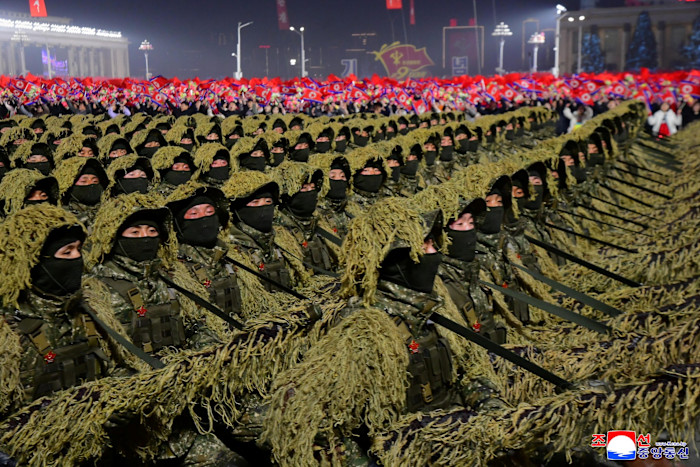
Pyongyang closed out the congress, which opened last week, with a 14,000-strong military parade and fireworks display on Wednesday night.
Despite Kim’s messaging to Trump, the parade did not showcase nuclear weapons, but signs of North Korea’s burgeoning relationship with Russia were on display. Troops that fought in Moscow’s war in Ukraine were among the participating units, and Kim arrived in a Russian-made Aurus limousine gifted by Russian President Vladimir Putin.
The North Korean leader also laid out his wider military ambitions, including “enhanced land- and submarine-launched intercontinental ballistic missile (ICBM) systems, various artificial intelligence unmanned attack systems, special assets to attack enemy satellites in times of crisis, highly powerful electronic warfare weapon systems to paralyse enemy command centres, and more advanced reconnaissance satellites”.
Kim, who is believed to be 42, was accompanied at the parade by his daughter Kim Ju Ae, who is believed to be 13 or 14, a move that will further fuel speculation that she is being groomed for eventual leadership.
“Kim intends to make her his successor,” said Koh Yu-hwan, professor emeritus at Dongguk University in Seoul. “If you look at his recent public appearances, he keeps accompanying his daughter and she is treated as the second most important person.”
But Kim Yeoul-soo at the Korea Institute for Military Affairs cautioned that the Kim dynasty’s elevation of its fourth-generation leader would be a long-term project.
“For North Koreans to naturally accept a woman as their leader,” he said, Kim Jong Un would need to “continue to bring her along and brainwash” his subjects.
“Kim Ju Ae’s succession scheme might be unveiled at the 10th party congress when she turns 18,” he added.
The congress also underscored Kim’s opposition to eventual reunification with South Korea, or even any sort of relationship.
“There is nothing to discuss . . . [the South] will be permanently excluded from the category of ‘same people’,” Chosun Sinbo said, using a phrase that refers to the historical ethnic and cultural ties between the Korean people.
It also referred to Seoul as the “number one hostile country and an unchanging principal enemy” of North Korea.
The rhetorical break with a policy reunification, which Kim first declared in 2023, marks a striking departure from the doctrines of his father Kim Jong Il and grandfather Kim Il Sung, North Korea’s founding leader.
Both had formally maintained that the two Koreas were part of a single nation destined for eventual unification under Pyongyang’s leadership.
Seoul has attempted to pursue closer relations with Pyongyang under a policy of “peaceful coexistence” rather than a declared goal of reunification by absorption or other means, a stance Kim has rejected as “deceptive”.
Kim Yeoul-soo of the Korea Institute for Military Affairs said the North Korean leader’s messaging reflected a strategy of “Tongmi-bongnam”, or “bypassing Seoul and engaging with the US”.
Kim used the congress to solidify his hold on power, elevating younger cadres he has groomed over those who had served under his father.
Additional reporting by Kang Buseong in Seoul