Unlock the Editor’s Digest for free
Roula Khalaf, Editor of the FT, selects her favourite stories in this weekly newsletter.
By three o’clock on the first Saturday in February, Lahore is already in motion. The streets pulse with anticipation as people head out to parties, carrying spools of string and delicate kites, some held high above the crowd. Traffic crawls; street-food vendors slip between cars and motorbikes, their calls mingling with the city’s cacophony. Above it all, the first kites rise silently, hovering and darting across the afternoon sky, as if Lahore itself has turned its gaze upward.
Basant, a three-day festival marking winter’s end, derives its name from the Sanskrit word for “spring”. For generations, Lahoris would welcome the season by climbing on to rooftops and flying bright paper kites. More recently, it has coincided with the lifting of the smog that sits over the city during winter.
But for nearly two decades, the sky has been empty: in 2007, the Punjab government banned the festival after a series of deaths and other injuries. Revellers fell from rooftops; others were electrocuted while trying to retrieve kites from power lines or were injured by celebratory gunfire. Many accidents were caused by so-called “killer” kite strings that had been coated in glass or metal in order to cut a rival’s line, with motorcyclists particularly at risk.
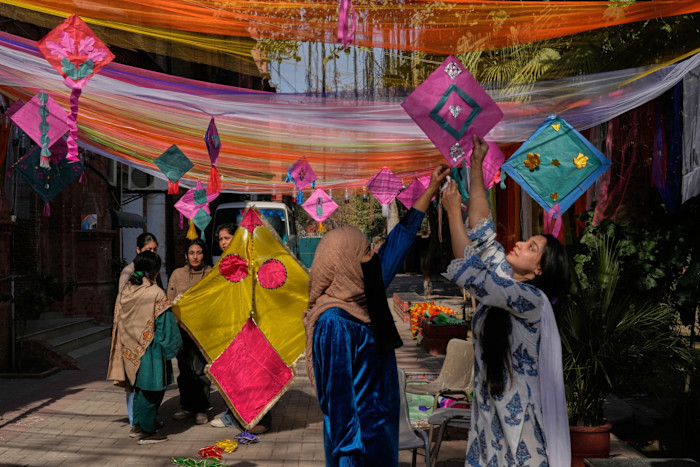
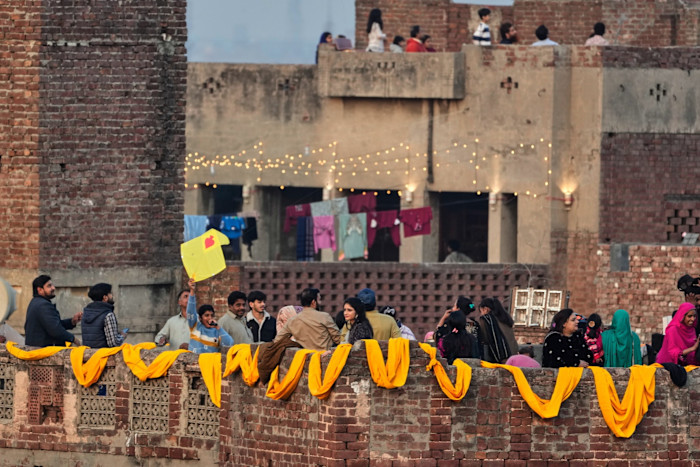
This year, with new safety regulations in place, the festival has returned. I’ve been invited to a party, and follow a pinned location that a friend has sent me, threading through Moti Bazar. Yellow has traditionally been associated with Basant — the colour of Punjab’s mustard fields that bloom at the start of spring — but the crowds are dressed in a broader palette, from neon pink to deep indigo. The shops are shuttered earlier than usual as business has given way to celebration. For a moment, I am convinced that I’m lost, then I spot my friend waving from a narrow entrance.
She leads me inside a block of offices and shops, then up several flights of stairs. “The only high points in Lahore are the buildings,” she tells me. “A family friend paid around $12,000 to rent this roof for the full three days. People have waited almost 20 years for this.”
At the top, we reach a terrace and the city opens before us. Though the sun has begun to set, the scale of the event becomes clear: rooftop after rooftop is crowded with parties, lit with floodlights and strung with speakers. On our terrace, catered food circulates and music competes with the roar of guests.
Kites are being flown from every corner of the roof. Rather than organised duels, the idea is just to cut the strings of other nearby kites when the opportunity arises. Cheers erupt each time a kite is cut loose; someone shouts “Wo kata!” (I’ve cut it!) and the cry ripples across the rooftops.
Safety precautions for this year’s event included a ban on the killer strings. Kite vendors had to be registered; buyers were required to use a QR code system to log their purchase and thus allow the authorities to trace the owner of each string in case of accident. For the festival’s duration, motorcyclists had to fit a metal rod to the front of their bikes, designed to act as a barrier against stray kite strings.
In a deeply divided country, many have hoped that the festival’s return would allow a moment of unity — Basant has traditionally been celebrated across Lahore’s religious communities including Muslims, Christians, Hindus and Sikhs. But the cost of participation — from the kites to the rooftop rentals — has raised questions about accessibility and whether the event actually underscores growing economic divisions in a country that has grappled with surging inflation.
Determined to see how those in working-class communities are marking the festival, the following morning I meet up with Usman, a local guide who lives in Androon, the historic Walled City. His neighbourhood, with its narrow alleyways and centuries-old houses, feels far removed from the expansive terrace of the night before.
We climb several steep flights of stairs inside his family home, then a wooden ladder to reach the roof. “We’ve lived here for five generations,” he says. “These decorations were packed away for the last 20 years.”
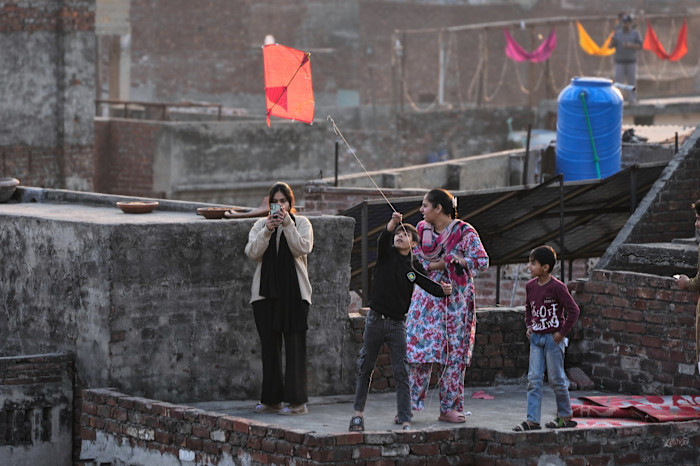
On the rooftops around us there are none of the previous night’s floodlights, sound systems or professional event organisers. Instead, grandparents are seated on charpoys, children huddled over their spools of thread while neighbours call across rooftops.
Usman hands me a kite to try. Within moments, my string jerks sharply, then falls loose to the floor — another flyer has cut it. Laughter rings out as my kite drifts away over the Walled City.
Find out about our latest stories first — follow FT Weekend on Instagram, Bluesky and X, and sign up to receive the FT Weekend newsletter every Saturday morning