In a tower overlooking Islamabad, a team of intelligence officers is scrolling Instagram, calling up fashion houses and planning a wedding.
With Pakistan’s rollicking wedding season in full swing, the Federal Board of Revenue’s “lifestyle monitoring cell” is reverse-engineering a lavish ceremony, which it believes costs far more than the suspected tax evader’s annual reported income.
“People love to play up how rich they are on social media,” said Rashid Langrial, the FBR’s chair. “But no one wants to show off their money in their tax filings.”
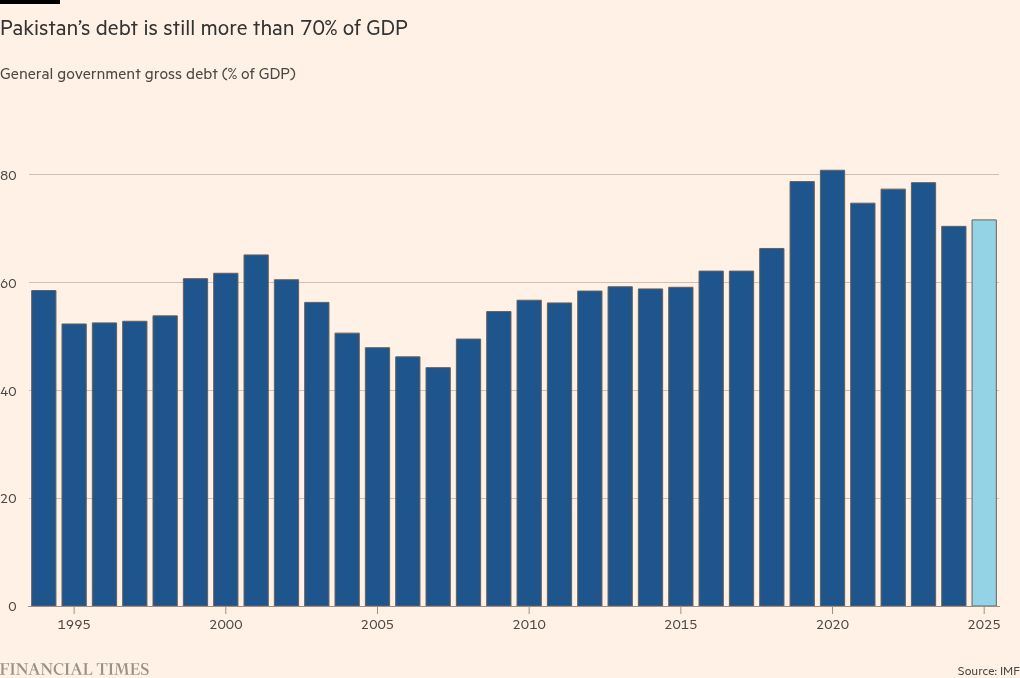
The cell’s officials have been scouring social media for potential audit targets as part of the agency’s efforts to boost cash-strapped Pakistan’s tax take, which is among the lowest in the region, and bring down the country’s ruinous public debt burden.
They are focusing on online influencers and celebrities whose modest tax filings disguise opulent lifestyles flaunted online with first-class flights, sports cars, racehorses and haute couture.
“For the first 15 reports we have issued, we could raise up to Rs2.5bn [$9mn],” said the unit’s leader, who asked not to be named to discuss ongoing cases.
The effort, which was launched in September and has about 30 intelligence officers, was partially inspired by similar campaigns in Malaysia and South Africa, the person added.
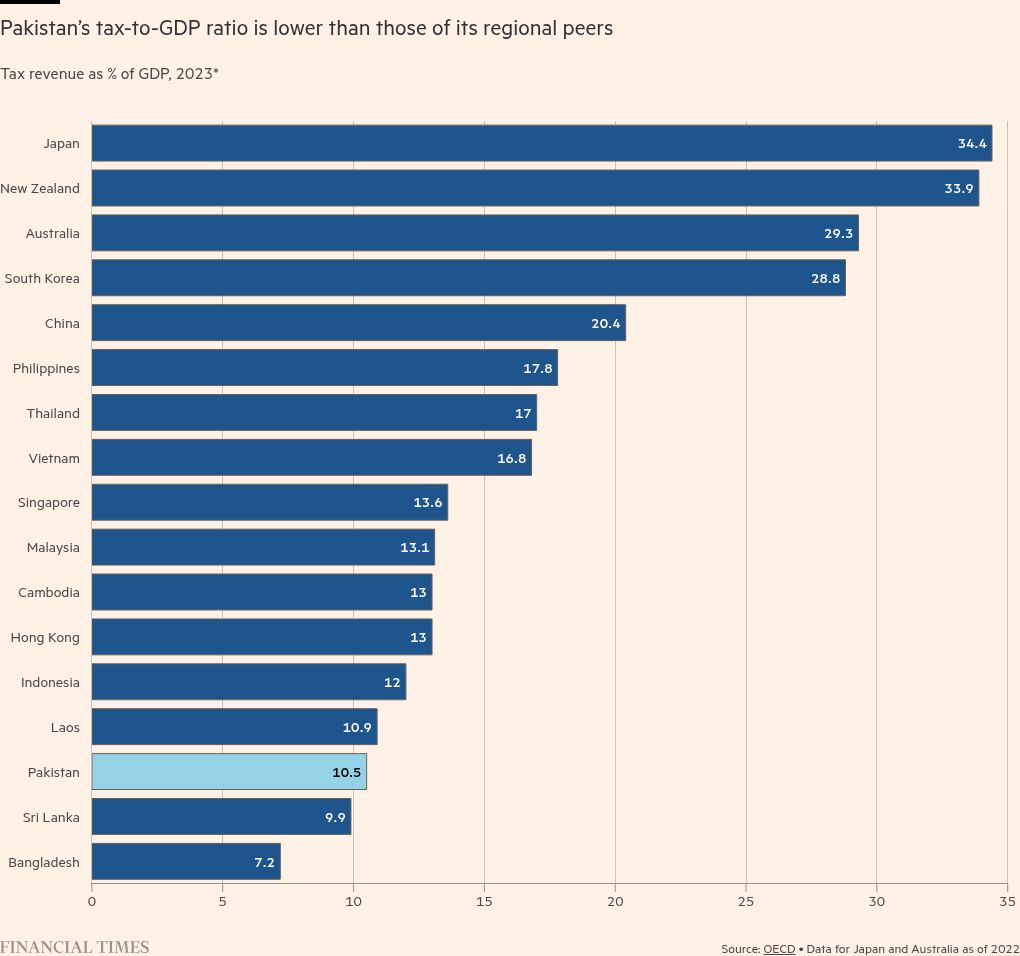
Pakistan’s tax revenue hovers around 9 to 10 per cent of GDP, lagging behind the region and forcing successive governments into cycles of IMF bailouts and bilateral debt to finance its budgets.
Expanding the tax base is of “existential importance” for Pakistan, said Ali Hasanain, associate professor of economics at the Lahore University of Management Sciences. “It is perhaps the most powerful route to reducing distortions in the economy . . . and reducing inequality and inflation.”
Tax evasion is also rife: only about 2 per cent of the population pays income tax, according to tax authorities. That leaves companies and salaried workers bearing much of the burden of public finances, and a vast informal economy out of the taxman’s reach.
The finance ministry and state bank are pushing to improve documentation of the economy, introducing measures such as raising withholding taxes on non-filers, reducing tax on credit card payments and pressing banks to digitise more transactions.
But some sectors, such as Pakistan’s wedding industry — which officials estimate could be worth up to $4bn annually — are mostly cash-based, and therefore difficult to trace.
However, Pakistani marriages are extremely public affairs, often with hundreds of guests — and plenty of photos and videos that FBR officials can scrutinise.
In one case, the unit tracked down fashion brands, jewellers, event planners, DJs and venues tagged by a Lahore-based influencer on Instagram and tallied their rates to estimate that the September ceremony, which was attended by 400 people, cost at least Rs238mn.
But the bride, who officials say is the daughter of a civil servant, declared an income loss of Rs760,000 in 2024, according to FBR documents seen by the Financial Times.
In another case, investigators recommended a money laundering investigation into a fintech entrepreneur who posted pictures and videos of Rs2.7bn worth of luxury cars that were not reported on his tax declarations.
One travel blogger, who claimed an income of just Rs600,000 in 2022, visited 43 countries in three years, according to their Instagram account, officers said. In Pakistan, tax residents — defined as those who spend more than 183 days in the country — are required to report foreign income of more than $10,000 and overseas assets of more than $100,000.
Critics said the FBR, which has a reputation for corruption, lacked not information but willpower in broadening Pakistan’s tax base.
“There is a lack of competence and willingness to pursue real tax evasion, which would mean catching many powerful bureaucrats and military officials,” said Huzaima Bukhari, a Lahore-based attorney who has written widely about tax reform.
“Social media monitoring is a gimmick,” she said. “If they want to pursue audits on this basis, it is unlikely to raise much new revenue.”
Hasanain cautioned that “enforcement theatrics” such as lifestyle audits “cannot substitute for a coherent, broad and credible tax regime”.
Tax collection rose to Rs11.7tn in the year to June, a 26 per cent jump on the previous 12-month period, according to FBR statistics, but short of its Rs11.9tn target.
Langrial, who took over the agency in August 2024, acknowledged concerns about graft. He highlighted reforms under his leadership, such as anonymous peer evaluations, reporting of corrupt staff to law enforcement for the first time and performance-based bonuses.
“We have built safeguards to ensure that this information is not abused by tax authorities,” he said.
Members of the social media monitoring unit say they hope its existence will encourage taxpayers to be more honest with their filings.
“Friends who know what I do for work are constantly sending me new accounts to investigate,” said the unit’s leader. “People failing to pay their taxes should know we will find them somehow.”
Data visualisation by Haohsiang Ko in Hong Kong