Unlock the Editor’s Digest for free
Roula Khalaf, Editor of the FT, selects her favourite stories in this weekly newsletter.
The world’s largest blood plasma company is urgently seeking its own corporate transfusion after it parted company with its chief executive and wrote down the value of two important business lines.
Australia’s CSL recorded an 81 per cent drop in half-year net profit on Wednesday. Chief executive Paul McKenzie had abruptly retired hours earlier, with CSL’s chair saying he did not have the skills the company needed.
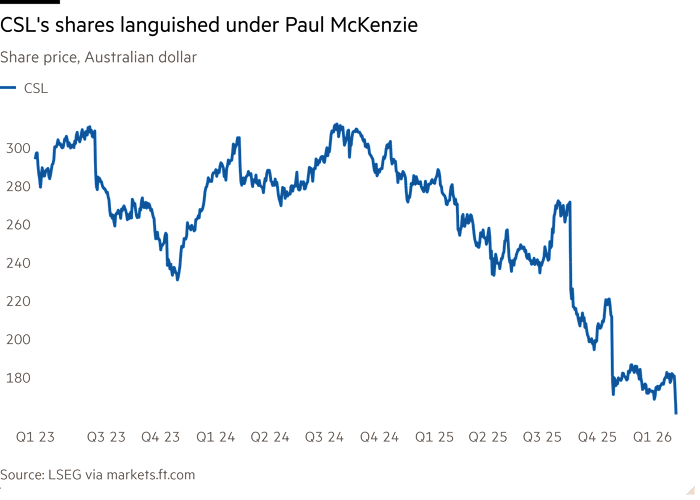
The turmoil at what was until recently Australia’s third-largest listed company, with an A$140bn ($99.5bn) market capitalisation, accelerated a collapse in value at the Melbourne-based group. Its shares have almost halved in 18 months.
CSL was transformed over three decades from a small government department into arguably Australia’s most global company outside the mining sector, expanding via multiple acquisitions in Europe and the US.
But over the past year it has struggled with factors including lower vaccination rates in the US, which have hit one of its three core businesses since Robert F Kennedy was named head of the Department of Health last year, and reduced demand for blood plasma from China because of new regulations.
“There’s blood on the carpet,” said Prasad Patkar, head of investments at Platypus Asset Management whose fund sold its last shares in CSL last year. “The old guard has been summoned to fix this. Some tough decisions need to be made.”
CSL also warned last year that it needed more than “tinkering”. Gordon Naylor, a company veteran, will replace McKenzie for up to a year as the company searches for a new chief executive.
Chair Brian McNamee, who as chief executive led CSL through its extraordinary initial growth in the 1990s, was blunt in talks with investors about why the board had moved on from McKenzie, an American who was only the third chief executive in its history.
“[McKenzie] didn’t have the skills we wanted for the future,” McNamee said on Tuesday.
Jun Bei Liu, founder of investment manager Ten Cap, a shareholder in CSL, said communication with investors had been “poor” over the past year as its financial performance had continued to deteriorate despite constant reassurance from management.
She said even the announcement of McKenzie’s exit was “messed up” as investors had seconds to react to the news before the market closed on Tuesday, triggering a 5 per cent sell-off in its shares.
On Wednesday, CSL revealed a US$1.1bn impairment in the value of its vaccine and iron supplement divisions, two of its three divisions, which pushed net profit in the six months to December down from US$2bn to US$401mn. Revenue at its core CSL Behring blood plasma business fell 7 per cent, driving a 4 per cent decline in total revenue to US$8.3bn.
The company maintained its full-year growth target. Shares were 6 per cent lower by the close of trading on Wednesday.
Steve Wheen, an analyst with investment bank Jarden, said there were “worrying trends” in the portfolio but the company had improved margins in its core blood plasma business. He said a lack of confidence in the company’s ability to hit its full-year targets could drive further share price weakness.
Formerly the Commonwealth Serum Laboratories, CSL grew under McNamee into a world leader in blood fractionation, where plasma is separated via centrifuge. Its global expansion included the US$275mn takeover of the Seqirus division of Novartis in 2015, which boosted its vaccines business and was successfully turned around under Naylor.
However, the near-US$12bn takeover of Vifor Pharma completed in 2022, its largest deal that took it into the field of iron deficiency and kidney disease, was the start of its problems, according to some investors.
Patkar said the deal was “an absolute dog” but that the issue had been masked by the consistent performance of its core operations.
However, CSL’s blood plasma business also started to underperform last year. The company said in August that it would cut 3,000 jobs. It also revealed a plan to spin off Seqirus but abruptly suspended the move in October owing to lower flu vaccination rates in the US.
Patkar said CSL’s golden years may have been burnished by weak competition. “Playing tennis against a weak opponent can make you look better than you are,” he said.
Naylor told investors on Wednesday that he would “deeply examine” where the company had gone wrong in the past two years. “As an investor, I’m not prepared to accept that we can’t do better,” he said.