Unlock the Editor’s Digest for free
Roula Khalaf, Editor of the FT, selects her favourite stories in this weekly newsletter.
Japan’s prime minister Sanae Takaichi has led her party to a crushing victory in Japan’s snap general election on Sunday.
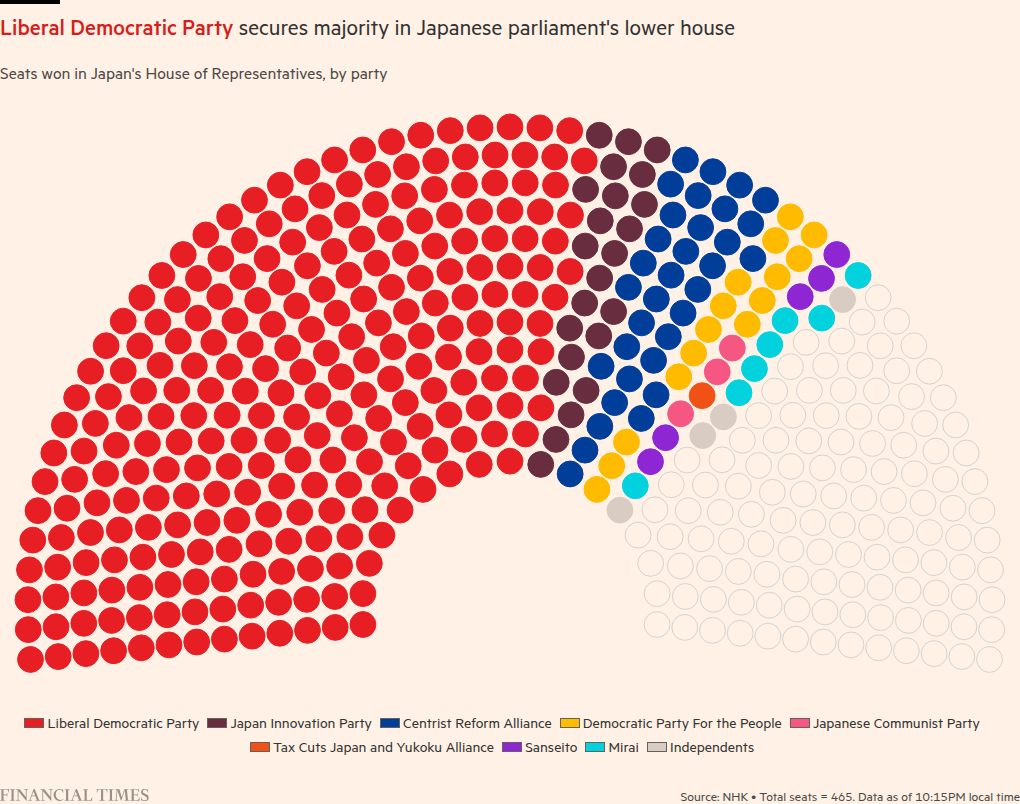
Less than two hours after polls closed Takaichi’s Liberal Democratic Party had already won 256 seats, according to results collated by broadcaster NHK, giving it a single-party majority in the 465-seat lower house of Japan’s parliament.
Takaichi called the surprise election on January 23, staking her three-month old premiership on a bet that the country would embrace her bluntly-spoken conservatism, promises of a new era of prosperity and expansive spending pledges.
A record 27mn voters cast their ballots early, reflecting the excitement that Takaichi has generated, especially among younger female voters.
In securing a clear mandate for her leadership, Takaichi has also engineered a stunning comeback for the LDP, which entered the election with low approval ratings after having lost its majority in both houses of parliament.
Exit polls project that the LDP and its coalition partner, the Japan Innovation Party, could win as many as 364 seats between them, with even lower estimates suggesting the two parties could secure a combined 300 seats.
A two-thirds majority would give Takaichi and the coalition overwhelming control of the lower house and allow the ruling bloc to over-rule opposition to draft legislation in the upper house.
Investors have said the scale of the LDP’s victory would probably reignite the so-called “Takaichi trade”, which has driven the Japanese stock market to record highs since she became prime minister in October.
But Takaichi’s pledges of government spending, and a pre-election pledge to suspend consumption tax on food for two years, have rattled Japanese bond markets and sent the yen sharply lower against the US dollar. Some analysts predict the yen could fall further when markets reopen.
Political analysts have said the projected victory would give Takaichi clear authority over the LDP, a party with a history of internal divisions.
She is on track to secure a parliamentary majority that could be larger even than that of the late Shinzo Abe, a hero of hers and Japan’s longest-serving prime minister in the modern era.
Takaichi’s decision to hold the election came at a time of growing economic distress among ordinary Japanese unhappy with rising food prices and stagnant wages.
The worsening geopolitical conditions, combined with growing worries around US commitment to its old alliances, have driven voters towards Takaichi, a nationalist who presents herself as a fierce proponent of Japan on the global stage.
Tobias Harris, a political analyst and founder of Japan Foresight, said Takaichi would feel “vindicated”, adding: “She has ambitions, she’s been given a huge mandate and will likely turn her power against the constraints that remain, such as the ministry of finance.”
The LDP’s success comes at the expense of the recently formed Centrist Reform Alliance bloc, which is projected to have lost about half the seats its members held. The bloc was formed from the Constitutional Democratic Party and the LDP’s former coalition partner, Komeito.
The new party was conceived to offer an alternative to voters nervous about Takaichi’s right-wing politics. Yoshihiko Noda, co-head of the CRA, said: “The results are harsh but we have to accept them.”
Neil Newman, Japan strategist at Astris Advisory, said the victory meant that the LDP was back in the driving seat and would accelerate investment to support the economy. “Japan will no longer fear or tolerate Chinese trade threats, but will invest to negate them. As investors we have a whole new Japan to reconsider from Monday,” he added.
Data visualisation by Haohsiang Ko in Hong Kong