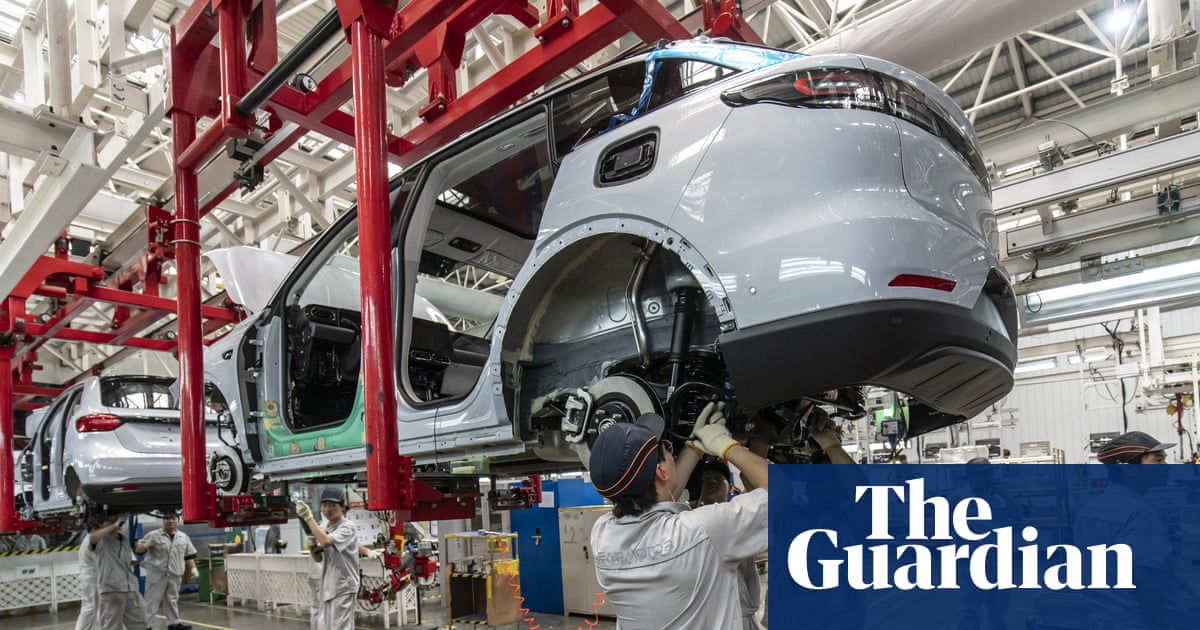
China’s clean energy industries drove more than 90% of the country’s investment growth last year, making the sectors bigger than all but seven of the world’s economies, a new analysis has shown.
For the second time in three years, the report showed the manufacture, installation and export of batteries, electric cars, solar, wind and related technologies accounted for more than a third of China’s economic growth.
Despite the chilling effect of Donald Trump’s tariffs and support for fossil fuels, the new data highlighted the continuing momentum behind the shift towards renewables.
The new analysis, produced by the Centre for Research on Energy and Clean Air and published in Carbon Brief, found that China’s clean-energy sectors nearly doubled in real value between 2022 and 2025.
Last year, they generated a record 15.4tn yuan ($2.2tn/£1.6tn) of business, comparable with the GDPs of Brazil or Canada. This accounted for 11.4% of China’s gross domestic product, up from 7.3% in 2022.
China is increasingly dependent on these sectors. Without clean energy, Beijing’s leaders would have missed their 5% annual growth target by a wide margin.
Most of the extra capacity is being used to meet domestic demand for a rollout of wind and solar that has recently been double that in the rest of the world combined.
Chinese government advisers say this is no longer just a transition of power generation, but a system-wide change in how the country is wired and made mobile. The most spectacular investment growth last year was in the battery sector, where ever more efficient technology is being used for electric vehicles (EVs) and grid storage upgrades.
Exports are also surging. Thanks to expanding output in the world’s manufacturing powerhouse, solar power has been credited by the International Energy Agency for providing “the cheapest electricity in history” and is now affordable in many global south nations.
“In a lot of other countries things are accelerating,” said the report’s lead author, Lauri Myllyvirta. “Many of the African countries have imported a lot of solar. EVs are just starting to be bought in places where no one had an EV breakthrough on their bingo card for last year or maybe not even this decade.”
He said the uptick in clean energy investment in China was positive news.
If the world’s biggest emitter of greenhouse gases continues to move away from fossil fuels at this speed, it will soon – or possibly already has – hit peak carbon, which would mark a global turning point.
But this is not yet assured. China’s coal industry is also a powerful political force and it will be contesting the speed of transition. Last year, developers submitted proposals to build a total 161 GW of new coal-fired power plants and more are in the pipeline. The future direction of the country’s energy sector should become clearer next month, when the government unveils its next five-year plan.
Climate campaigners said it was time for China to make up its mind. “This is a historic turning point: solar power is set to overtake coal in China for the first time in 2026. This is maybe the clearest demonstration yet that clean energy has won – on cost, scale, and air quality,” said Andreas Sieber, the head of political strategy at 350.org.
“However, China is responding to coal’s economic defeat by building more of it. With around 290 GW of new coal capacity already permitted or under construction, and another record year for approvals, the country is … proving coal is obsolete while rushing to entrench it. This mostly serves a coal industry racing against time. The consequence is predictable: stranded assets, higher system costs, and a transition made harder.”