Unlock the Editor’s Digest for free
Roula Khalaf, Editor of the FT, selects her favourite stories in this weekly newsletter.
India has pledged to raise investment in manufacturing and semiconductors, boost infrastructure spending and offer incentives for data centres as Prime Minister Narendra Modi’s government seeks to sustain economic momentum in the face of trade tensions with the US.
“Today, we face an external environment in which trade and multilateralism are imperilled and access to resources and supply chains are disrupted,” finance minister Nirmala Sitharaman told India’s parliament on Sunday as she laid out a roadmap for the world’s fastest-growing major economy.
India has yet to secure a trade deal with the US, its largest trading partner, and President Donald Trump has imposed levies as high as 50 per cent over New Delhi’s purchases of Russian oil.
Sitharaman said the budget for the 2026-27 fiscal year would “accelerate and sustain economic growth by enhancing productivity and competitiveness and building resilience to volatile global dynamics”.
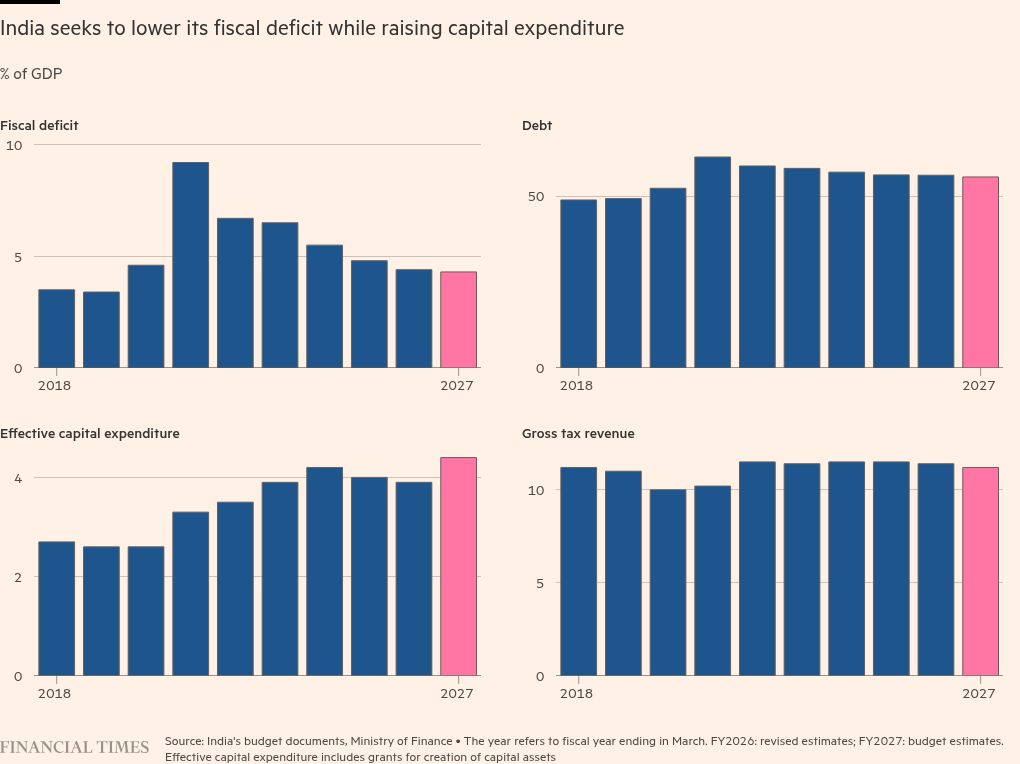
She outlined plans to raise capital expenditure by almost 9 per cent, including support for manufacturing in “strategic and frontier sectors”, while trimming the fiscal deficit even as the government raised borrowing.
Modi has set a goal of boosting the manufacturing sector’s share of India’s economy to 25 per cent, part of his ambitions to challenge China for global supply chains, but the level has lagged behind at about 16 per cent.
The budget included measures for some of the industries hit hardest by Trump’s tariffs, including “mega textile parks” to further support exports. Sitharaman also announced Rs100bn ($1.1bn) over five years for the biopharmaceuticals industry, which Trump has not targeted, and to double spending for semiconductor manufacturing to Rs400bn.
“The central government delivered a fairly non-adventurous budget in a challenging global environment,” said Dhiraj Nim, economist at ANZ Research.
In a special Sunday trading session, the blue-chip Nifty 50 index fell more than 1 per cent.
India has signed a flurry of recent trade deals, including with the EU this past week. The economy’s relatively low reliance on exports, compared with its Asian peers, has also limited the impact of Trump’s trade war.
But the trade tensions spurred Modi’s government last year to hasten a “reform express” drive, slashing the complex goods and services tax regime and implementing new labour codes.
Sitharaman announced further modifications to customs duties as well as exemptions and cuts to benefit sectors ranging from defence, aviation and healthcare to nuclear power. She also unveiled a tax holiday until 2047 for foreign companies investing in cloud computing in an effort to lure foreign capital for data centres.
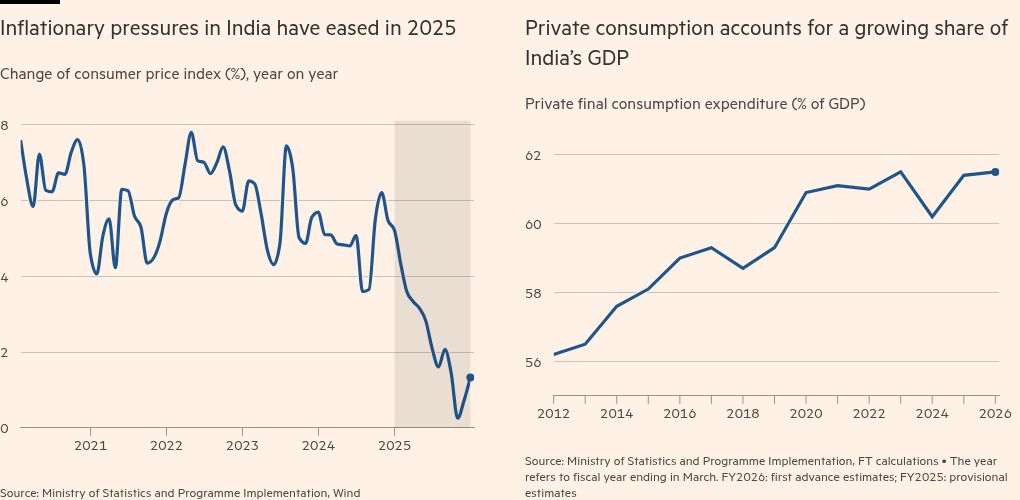
India’s economy is still growing strongly, buoyed by domestic demand, but economists and analysts expect that pace to moderate. Modi has set a target of reaching developed economy status by 2047, the centenary of independence, which economists have estimated would require average annual growth of 7 per cent to 8 per cent a year.
The country’s annual economic survey, published on Thursday, forecast GDP growth of 7.4 per cent for the fiscal year ending in March. Last month, the IMF put growth at 7.3 per cent for 2025 and raised its 2026 figure to 6.4 per cent.
Sitharaman said India would seek to trim its current debt-to-GDP ratio of 56.1 per cent to 55.6 per cent for the next fiscal year, in line with plans to reach about 50 per cent over the next five years.
India Business Briefing
The Indian professional’s must-read on business and policy in the world’s fastest-growing big economy. Sign up for the newsletter here
She said the fiscal deficit was expected to remain at 4.4 per cent of GDP and edge down to 4.3 per cent for the next fiscal year, while gross borrowing would rise to Rs17.2tn, from Rs14.8tn.
But analysts raised concerns about plans to raise capital expenditure to a record Rs12.2tn, 8.8 per cent higher than last year’s budget, which was itself a record, and exceeding net market borrowing of Rs11.7tn.
“I pray that a path is laid where one day capital expenditure will be more than the total borrowing including small savings,” said Nilesh Shah, managing director of Kotak Mahindra Asset Management.
Data visualisation by Haohsiang Ko in Hong Kong