Unlock the Editor’s Digest for free
Roula Khalaf, Editor of the FT, selects her favourite stories in this weekly newsletter.
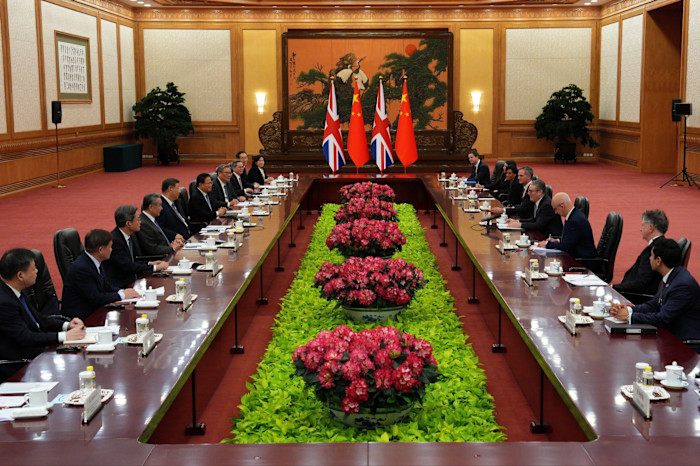
China is lifting its travel ban on MPs and peers who criticised the country’s human rights record and will allow all British parliamentarians to enter the country, Sir Keir Starmer has announced.
Starmer said the lifting of the travel ban, which affects four currently serving MPs and two peers, was a vindication of his approach in engaging “constructively” with China during a four-day visit to the country.
The UK prime minister said he raised the sanctions on parliamentarians during talks in Beijing. “The response of the Chinese as a result of our discussions is that the restrictions no longer apply,” he told the BBC.
“And President Xi [Jinping] said to me, that means that all parliamentarians are free to travel to China.”
The MPs and peers were sanctioned in 2021 shortly after the UK had placed sanctions on Chinese officials over the alleged human rights abuses of the Uyghur Muslim minority group.
Sir Iain Duncan Smith, former Conservative leader, was among those sanctioned and he said he would wear this as “a badge of honour”.
Beijing accused the British lawmakers of spreading “lies and disinformation” about the country. Downing Street said the lifting of sanctions by China covered current parliamentarians, not ex-MPs or other individuals affected by travel bans.
But the parliamentarians said that they would be angry if their status had been used as a “bargaining chip” that saw the UK lift sanctions against Chinese officials responsible for the “genocide” in Xinjiang. Downing Street said that there had not been a “quid pro quo” for the deal.
The parliamentarians also said they would “reject” any deal that did not also see sanctions lifted on lawyers and academics.
In a joint statement five current and former Tory MPs, including Duncan Smith, former security minister Tom Tugendhat, Neil O’Brien and Nusrat Ghani, the deputy speaker of the House of Commons said: “We would reject any deal that prioritises our personal convenience over the pursuit of justice for the Uyghur people.”
The statement, co-ordinated by the hawkish Inter-Parliamentary Alliance on China and also signed by Labour and Liberal Democrat peers Baroness Kennedy and Lord Alton, added: “We will not accept any reprieve that applies only to sitting lawmakers while others, including civil society organisations, remain sanctioned.”
The MPs and peers were sanctioned alongside the lawyer Sir Geoffrey Nice QC, who was chair of the Uyghur Tribunal that investigated alleged atrocities against the minority group, as well as academic Jo Smith Finley, whose research focuses on the Uyghurs. One former Tory MP, Tim Loughton, was also sanctioned in 2021.
China’s targeting of UK parliamentarians with sanctions has caused concern in Westminster, while MI5 also issued a warning in November about Beijing’s intelligence services trying to recruit people who work in parliament.
Chinese officials were barred from visiting the Queen’s lying-in-state in 2022 by the Speaker of the House Sir Lindsay Hoyle, over the sanctioning of UK parliamentarians.
Lifting the sanctions on MPs and peers is intended to clear the way for future visits to Westminster by Chinese officials and politicians. Starmer and Xi agreed there should be future exchanges by legislators from the two countries.