Unlock the White House Watch newsletter for free
Your guide to what Trump’s second term means for Washington, business and the world
US President Donald Trump has warned Sir Keir Starmer that it is “very dangerous” to build closer business ties with China, after the UK prime minister hailed “strong” relations with Beijing on a trip to the country.
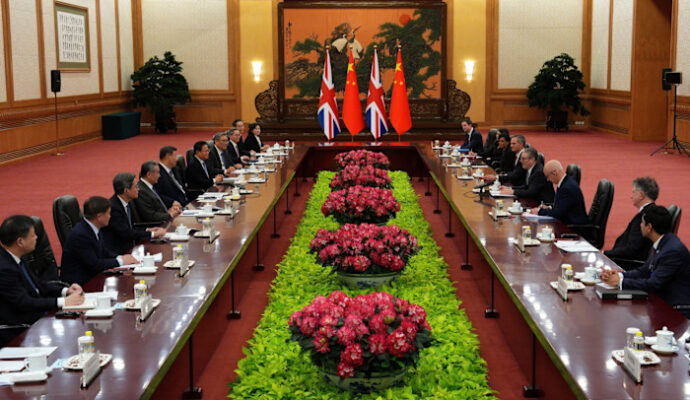
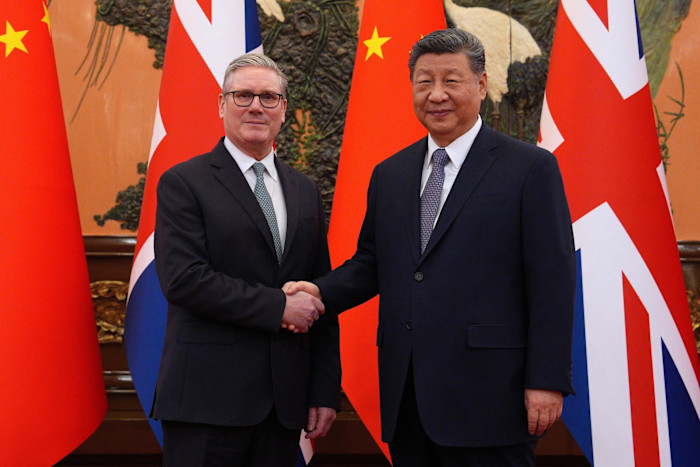
The intervention from Trump came a day after Starmer held what he said were “very warm and constructive” talks with Chinese President Xi Jinping. The two sides also signed deals to halve Chinese tariffs on whisky from 10 per cent to 5 per cent and introduce visa-free travel for British citizens.
Starmer said those deals were the first fruits of a new, “sophisticated” relationship with China. He will travel from Beijing to Shanghai on Friday to try to drum up more business for British companies.
But the diplomatic delicacy of the mission was reinforced when Trump attacked Starmer’s trip.
Asked what he thought of Starmer trying to forge closer business ties with China, Trump said: “Well, it’s very dangerous for them to do that.”
The US president also reopened his attack on Canada’s Prime Minister Mark Carney, who agreed to cut tariffs on Chinese electric vehicle exports on a visit to Beijing earlier this month.
That move had prompted Trump to threaten to impose 100 per cent tariffs on Canada, which he said Carney was trying to make a “drop-off port” for Chinese goods.
“It’s even more dangerous, I think, for Canada to get into business with China,” Trump said late on Thursday in Washington at the premiere of the documentary film Melania about the first lady.
“Canada is not doing well. They’re doing very poorly, and you can’t look at China as the answer,” Trump said. He added: “I know China very well. I know President Xi is a friend of mine. I know him very well.”
China’s foreign ministry said that it believed in “win-win outcomes” when asked about Trump’s comments.
Trump himself is expected to visit Beijing in April after the US and China agreed a truce in their tariff war late last year, when Beijing forced the US president to climb down on his tariff threats by choking off the supply of rare earths to American industry.
China has sought to exploit growing fissures between the US and its traditional allies caused by Trump’s erratic policymaking, including by inviting leaders such as Starmer and Carney.
Wang Dong, executive director of the Institute for Global Cooperation and Understanding at Peking University, said China was carefully managing relations with Washington ahead of Trump’s visit and would not unduly react to outbursts from the US president.
But he added that Trump risked pushing allies further away with his comments. “With each and every warning that Trump issues to American allies, he will further alienate them,” Wang said.
British officials said they hoped Starmer’s visit would usher in business deals worth billions of pounds.
The UK and Chinese leaders also agreed to launch a “feasibility study” into negotiations to open up markets in business and financial services, although UK officials admitted these were only “talks about talks”.
In a sign of UK concerns that Trump might object to that effort, one British official stressed: “This is not a trade deal.”
On Friday, Starmer said he had held “very warm, very good meetings” with Xi that had provided “just the level of engagement that we hoped for”.
“We warmly engaged and made some real progress, actually, because the UK has got a huge amount to offer,” Starmer told a meeting of the UK-China Business Forum at the Bank of China in Beijing.
He also touted the agreements on visa-free travel and lowering whisky tariffs as “really important access, symbolic of what we’re doing with the relationship”.
“That is the way that we build the mutual trust and respect that is so important,” he said at the event, which was attended by British and Chinese businesspeople.
A British official said that Downing Street had discussed the objectives of Starmer’s trip with the US in advance and noted Trump’s own upcoming visit to China.