Stay informed with free updates
Simply sign up to the Chinese politics & policy myFT Digest — delivered directly to your inbox.
The writer is a professor at Georgetown and Texas A&M universities and was Special Assistant to the President and senior director for east Asia at the National Security Council (2005-2009)
Since Xi Jinping became president of the People’s Republic of China in 2013, many analysts have convinced themselves that he is omnipotent, his power and authority unchallenged.
For such observers, the purging of China’s military leadership, including top general Zhang Youxia last weekend, among others, was simply another example of Xi clearing out the dead wood, rooting out the corrupt or underperformers in the upper echelons of the People’s Liberation Army. However, recent events show that this assessment is dangerously wrong.
First, it ignores the longtime paranoia of Xi, who claims to have discerned the evil hand of the American CIA behind every episode of domestic unrest from the Tiananmen Square student movement of 1989 to the pro-democracy protests in Hong Kong or Uyghur unrest. This time around, there may in fact be good reason for Xi to feel paranoid, as party leaders question his judgment in removing Zhang.
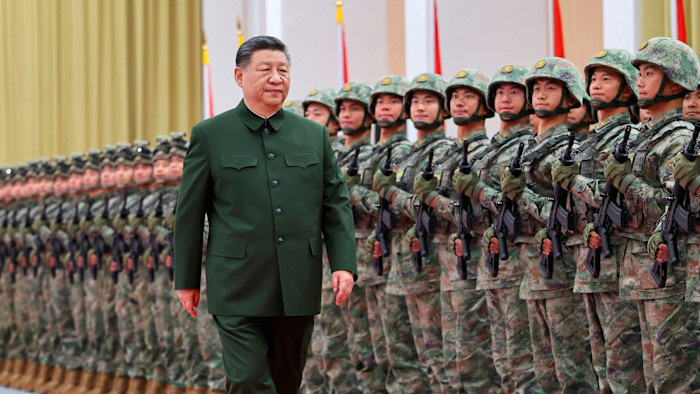
Second, and more significantly, the assessment ignores the inevitable tensions between the first and second most powerful institutions in the Chinese communist system: the party and the army.
The fact is that every civilian leader since the establishment of the People’s Republic in 1949 has had an uneasy relationship with the PLA, even Mao Zedong. History is littered with instances in which the army has questioned the wisdom of the civilian leadership. In 1958, for example, Peng Dehuai, the commander of PLA forces in the Korean war, questioned the wisdom of Mao’s economic Great Leap Forward. He cited letters from his soldiers saying that their families were dying of starvation. Only a military man would have presumed to question the party leader so openly. But that was no protection against Mao’s wrath: Peng was purged.
In a less dramatic but equally telling fashion, in January 2011 the PLA apparently showed its displeasure with how then president and party general secretary Hu Jintao was handling US-China relations during a visit to Beijing by then American defence secretary Robert Gates. As Gates tells it, the PLA, in a remarkable flexing of its muscles, rolled out for the first time its new J-20 fighter, just hours before the American was due to meet Hu. One of Gates’ aides told him: “This is about as big a ‘fuck you’ as you can get.” Hu was embarrassed and the only man in the room who knew of the test was the Chinese military representative.
There is no evidence that General Zhang ever defied Xi. Nor has there been any hint of disagreement between the two men. Indeed, Xi promoted Zhang to the Central Military Commission and has relied on him to run the PLA — until now.
So, what happened? It seems likely that Xi was alarmed when, last summer, Zhang was able to purge the CMC of two generals whom Xi had personally installed at the top of the military command structure. He Weidong and Miao Hua were military commanders on the Taiwan front when Xi was a party leader in that same region.
We may never know what caused Zhang to trigger their removal or indeed if Xi, at the time, acquiesced. There is some speculation that they were arguing for a more aggressive military approach to dealing with Taiwan. Some Chinese sources believe Zhang, as an old soldier experienced in combat on the Vietnamese border, did not believe that the PLA was ready to change its approach. It could also be that the younger generals simply had different ideas about military modernisation and policy.
But it seems clear that Xi became concerned about Zhang’s accumulation of unchecked power after eliminating his rivals on the CMC. The charges levelled at Zhang include the allegation that he “severely trampled on and damaged the chairman responsibility system”, an obvious allusion to Xi’s position as the commander-in-chief of the PLA.
Xi might have wondered whether he might be Zhang’s next target or that Zhang might try to prevent him enjoying a fourth five-year term as leader. As a member of the politburo, as well as the top uniformed officer, Zhang could conceivably have worked over the next year with other members of the politburo and retired party elders to do so.
More ominously, it is also possible that Zhang had voiced opposition to Xi’s drive to prepare the military for combat in the Taiwan Strait by 2027.
Whatever the truth, there is a risk that Zhang’s downfall triggers concern among the party elite about Xi’s judgment and leadership. They could, for example, press him to name a successor — something he has been loath to do thus far — or seek power-sharing arrangements that allow younger leaders to come to the fore.
Since 2013, Xi has ruled China with an iron hand. But taking out Zhang may have been authoritarian over-reach.
One thing is certain: Zhang’s real crime was not corruption or incompetent leadership. It was that he became too powerful for Xi to bear.