Unlock the Editor’s Digest for free
Roula Khalaf, Editor of the FT, selects her favourite stories in this weekly newsletter.
At first glance, Singapore may appear an odd winner from the disruption to global trade brought on by Donald Trump’s “reciprocal” tariff regime. As a major beneficiary of the postwar era of globalisation, the city-state’s entire economy is structured upon being a linchpin for international commerce.
But after a year dominated by trade shocks and geopolitical tension, international investors are flocking to Singapore. The country’s stock market had its best year for a decade in 2025, with a total return of 28.6 per cent, while foreign investors rushed to buy its banks’ bonds, a safety-first asset class favoured primarily by domestic buyers.
The Singapore dollar hit an 11-year high against its US namesake this week, in stark contrast to Japan’s yen and South Korea’s won, which are trading at multi-decade lows.
As a shipping hub linking China to the west, about 30 per cent of global maritime trade passes its coastline, according to the International Maritime Bureau. The country’s international financial centre — as well as its ever-expanding professional services sector — is predicated on the international movement of capital. Its own leaders have warned that a global trade war is Singapore’s “greatest fear” and that the country of 6mn people risks being “squeezed out, marginalised and left behind”.
And yet, global investors see things differently. Singapore’s close relations with the US and China have given hope that as both superpowers trade blows, their south-east Asian trade partner will avoid the worst of the collateral damage.
Meanwhile, Singapore’s predictable politics — with the pro-business People’s Action party winning its 16th consecutive election last year — has given confidence that it will avoid lurching to the protectionist populism stirring in many western countries.
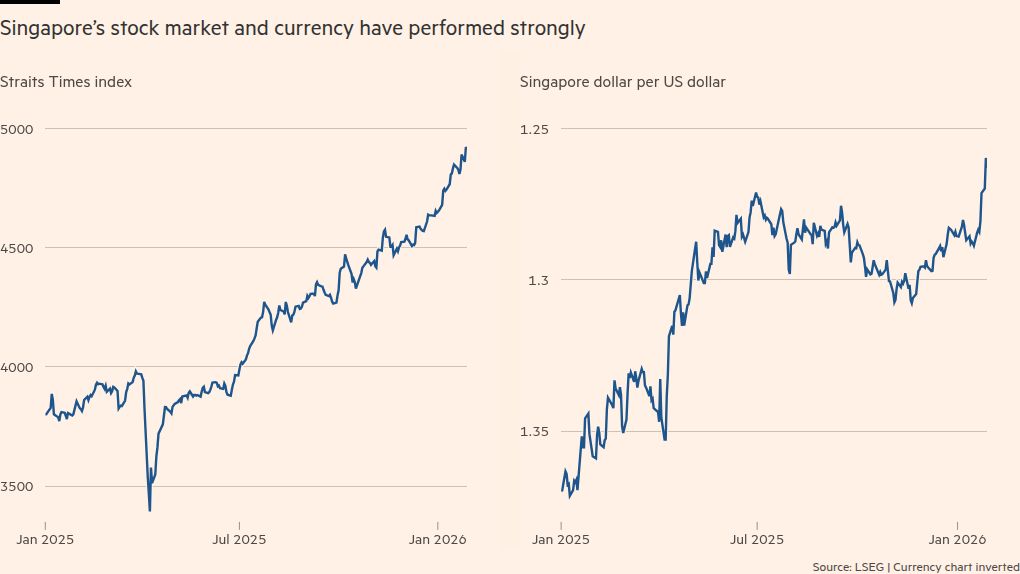
From lows after Trump unveiled his tariffs last April, shares in Singaporean property and infrastructure group Keppel are up 94 per cent, while fellow real estate manager UOL Group has gained 101 per cent. ST Engineering, the aerospace and defence group, has enjoyed a 49 per cent uplift, thanks also to countries around the world re-arming.
Singapore’s banks have also attracted overseas investors, despite their businesses being exposed to a slowdown in regional trade. Shares in two of the big three — DBS and OCBC — are up 59 per cent and 48 per cent since April, respectively. Even Singapore’s stock market operator, SGX Group, has enjoyed a 49 per cent share price jump, despite its struggles convincing high-growth companies to list on its exchange.
The bourse’s strong performance is not solely due to a global flight to quality. Reforms the government put in place to boost listings are starting to bear fruit, while many of the biggest constituents were generous with their dividend payouts.
Other Asian stock markets also performed strongly last year, notably South Korea’s Kospi, which gained 76 per cent, its best year since 1999. Yet while much of the momentum across Asia’s equity markets came from a rush to invest in AI-related businesses, Singapore’s biggest risers were steadier businesses such as banks and property companies.
It is not just Singaporean equities that international investors are lapping up. UOB, the country’s third-biggest bank by assets, has dipped into the bond market twice so far this month and received significant overseas interest.
In its first issuance, the bank raised S$850mn ($670mn) with a convertible bond on a 3 per cent yield. Though these types of products are sold mostly to domestic investors through private lenders in Singapore, bankers on the deal said there was strong demand from international investors, who made up more than a quarter of buyers. UOB followed a week later with a A$2bn ($1.4bn) bond sale to Australian dollar investors, with the order book peaking at more than A$5bn.
There is an argument that investors are overly optimistic about Singapore’s ability to weather the long-term disruption to global trade, which has yet to hit fully. The government itself has warned that it expects GDP growth to fall to between 1 and 3 per cent this year from last year’s surprisingly strong 4.8 per cent. The small economy would also be particularly susceptible to a rise in global inflation.
But compared with other markets, Singapore is still seen by some as a relatively safe bet. “In the face of geopolitical volatility, Singapore offers a safe harbour,” said one banker involved in selling UOB’s bonds. “As we enter another year of unknowns, Singapore Inc is once again offering surety.”