Unlock the Editor’s Digest for free
Roula Khalaf, Editor of the FT, selects her favourite stories in this weekly newsletter.
The dollar sank to a four-month low on Monday and gold surged above $5,000 a troy ounce for the first time, as speculation over potential joint US-Japan action to support the yen piled further pressure on the US currency.
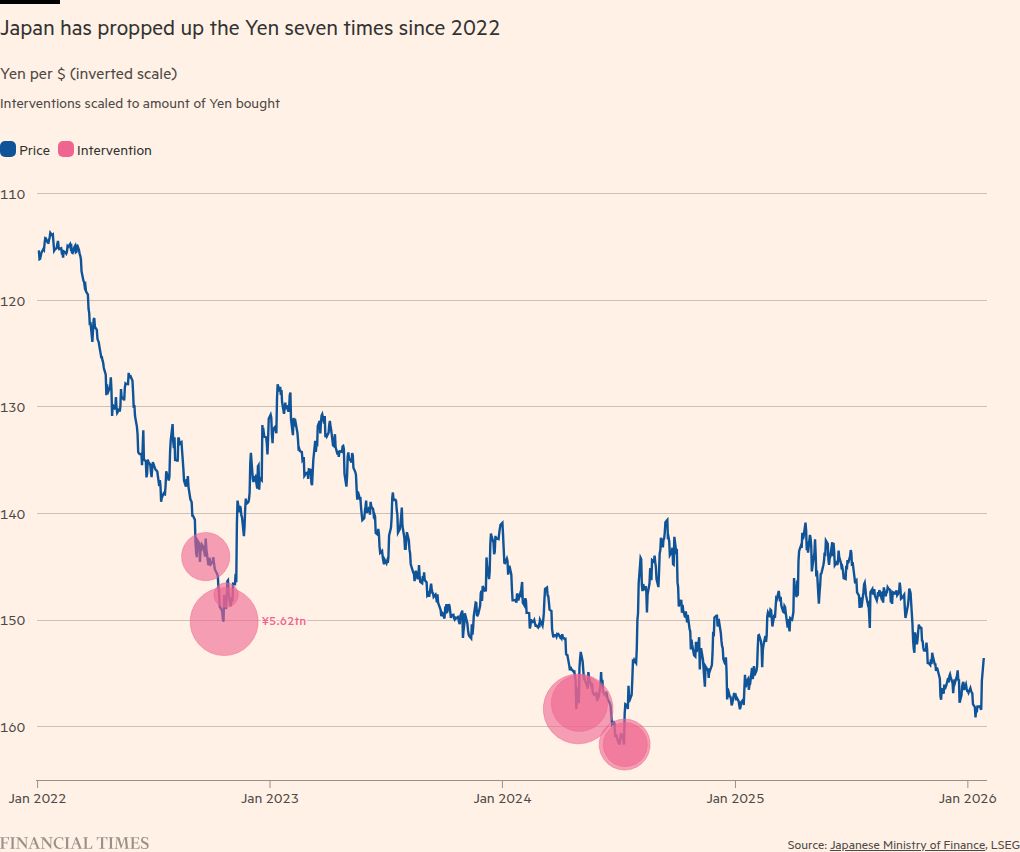
The yen climbed 1.3 per cent to just below ¥154 to the dollar, extending its gains from a volatile session on Friday that included a “rate check” of market participants by US authorities, a move that is often a precursor to foreign-exchange market intervention.
The dollar fell 0.6 per cent on Monday against a broader group of major currencies, extending the losses sparked by last week’s Greenland crisis, which drove it to its worst week since May.
The surge in the yen has come as traders speculate that the US and Japan could be lining up their first co-ordinated intervention in the currency since the G7 acted to weaken it after the 2011 earthquake. Japanese authorities have intervened to support the currency seven times since 2022.
The yen speculation had “reinforced the dollar sell-off”, said analysts at MUFG, saying a joint intervention would “send a strong signal that the Trump administration wants a weaker dollar”.
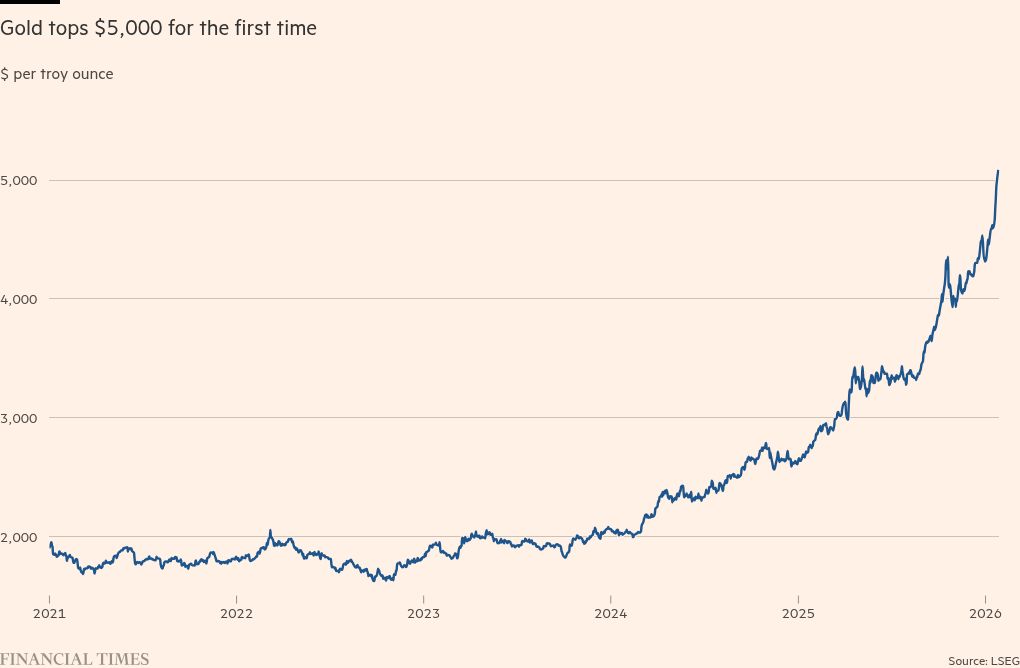
Gold prices climbed more than 2 per cent to a new record above $5,100 a troy ounce as a weaker dollar and continued concern about erratic US policymaking triggered a scramble for precious metals.
“We have passed another threshold, just much faster than I thought we would,” said Michael Haigh, analyst at Société Générale.
“People are price insensitive to gold now, as they expect this momentum to continue,” he added. Global “uncertainty levels are high”, he said, pointing to recent events in Venezuela, Greenland and Iran as factors that had driven investors to traditional haven assets, such as bullion.
The bounce in the yen comes after officials and investors had become increasingly anxious about a simultaneous sell-off in the currency and Japan’s bond market ahead of a snap election on February 8.
The yen hit an 18-month low earlier this month as traders responded to a stimulus plan from the country’s new prime minister, Sanae Takaichi. Investors have worried that authorities face a choice between supporting the currency with higher interest rates or keeping borrowing costs lower to arrest the rout in the Japanese bond market.
Yujiro Goto, chief foreign exchange strategist at Nomura, said that while there was not yet data to confirm market rumours, it appeared “highly likely” that the Japanese authorities may have already directly intervened in the market on Monday, given that currency moves had been larger than would be expected for purely verbal intervention.
Goto said such a sharp fall of the dollar would normally trigger “dip buying” by investors. “Without intervention, you would probably have seen the dollar recovering this morning, so I would not be surprised if there had been intervention by Japan,” said Goto.
Traders were braced for further currency swings, with a CME Group index of implied volatility in the dollar-yen exchange rate reaching its highest since last July.
Japanese authorities last intervened directly in foreign exchange markets on four occasions in 2024, buying almost $100bn worth of yen to support the currency as it slipped to a rate of about ¥160 against the dollar.
The yen’s rise accelerated after Atsushi Mimura, Japan’s currency chief at the finance ministry, told reporters on Monday, “We will continue responding appropriately against foreign exchange moves, working closely with US authorities as needed.”
His comments followed remarks by Takaichi, who said on Sunday that her government would take “all necessary measures to address speculative and highly abnormal movements”.
Traders said the market had reacted to the idea that the US clearly shared Japan’s concerns over the yen’s prolonged weakness, reversing what had been more than three months of steady declines.
“Perception is key. If the market perception is that Japan is acting in co-ordination with the US, that makes verbal intervention much more effective,” said Benjamin Shatil, senior economist at JPMorgan in Tokyo. “This may have been enough to move the market.”
Japanese stocks fell heavily on Monday, propelled by the yen’s strength and concerns over its likely effect on corporate profits. A stronger yen reduces foreign currency earnings for Japanese exporters. The Nikkei 225 index shed 1.8 per cent.
Shrikant Kale, a strategist at Jefferies, said: “Today’s trading is a knee-jerk reaction. It has always been the case when you see a massive yen movement. The number-one request I’ve received in the last 24 hours is ‘Just give me the names of companies which are positively and negatively correlated with the yen’.”
Data visualisation by Jonathan Vincent