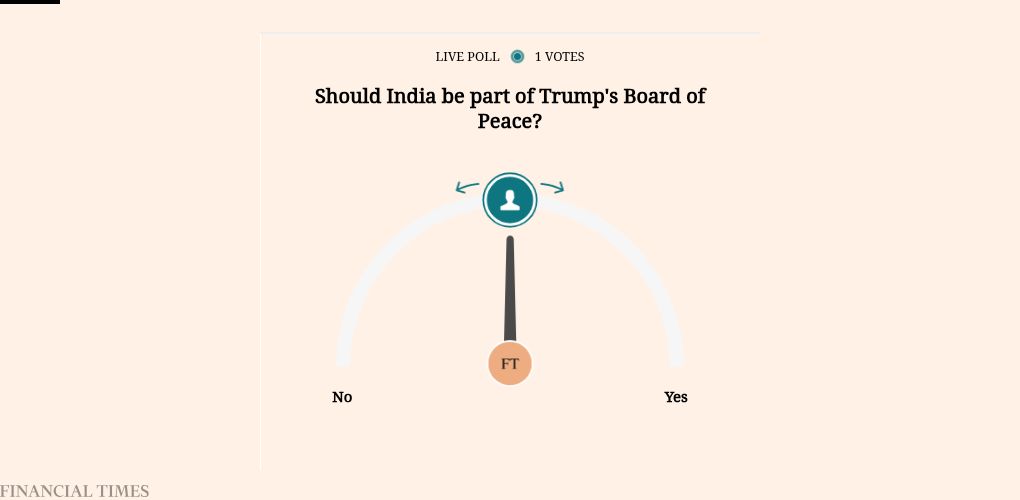
Good morning. India has received an invitation to be part of US President Donald Trump’s “Board of Peace”. I can’t wait to find out if the Modi government will accept it. Do you think India should pay the $1bn to be a part of Trump’s potential UN rival? Take our poll below or write to me at indiabrief@ft.com.
I am away for a couple of weeks, chasing some sun and grand slam tennis in Australia. Look out for crowd favourite Robin Harding in your mailboxes on Friday.
Taxing times
In a landmark judgment, India’s supreme court has ruled that US-based investment firm Tiger Global is liable to pay taxes in India on the sale of its stake in the ecommerce company Flipkart. The ruling has far-reaching implications for how India applies tax treaties to offshore transactions, and increases the uncertainty for global investors over how capital gains from investments in India will be treated.
The case dates back to 2018 when Tiger Global, which had invested in Flipkart through three Mauritius-based entities, sold its entire stake to US retail group Walmart for about $1.6bn. It was hailed then as one of the biggest exits by a foreign investor in an Indian start-up. Tiger Global had argued that capital gains on the transaction should only be taxed in Mauritius and not India, in line with a treaty in place between both countries for decades. While a significant amendment in 2017 to the treaty had made capital gains on transactions in Indian shares taxable in India, it also exempted share purchases that were made before the change came into force. The Delhi High Court agreed with this view at the time.
Last week’s ruling essentially strikes down this interpretation and makes all transactions vulnerable to being taxed in the country. The exact amount Tiger Global will have to pay the tax authorities is unclear, but some estimates suggest that tax plus penalties may be close to $1.5bn.
The wording of Thursday’s judgment has spooked investors, according to the tax experts I spoke to. The court said holding a tax residency certificate was not a “magic wand” that automatically bestowed the benefits of the treaty, and that Indian tax authorities could examine whether the structure of an investment had been created primarily to avoid taxes. In his concurring opinion, one judge wrote: “Taxing an income arising out of its own country is an inherent sovereign right. Any dilution of this is a threat to a nation’s long-term interest.” This signals that the court could take a similar approach if presiding over other investments.
Foreign investors typically use Singapore, Mauritius, the Netherlands or other treaty jurisdictions to structure their investments into India. The supreme court’s order will force a rethink on this. More significantly, it reintroduces the bogeyman of retrospective taxation. The ruling will have a significant impact on foreign direct investments in the country because they have been structured via this route for a few decades now. This forces a rethink on the fundamentals of investing in India and the optimal channels for it.
Do you think this order will have an impact on how foreign investors view India? Hit reply or email us at indiabrief@ft.com
Recommended stories
Tata’s defence division is looking to Africa and Europe for growth.
Can India be luxury’s next big thing?
The threat to the global economy from Trump’s war on the Fed.
The EU is looking to restrict US companies in retaliation over Trump’s Greenland threat.
BlackRock chief Larry Fink tries to revive the scandal-hit Davos.
Drinks makers have been left with a lake of unsold spirits as demand drops.
Port of call

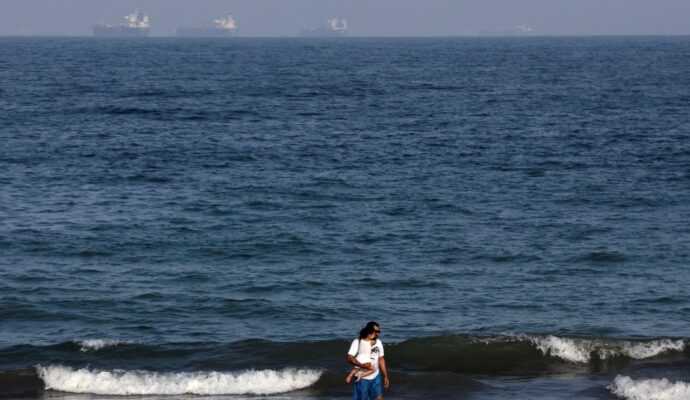
Indian officials on Friday said New Delhi was in talks with Washington and Tehran to continue its operations in the Chabahar port, dismissing speculation that the government is walking away from its investment after Donald Trump imposed tariffs on the Islamic republic’s trading partners. The port in Iran’s south-east is run by India and is of strategic significance, offering connections to Afghanistan and central Asia while avoiding overland access through Pakistan.
This is not the first time India’s investment in Chabahar has come under US scrutiny. During Trump’s first term, his administration had waived sanctions for India as they related to the port. This was withdrawn last September before being reinstated a few weeks later with a conditional extension of the waiver until April 26 this year. Ministry officials on Friday explained that the government was engaged with the US administration in working out the arrangements for these conditions. Foreign minister S Jaishankar is scheduled to meet US secretary of state Marco Rubio next month and the matter of India’s trade with Iran is certain to come up.
New Delhi, which committed a further $370mn for Chabahar port as recently as 2024, will want to hold on to its investment. In the past few days Trump has not mentioned anything about his plans for Tehran, distracted as he is by his ambitions for Greenland. But as we have learned by now, anything is possible. No matter how things change on a day-to-day basis, the Modi government has a lot of thinking to do about how to protect India’s strategic interests in the western part of Asia without upsetting Trump further.
Go figure
China has recorded GDP growth for 2025 in line with Beijing’s official targets, as booming exports offset weaker growth in the domestic economy. The country’s population declined for the fourth year running in 2025, with the lowest number of births on record at 5.63 per 1,000 people.
Here are some key figures.
5%
2025 growth
4.5-5%
2026 target
5.2%
Dec industrial production growth
My mantra
“When you love something immensely and are completely involved in it, it doesn’t feel like work. Indulge yourself fully and enjoy the process, a great outcome is just a byproduct.”
Ashish Khanna, chief executive, Adani Green Energy

Each week we invite a successful business leader to tell us their mantra for work and life. Want to know what your boss is thinking? Nominate them by replying to indiabrief@ft.com
Quick question
Should India be part of Trump’s “Board of Peace”? Tell us here.
Buzzer round
On Friday, we asked: Which company’s original name was Blue Ribbon Sports and was initially started to distribute Onitsuka Tiger shoes in the US?
The answer is Nike.
Nitin Lall was first with the right answer, followed by Vivek Kumar, Anjaneya Das and Aniruddha Dutta. Congratulations!
Thank you for reading. India Business Briefing is edited by Tee Zhuo. Please send feedback, suggestions (and gossip) to indiabrief@ft.com.