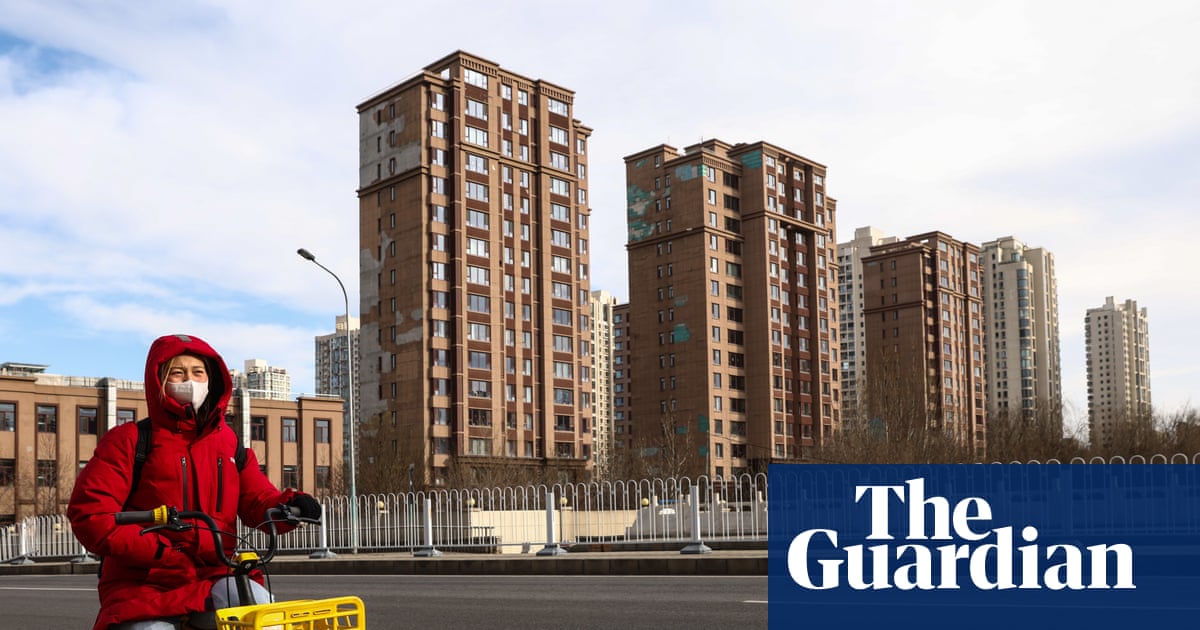
Chinese authorities can say they hit their growth goals last year, but Donald Trump’s ongoing trade aggression, a slow-motion housing market collapse and unhappy consumers remain major challenges for the world’s second-largest economy.
Data released on Monday showed the Chinese economy grew by 5% in 2025, steady on the year before and hitting the official target of “around” that pace.
Experts had expected punitive US tariffs would deliver a major blow to China’s economic performance in 2025. Instead, the country defied expectations by recording its largest-ever trade surplus (US$1.2tn) as it found alternative markets for its products and American tariffs proved less punitive than originally threatened.
The Commonwealth Bank of Australia’s chief economist, Luke Yeaman, said navigating a fraught geopolitical landscape remained a “major wildcard”, but that China’s economy should continue to grow through 2026.
At the same time, Yeaman warned “the structural challenges plaguing China’s domestic economy are not going away”.
Among thoseis a four-year housing market meltdown that has left Chinese homeowners depressed and unwilling to spend.
Home prices have plunged by more than 20% since their peaks in 2021, which in addition to the blow to consumer confidence has also left a looming debt crisis in the property sector that casts a pall over the country’s economic prospects.
While much of the developed world fights to contain inflation, China has battled deflation in recent years, with consumer prices climbing by just 0.8% in 2025.
Yeaman said Japan in the 1990s and early 2000s set a gloomy precedent. “Even without a banking collapse, property busts can suppress growth for years,” he said.
The head of China’s National Bureau of Statistics, Kang Yi, said on Monday that while the world’s second-largest economy “faces problems and challenges”, it would “maintain stable, sound growth momentum this year”.
But the latest figures masked a slowdown in late 2025, with output in the December quarter only 4.5% higher than a year earlier – the weakest since late 2022.
Citi analysts describe a “K-shaped” economy of contrasting fortunes, as retail sales disappointed in December, even as exports and manufacturing climbed again and underpinned overall growth.
Further complicating the picture is that experts have long warned that official statistics are not reliable, with Capital Economics estimating the latest growth numbers could be inflated by as much as 1.5 percentage points.
China’s leaders have vowed to “significantly” lift household consumption as a share of the economy over the coming five years. Household spending accounts for under 40% of annual economic output, unusual for a country of China’s income level and against a global average of 60%.
As part of efforts to boost the economy, last year the Chinese government provided 300bn yuan (US$43bn) in subsidies to households that traded in old appliances for new ones.
While that scheme will be extended into this year, Moody’s Analytics analysts said the start of 2026 “brings a sense of déjà vu to China’s economic debate”.
“Once again, officials are promising stronger support to lift confidence and stabilise growth. And once again, households and businesses are wondering whether action will match the rhetoric.”