Unlock the Editor’s Digest for free
Roula Khalaf, Editor of the FT, selects her favourite stories in this weekly newsletter.
Two of Japan’s largest opposition parties have announced plans to form a new centrist political bloc, raising the risks for Prime Minister Sanae Takaichi as she prepares to call a snap general election for next month.
The parliamentary union between the Constitutional Democratic Party of Japan (CDPJ) and the Komeito party in Japan’s more powerful lower house of parliament presents a more concerted challenge to Takaichi’s long-ruling Liberal Democratic Party.
It also comes as the Japanese political landscape has fractured in recent years, with the emergence of small populist parties that have sapped support from the country’s traditional political groups.
CDPJ and Komeito said they would create a new party to be joined by their members of Japan’s lower House of Representatives. Members of the less powerful upper House of Councillors and local assemblies will for now remain with their original parties.
The plan was announced on Thursday evening, just a day after senior members of Takaichi’s party and the leader of the Japan Innovation Party, the LDP’s junior coalition partner, said the prime minister planned to dissolve the lower house of parliament after it reconvenes on January 23.
This will pave the way for a general election as early as February 8, as Japan’s first female prime minister looks to turn high public approval of her cabinet into a parliamentary majority for the struggling LDP.
Under Takaichi’s predecessor, the LDP suffered two major election setbacks that cost the party its parliamentary majorities.
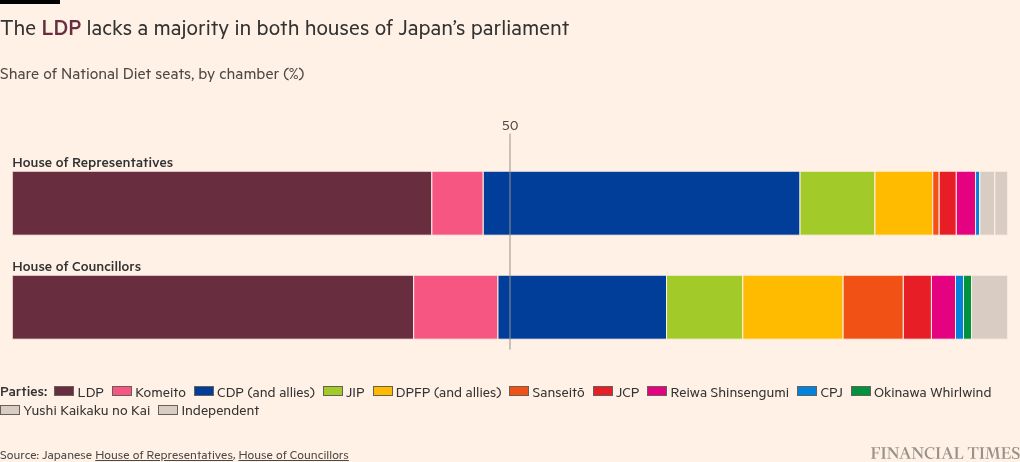
The new opposition front has yet to be formally named but MPs said it would probably be known as the Centre Reform Party.
“An opportunity to put centrists at the centre of Japan’s politics has come,” Yoshihiko Noda, a former prime minister and leader of the CDPJ, told reporters on Thursday.
Komeito’s decision to align itself with Japan’s biggest opposition party was a particularly important symbol of the country’s shifting politics, said political analysts.
For 26 years, the pacifist Komeito was tightly entwined with the LDP, weathering a number of political disagreements and supporting the ruling party’s almost-unbroken grip on power in postwar Japan.
But their alliance disintegrated in October over a political funding scandal that continues to dog the LDP, which in turn has drifted further to the right under the leadership of the conservative Takaichi.
Despite Takaichi’s popularity, a well organised centrist opposition could frustrate her ambitions of an easy victory, analysts said. Previously, the LDP and Komeito had co-operated to back one another’s candidates in closely contested districts.
Neither the LDP, which is still settling into its partnership with the JIP, nor Takaichi, who has been in office for only three months, has had much time to work out how to campaign in those districts without Komeito, said one seasoned LDP election planner.
Mieko Nakabayashi, a political scientist at Waseda University, said that the loss of Komeito’s electoral support could affect the number of seats the LDP is able to win. But she expressed reservations about the prospects of a CDPJ-Komeito alliance, which she said had been “formed out of desperation”.
“The CDPJ is kind of an obsolete, declining force and the Komeito is not going to give the CDP a lot of additional power,” she said. “I don’t think that this marriage is good.”
Data visualisation by Martin Stabe