<div data-o-component="o-expander" class="o-expander o-expander__info-box" data-o-expander-shrink-to="hidden" data-trackable="clip-info-box" data-o-expander-collapsed-toggle-text="” data-o-expander-expanded-toggle-text=”“>
Why Japan has fallen for its new prime minister
In December, with Japan’s new prime minister enjoying high approval ratings, one hotel in her home city of Nara offered guests a Sanae Takaichi-themed lunch featuring the so-called Iron Lady’s favourite mini dumplings and sashimi.
By early January, inundated with bookings for the ¥3,700 ($23)-a-head lunch set, the Nara Royal extended the offer for another two months — a period in which Takaichi is set to call a snap general election early next week, betting that she can convert her popularity into an unlikely revival for the embattled Liberal Democratic Party.
While risky, that gamble may well pay off, political analysts said. The rightwinger, who has pitched herself as an uncompromising conservative in a political system built around consensus, has managed to capture the public imagination.
Despite relations strained by tariffs and geopolitics, she has held successful summits with US President Donald Trump and South Korean President Lee Jae Myung.
In a demonstration of her distinctive approach to the premiership, Takaichi — who as a teenager was a heavy metal drummer — even played a drum duet with Lee after their meeting in Japan this week.
She commands personal popularity ratings that defy early predictions that she would struggle. Opinion polls put Takaichi’s cabinet approval rating as high as 76 per cent. Her popularity among younger women, many of whom were initially sceptical of Japan’s first female prime minister, has nudged into the 80s.

“I haven’t voted for the LDP before, but I would vote for Takaichi in an election because I think she is good for Japan,” said Hana Ozaki, a member of a Tokyo running club for women in their twenties. “She’s different, and I think Japan needed something different.”
Takaichi’s unexpected surge in popularity reflects voters’ desire for a fresh set of ideas about how to deal with Japan’s chronic problems after a succession of uninspiring premiers, political analysts said.
She took office in October, inheriting a scandal-battered LDP clinging to power as it struggled to convey confidence in the economy and prevent a voter exodus to smaller, populist parties.
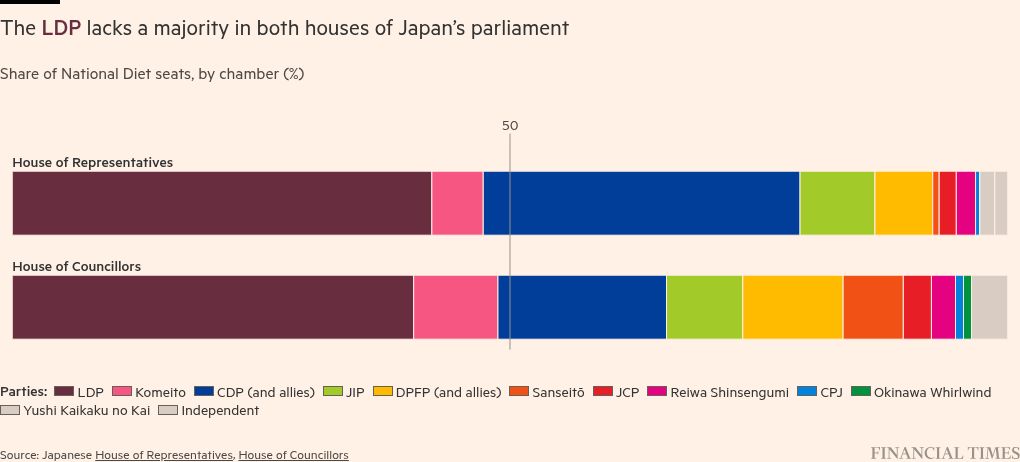
Under her predecessor, Shigeru Ishiba, the LDP suffered two major election setbacks that stripped the party of its parliamentary majorities.
Many analysts questioned how long the former TV news anchor, who, unlike many in the top echelons of the LDP, has no family background in politics, would survive.
She also faced a formidable set of challenges, including dealing with an unpredictable Trump administration, managing a coalition with a slim majority, shielding Japanese households from rising living costs and managing a deepening diplomatic dispute with China.
But in just three months, Takaichi has surprised both the LDP and the country.
“She is not a typical or traditional politician,” said Mieko Nakabayashi, a political scientist at Waseda University. “She isn’t a man. She says things that are quite extraordinary. She doesn’t compromise like traditional politicians.”
Under Takaichi, the LDP’s approval ratings have risen about 10 percentage points to 35 per cent, Nakabayashi noted. As a result, “the old-timers in the LDP cannot openly criticise her, and she doesn’t consult with them”.
“The substance of the LDP may not, under the surface, be changing very much, but Takaichi has changed the way people look [at it from] the outside,” said Nakabayashi. “People, especially younger Japanese, believe that she can change things.”

Takaichi’s decisiveness and strong leadership reminded voters of her mentor, the late Shinzo Abe, who went on to become Japan’s longest-serving prime minister, said Yu Uchiyama, a political scientist at Tokyo University.
Far from denting her popularity, Uchiyama added, the spat with China — sparked by Takaichi’s observation late last year that a Chinese attack on Taiwan could be interpreted as an “existential threat” to Japan, justifying a military response — had gone down well with her domestic audience.
“Conservatives welcome her remarks. Business leaders may be worried about the economic relationship with China, but ordinary voters are not so worried about that,” said Uchiyama. “Her hawkishness reflects the new political atmosphere of Japan.”
While Takaichi was “reprising Abe’s old magic”, Jeff Kingston at Tokyo’s Temple University said she would need to deliver results for voters soon.
“Japan’s economy is not heading for warm waters,” he said. “The alliance with the US is not in a sweet spot in terms of offering reassurance. She is playing a bad hand relatively well.”
For now, though, the formula is working.
In Nara, almost three-quarters of bookings for the Nara Royal lunch set are from women around the same age as the 64-year-old Takaichi — a strong support base.
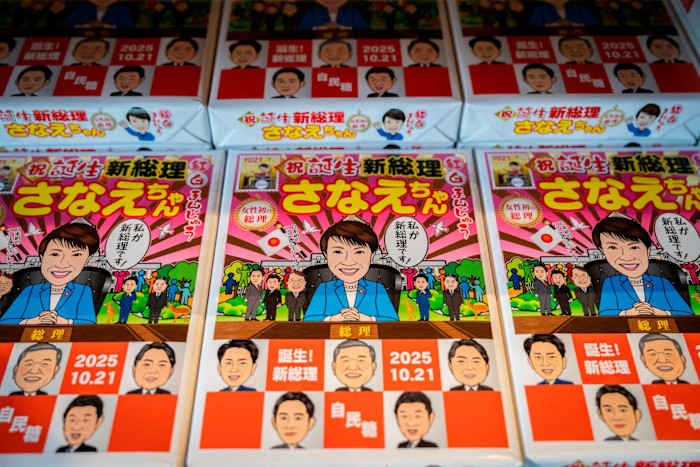
Elsewhere, souvenir shops sell sweets and biscuits bearing cartoon images of the prime minister, either in a traditional kimono or her signature blue suit.
The Mahoroba car museum in Nara, which has restored the Toyota Supra that Takaichi used to drive in the early 1990s, has seen a 10-fold increase in visitors, while sales of the pink Mitsubishi Jetstream 4&1 multi-pen — which she has been spotted using multiple times — have soared.
“We had to extend the offer of the ‘Sana-katsu Lunch’,” said a spokesperson at the Nara Royal. “There were just so many people coming only for that.”