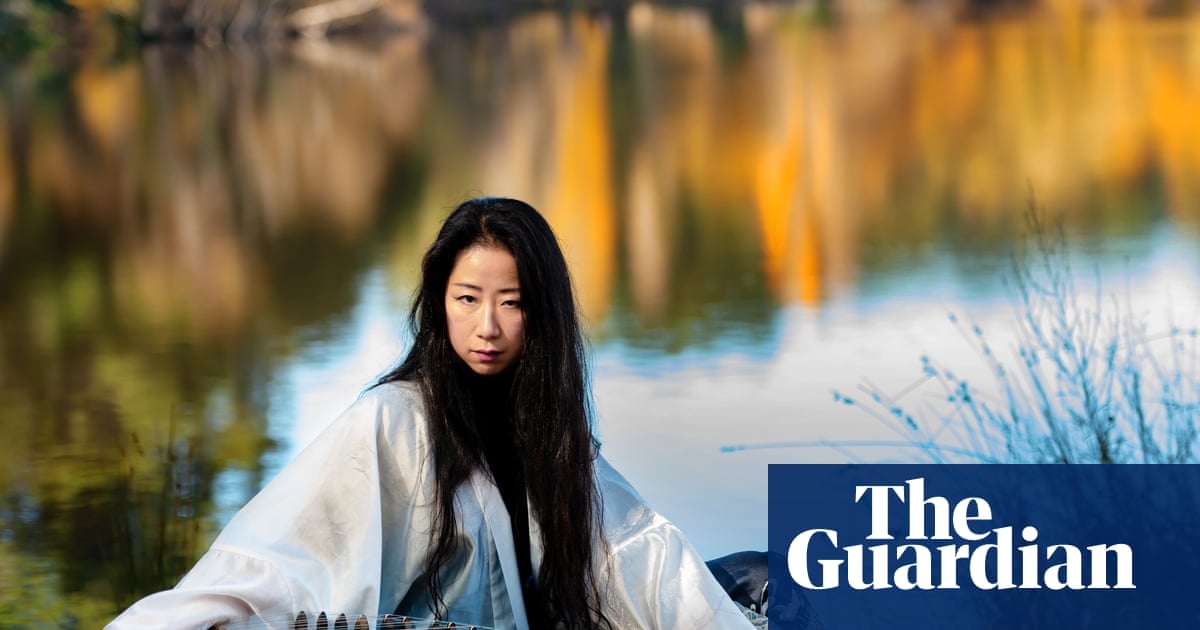
When Mindy Meng Wang’s father died in 2015, the Melbourne-based musician found herself navigating grief while also organising his funeral in her home city in north-western China. It was to be an elaborate, three-day ceremony filled with prescribed rites, including burning paper effigies, ritualised crying and prayer chants.
Looking back, Wang describes the experience as “completely shocking and disorienting”. “There were so many rules for what I had to do over those three days, and so many things that I could not understand,” she says. “People criticised my crying; at a certain point, when certain [guests] came in, I was meant to do a performative cry – really loud and a big gesture – but it was like, ‘I’m actually feeling really sad, I can’t do this!’”
A decade later, the guzheng (Chinese plucked zither) virtuoso and composer is processing the experience on stage in Opera for the Dead 祭歌. Described as a “contemporary Chinese cyber-opera”, and inspired by traditional funerals, it’s opening this week at Sydney festival, followed by an encore season in Melbourne (where it debuted in 2025).
Opera for the Dead 祭歌 is Wang’s most ambitious work by far: the culmination of a remarkable four-decade journey that began with childhood guzheng lessons in China and has led to her playing in the most prestigious venues in the world, alongside acts from Gorillaz to the London Symphony Orchestra.
Blending live music and singing with 3D-mapped projections and vivid animations, the one-hour show invites audience members to walk through an immersive environment with six moving stages, video screens and five performers – including a countertenor, cellist, and Wang playing the guzheng.
The show was co-created by Wang and the composer and sound artist Monica Lim, springing from a conversation between the friends about funeral rituals across the Chinese diaspora. Lim, a Malaysia-born Chinese Australian, had strong memories of her grandfather’s funeral; both women were particularly interested in exploring the contradiction between spirituality and materialism in contemporary ceremonies.
“In the past [at funerals] you would burn the yellow round paper, symbolic of money, because they believe the more you burn, the richer your family member will be in the other world,” Wang says. “Now they burn paper iPhones, Mercedes, servants, American Express.”
Other practices have been changed for contemporary convenience: “Family used to just do the chanting themselves. [At my father’s funeral] I was really shocked when my auntie, who called herself a Buddhist, took a little chanting machine out and switched it on and hooked it on the tent where everything was happening – and then she went out for lunch with her friends,” says Wang. “And everybody’s doing that.”
Wang started learning the guzheng, a stringed instrument with a 2,500-year history, around the age of six while living in Lanzhou, a city in Gansu province. With a top teacher and a strict daily regime – practising as much as eight hours a day, six days a week during school holidays – she emerged as a musical prodigy; by the time she was 16, she’d received offers from China’s top conservatoriums. She was on a clear path to becoming a master and teacher of the instrument.
Then something unusual happened: Wang’s father, a professor, suggested that in lieu of prepping for her final year exams – redundant given she already had offers – she should undertake a UK exchange program run by his university.
At 16, Wang got on a plane for the first time and travelled, alone, to London, where she studied English for six months. At the end, she decided not to go home, and instead enrolled in a musicology degree. It was a life-changing experience.
“It really broadened my knowledge about western music, all genres and repertoires. I saw so many different possibilities, and I think that really changed how I wanted to approach music, performance and creativity,” she says.
“I started to practise in a way that was responding to other people, instead of just doing it by myself.”
She also maintained her classical practice, and was recruited to play in the Silk String Quartet, one of the top traditional Chinese music ensembles in Europe. It was through Silk String that she was invited to perform in Monkey: Journey to the West, a pop opera version of the Chinese tale co-created by Damon Albarn and Jamie Hewlett of Gorillaz with the Chinese theatre luminary Chen Shi-Zheng. For Wang, it was an eye-opening glimpse into what music could do: “It was a traditional story being turned into indie pop … I thought, ‘Oh, I wish I could write something like that’.”
While living in London, Wang fell in love with an Australian, which led her to visit Melbourne for the first time in 2010. The relationship ended, but she had fallen for the city and its music scene, returning for months at a time and forging friendships and collaborative relationships. After her father died, she decided to move to Australia permanently, where she has flourished musically, pushing the boundaries of how the guzheng could be played.
“I always want to do something that hasn’t been done before,” Wang says. “I’m curious about the sound that I can create, the new music that I can play on the instrument.”
While Opera for the Dead 祭歌 is informed by specific cultural references and personal experiences, Wang says the work is designed to be accessible regardless of cultural background.
“Most people will find it quite emotional in parts – and other parts are more light and fun. You don’t need certain knowledge to be able to enjoy the show. In fact, the whole design is so – I hope – each person can have a different experience.”