Stay informed with free updates
Simply sign up to the Japanese business & finance myFT Digest — delivered directly to your inbox.
Japanese shares have logged their highest ever year-end close, driven by technology stocks as investors bet on the artificial intelligence boom and Tokyo’s ability to withstand increased geopolitical turbulence and trade tensions.
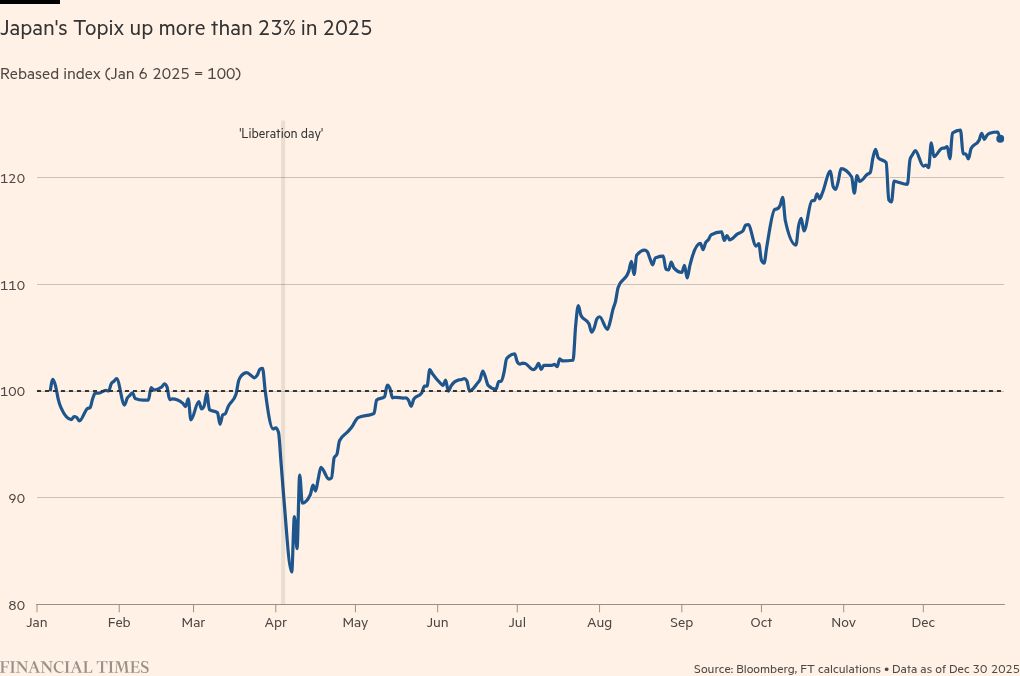
The Topix closed the final session of 2025 at 3,408.97: up 23.7 per cent since the start of January and marking the first time that the broadest index of Japanese stocks has ended a year above 3,000 points.
The Topix’s best performing stock of the year was Kioxia, the memory chipmaker whose fortunes have been spectacularly boosted by AI and the expected demand for data storage. The company’s shares surged 540 per cent in 2025.
The record finish comes less than two weeks after the Bank of Japan raised its policy interest rate to the highest level in 30 years, as inflation accelerates.
Rising inflation lay squarely behind the ousting of former prime minister Shigeru Ishiba and his replacement by Japan’s first female leader Sanae Takaichi in late October. Her plans for massive stimulus spending and high approval ratings have also buoyed markets.
Defence equipment manufacturers have thrived as government spending has risen and regional security concerns have swirled. Major banking groups have also outperformed on expectations of further interest rate increases in 2026.
In the light of a diplomatic spat between Japan and China, shares in Japanese companies with high exposure to Chinese consumers, or manufacturers battling ever more competitive Chinese products, were a drag on the index.
The closing performance of the Topix marks a huge swing from earlier in the year, when Donald Trump’s sudden announcement of “liberation day” tariffs triggered a heavy sell-off of Japan’s exporters. The Topix has rebounded by about 50 per cent since its year low on April 7.
Japan was among the first countries to open formal talks with the US on the threatened 27.5 per cent tariffs, particularly to protect the country’s automotive industry. Under the deal that came into force in September and represented a much better outcome than many investors had feared, the US will apply a baseline tariff of 15 per cent on most Japanese imports.
Takeo Kamai, head of execution services at CLSA Securities in Tokyo, said: “Given the global macro landscape heading into 2025 and all of the drama that happened throughout the year, this year was one which investors’ pivoted from traditional metrics of investing and thrived in a ‘new normal’ environment.”
The weakness of the yen, at roughly the same level against the dollar as it began the year, also helped Japanese exporters.