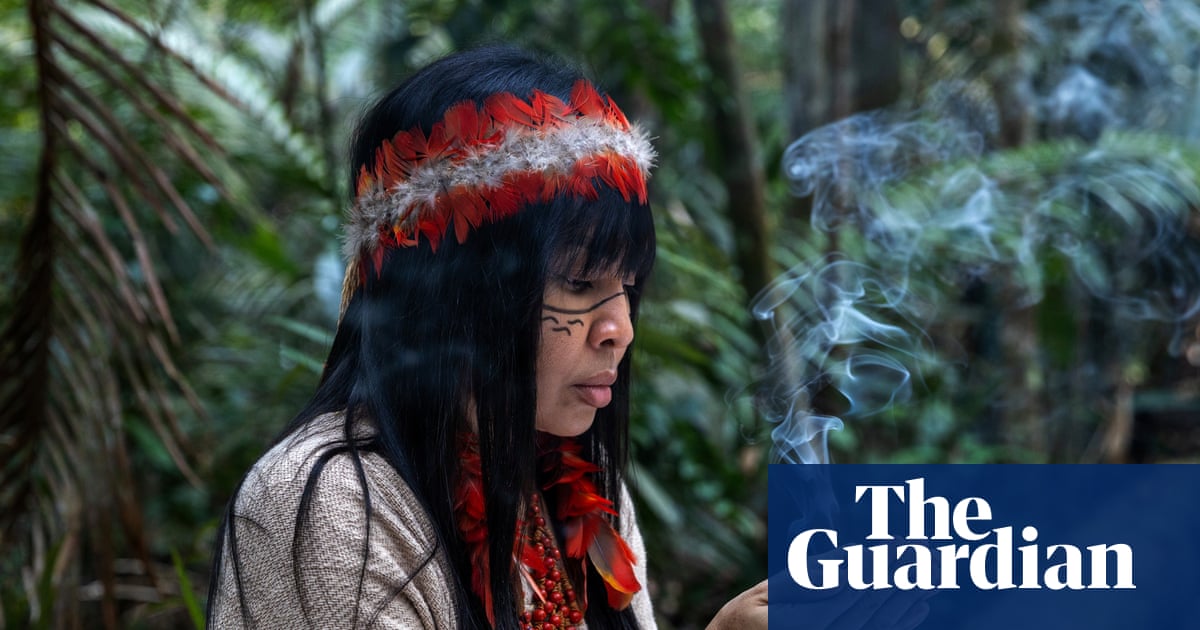
The Indigenous doctor uniting western and traditional medicine in Brazil
In 2012, Adana Omágua Kambeba travelled 4,000km (2,500 miles) from her home in Manaus, in the Brazilian Amazon, to take up a coveted place to study medicine at the Federal University of Minas Gerais in south-east Brazil. She became the first among her people, the Kambeba, or Omágua, to graduate in the field, still largely dominated by white elites. According to the 2022 census, Indigenous people represented 0.1% of those who graduated in medicine in Brazil.
Even before receiving her diploma, Adana started fasting, striving to reach her next goal: to become a shaman. Her calling, she believes, is to bridge gaps between western medicine and the many healing traditions of Indigenous peoples.
This message struck me when I first saw Adana, at a conference for innovation in Rio de Janeiro, in 2024. She stood out among hundreds of panellists and sponsors who were talking about business insights, new tech frontiers and standardised buzzwords. Adana, on stage with long feather earrings and rattles made of seeds, gave a powerful talk about the invisibility of Indigenous knowledge, emphasising that scientific research must not usurp Indigenous expertise.
After Adana returned to Manaus, we had long video calls and exchanged voice messages over several weeks for her profile. I was struck by how she mediates conflicts that arise when doctors don’t respect the healing traditions of Indigenous people, or when Indigenous patients mistrust treatments prescribed by doctors. As an activist, she campaigns for biomedicine to open up to Indigenous knowledge, and not subjugate it.
The path has not been easy. At university, Adana faced prejudice and almost had a breakdown. Then she heard a voice that strengthened her resolve: “Something inside me said, ‘This is your mission. Never doubt it.’”
Júlia Dias Carneiro
The exiled Iranian fighting to save her father from death row
For two years, Zhino Babamiri has lived between two wars: one waged by the Islamic Republic, which sentenced her father, Rezgar Beigzadeh Babamiri to death in Iran, the other within herself. During months of sleepless nights, she weighed up whether speaking about her father might be the very thing that would seal his fate.
For families like Zhino’s, the terror is not in speaking to western media, but in what follows: retaliation. I have interviewed several families in Iran who learned their loved ones were hanged at dawn; no final goodbyes or last embrace. More than 1,400 people have been executed in Iran this year, according to rights groups, crushing dreams and destroying families. The fear is palpable.
Rezgar Beigzadeh Babamiri, a Kurdish political prisoner who was arrested and sentenced to death, with his now-exiled daughter, Zhino
Even during our interview, I sensed the terror in Zhino’s voice, but also the determination to save her father. She made it very clear, that silence hadn’t saved him. Each morning, her heart races as she unlocks her phone, bracing for news she is not ready to receive. And still, she wakes up every day ready to continue the fight – not only for her dad, but for other Iranian fathers on death row.
Alongside children of fathers facing the same fate, Zhino, 24, co-founded the Daughters of Justice to campaign against the record number of executions in Iran. She refuses to stand back, launching online campaigns and meeting European politicians in an attempt to save lives.
Watching her take up this fight in exile, reminds me of the first few days after Mahsa Amini’s death in custody, when I interviewed young Iranian women who marched the streets for freedom.
She has also had to endure the ongoing trauma of reading about torture and the awful conditions her father has had to deal with.
All Zhino wants is her father back home; to sit beside him again and rewatch the US sitcom How I Met Your Mother, like they did when she was younger.
When I asked her what keeps her going, she told me: “My father used to say, ‘Berxwedan jiyan e’ – resistance is life. Now, I am only doing what he taught me: resisting.”
Deepa Parent
The Ugandan politician who stood up to sexism
The world will be watching Uganda next month as the country goes to the polls. Will president Yoweri Museveni lose his grip on power after four decades of rule? One thing is certain: it won’t be a woman who unseats the octogenarian incumbent because all eight candidates on the ballot are men. This is not because women didn’t put themselves forward. It is because politics remains a boys’ club and women are not welcome.
Yvonne Mpambara had first-hand experience of the barriers women face, when she ran as a presidential candidate for the 2026 election. She was one of just three women who gained enough support to be considered for nomination – none made it on to the final ballot.
As a young lawyer from a civil society background Mpambara was well aware that her chances of success were slim but she did not anticipate the level of sexist abuse and objectification that she would face. Men either accused her of sleeping with politicians to get to the top, or propositioned her themselves.
Mpambara, 33, described the experience as “one of the most disrespectful periods of my life”. Depressingly, her article detailing the harassment unleashed more abuse. “The misogyny is coming out in full force,” she messaged me shortly after it was published. Men had commented that she should just “learn to take nice compliments”.
Yet she refuses to let the abuse derail her. She may not have made the ballot this time but she is fighting back in the most effective way – by setting up a foundation that will nurture future female leaders. She is also in the process of establishing an all-female political party.
Mpambara epitomises the notion that gender equality is never a given, it is always fought for. I have no doubt that she is now a role model for many girls and young women who followed her as she offered a new political vision for Uganda, and a future where women are given the same opportunities and respect as men.
Isabel Choat
The Gazan father who risked his life to feed his children
Each day, Raed Jamal would leave his tent on the coast in south-west Gaza and start walking towards the one place he might have a chance of getting food for his family – what he called “the American aid” centres. He would have to queue with others, walk along a specified route and pass through checkpoints, surrounded at all times by Israeli soldiers and US mercenaries. Often, he would post TikToks of this journey – and that’s how I first found him.
I spoke to Jamal soon after he posted a video of himself and friends lying on the ground as bullets whizzed overhead. He told me how he had seen people killed while trying to get aid from the Gaza Humanitarian Foundation – a US-run militarised aid system that, at the time, had replaced UN distributions. Despite the danger and the times he returned with empty bags, he kept going, because food in the markets was too expensive and this was the only way he could feed his family.
“What else can we do? Our life is a struggle,” he told me.
Jamal’s struggle to look after his family has continued since a ceasefire was agreed in October. Aid access is better than before but his concern now is how to protect his family from rains that flood their tattered tent. With little money and unable to return home, he is constantly searching for ways to keep their tent standing and his family warm.
Gaza has fallen out of the headlines but hundreds of thousands of ordinary Palestinians like Raed face a third winter of hunger and homelessness.
Kaamil Ahmed
The Uyghur woman who took on China
Four years ago, Zeynure Hasan was alone with her three young children in Istanbul and facing a seemingly impossible task to reunite her family. Her husband, Idris, was in jail in Morocco at the behest of the Chinese authorities. A victim of their relentless pursuit of Uyghurs – a mostly Muslim ethnic group from the country’s north-western Xinjiang province – who have managed to flee into exile.
Zeynure told me she had lived a quiet family life and “didn’t have Facebook or these kinds of things”. Yet she knew she had to make as public a stand as possible to rescue her husband. “Everyone knows Uyghurs sent to China will be tortured or die. They [the Chinese government] pushed me to speak out.”
At significant risk to her life, she started a personal campaign to raise awareness of Idris’s fate and his imprisonment for helping to promote Uyghur culture and identity. She spoke to journalists, politicians, lawyers and campaigners – all while juggling work as a teacher and a parent.
With Morocco under pressure from China to deport him, rescuing Idris seemed unlikely. Yet her love and support for him, and her belief that she could save him, never wavered as the months and years passed. The family was finally reunited in September this year after being granted asylum in Canada.
Tom Levitt
Alaak ‘Kuku’ Akuei remembers the meaningless street battles, drug use and his mother’s tears when she visited him in jail. “It took me three years to exit the group,” the 25-year-old former gangster recalls, “because to leave a gang, there are conditions, you must pay to be free.”
Now a football coach and head of the Young Dream Football Academy, which he founded in Sherikat, an eastern suburb of Juba, South Sudan’s capital, Akuei believes in the power of sport to counter the dramatic rise of youth violence in his country.
His mission to offer an alternative to gang life is rooted in his own experience, and what it feels like to have “no support” while at the same time wanting to “be someone”. “Youths want to be famous in their neighbourhood, and they need money. Sometimes they just don’t have enough to eat. Gangs can provide all that,” he says, recalling his own motivations to join a crew in 2013, when, aged 13, he arrived in Juba, without his parents, to stay with an uncle.
“My problem is that I didn’t go to school,” he says, apologising that his English is not 100%. “I want to build my career as a leader. Right now, I’m leading a lot of people,” he says. “I started with seven kids and now we’re 1,000. It makes me believe that I can stop this issue of gang groups with football.”
What impressed me about Akuei is not just that he escaped from a destructive path, but that he has become a respected figure in the same neighbourhood where he joined gangs. He can now be proud to offer a safe space and a sense of belonging to children who might otherwise think society has let them down.
Florence Miettaux
The South African outreach worker forced back to sex work by USAID cuts
I met Amanda in downtown Johannesburg on a crisp late-autumn day in May. For seven years she had been an outreach worker at a clinic for sex workers run by the reproductive health and HIV institute at the University of the Witwatersrand (Wits RHI), but had been forced to go back to street sex work at the age of 39 when the clinic closed in the wake of USAID cuts.
Amanda showed me around the sex work “hotspots” of Johannesburg’s rundown central business district – a car park with shacks where women took their clients, a roadside under a bridge where they could be picked up by clients in cars. She knew everyone by name and it was clear they respected her.
Amanda is HIV positive herself and had to get a client to buy her medication. But she carried herself with confidence and continued to communicate with care for others.
With her empathy and savviness, I could tell that Amanda had been an incredible outreach worker. Grassroots community workers are the unsung heroes of healthcare worldwide. It is a shame that it has taken the firing of so many of them for people to recognise their importance.
The Wits RHI clinic is scheduled to reopen once an agreement is signed with the ministry of health. But the services will be more limited as they aim to train ministry workers and transfer patients to the government. Amanda has applied for jobs that have been advertised, but not heard back yet.
Rachel Savage