This article is an on-site version of our FirstFT newsletter. Subscribers can sign up to our Asia, Europe/Africa or Americas edition to get the newsletter delivered every weekday morning. Explore all of our newsletters here
Good morning and welcome back to FirstFT Asia. In today’s newsletter:
Indonesia calls in the military to help clear forests
Inside Tencent’s deal to use advanced Nvidia chips in Japan
Chinese stock rally cools
Indonesia is clearing forests at a rapid pace with military assistance in one of its most biodiverse regions for a state-backed agricultural project, even as recent fatal floods have illustrated the dangers of deforestation.
About the project: Billed as an effort to ensure the country’s food and energy security, Indonesia plans to cultivate rice and sugar on 3mn hectares in the eastern province of Papua. Natural ecosystems in the area — a mix of primary forests, grasslands, woodlands and wetlands — had previously remained largely intact because of its remoteness and the presence of indigenous communities. It will ultimately be five times the size of London and bring irreversible environmental consequences.
The project stands in sharp contrast to the climate pledges that President Prabowo Subianto has made to achieve net zero emissions before 2060, and his public comments in the aftermath of floods in recent weeks that claimed more than 1,000 lives in Sumatra.
The military’s role: A former general is overseeing the project, and five battalions have been placed in Papua to support the government’s food security initiatives in the province. Residents and local activists say soldiers are involved in the clearing of forests and eviction of residents, in addition to providing security.
“The Indonesian National Armed Forces are working in the field with full weapons . . . some are holding long firearms. So, when landowners want to protest, they are afraid,” said Ambrosius Mulait, a researcher from Pusaka, a group advocating for indigenous rights. Here’s the full story — which includes satellite imagery showing the deforestation under way.
And here’s what else we’re keeping tabs on today:
Economic data: Hong Kong and Malaysia publish November inflation data. Taiwan reports monthly jobs figures.
Monetary policy: The People’s Bank of China makes its loan prime rate decision.
Cambodia-Thailand conflict: Asean foreign ministers meet in Malaysia to discuss the fighting in the Thai-Cambodian border region.
Malaysia: A court is expected to decide on jailed former prime minister Najib Razak’s bid to serve the remainder of his six-year sentence under house arrest. Najib was convicted of graft and money laundering linked to the 1MDB fund he established in 2009.
Five more top stories
1. Macro hedge funds are enjoying their best year since at least 2008, as huge swings in the price of currencies, commodities and bonds have provided fertile conditions for traders. Greg Coffey, the Australian hedge fund star once nicknamed the “Wizard of Oz”, has emerged as one of the biggest winners this year.
2. Swedish authorities boarded a sanctioned Russian ship previously used for transporting weapons just off the country’s west coast. Read more about the latest incident between Nato countries and Moscow’s vessels in the Baltic Sea region.
3. Donald Trump’s administration faced new criticism of its handling of documents related to late sex offender Jeffrey Epstein after the justice department removed 16 files, including an image of the president, from a trove of information released on Friday. Here’s what we know about the images deleted on Saturday.
4. JPMorgan Chase was aware for more than a year of “serious material weaknesses in accounting practices” at Tricolor Holdings, the Texas-based subprime auto lender and retailer that collapsed in September, according to a civil lawsuit from its bankruptcy trustee.
5. Collectors are using documents produced by AI to “prove” artworks’ authenticity and ownership when obtaining valuations or making insurance claims. Chatbots are helping fraudsters forge convincing sales invoices and other documents, according to industry figures.
News in-depth

In a data centre outside of Osaka, Japan, Nvidia’s cutting-edge semiconductors are at the disposal of one customer: China’s Tencent. A deal between the Chinese tech giant and Japanese marketing solutions provider Datasection, which sharply switched into running AI data centres last year, allows Tencent to use a legal but geopolitically fraught strategy to access Nvidia’s advanced AI chips.
We’re also reading . . .
India-China naval rivalry: New Delhi is building up its maritime capability as a counter to Beijing’s growing assertiveness in the Indian Ocean.
In praise of male courage: The heroes of Bondi Beach should be celebrated in an era of “toxic masculinity”, writes Jemima Kelly.
Don’t bet against NYC: Despite fears about what a Mamdani mayoralty might mean, big business continues to invest in the city, writes Richard Florida.
Chart of the day
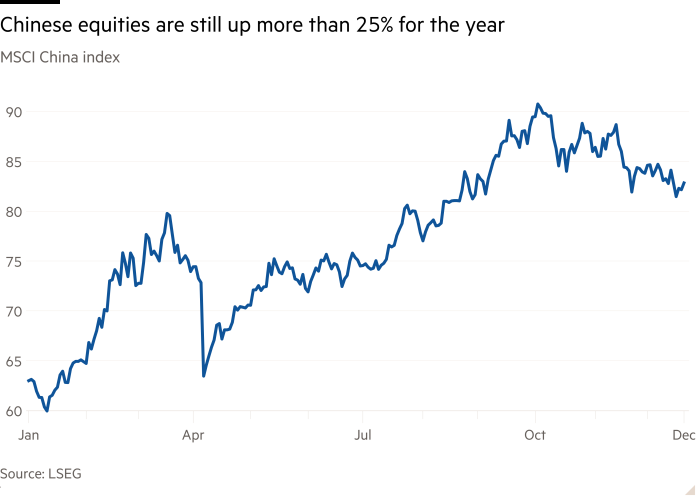
A steep rally in Chinese stock markets has cooled in the past three months, as weak economic data and profit-taking contributed to the worst quarterly performance in an otherwise strong year for the country’s equities. The MSCI China index is still up 28.7 per cent in the year to date.
Take a break from the news . . .
Millions of people have started using AI chatbots for therapy. The FT’s Henry Mance decided to see if it could help with a midlife crisis — for the sake of journalism, of course.