Good morning. This is the last week of parliament’s winter session, another washout in which not much of merit was discussed, unless you count the 12-hour debate on the lyrics of the national song. Do you think our elected representatives are doing the best they can? Tell us in our poll below.
In today’s newsletter, India looks set to open up the nuclear and atomic power sector to private investment. But first, is this a record year for FDI? Buzzer Round enthusiasts, please check out the leaderboard below.
In and out
Is India having a great year for foreign direct investment? The country secured FDI of $50.4bn from April to September, a 16 per cent increase from the same period last year and a record high, minister of state for finance Pankaj Chaudhary told parliament.
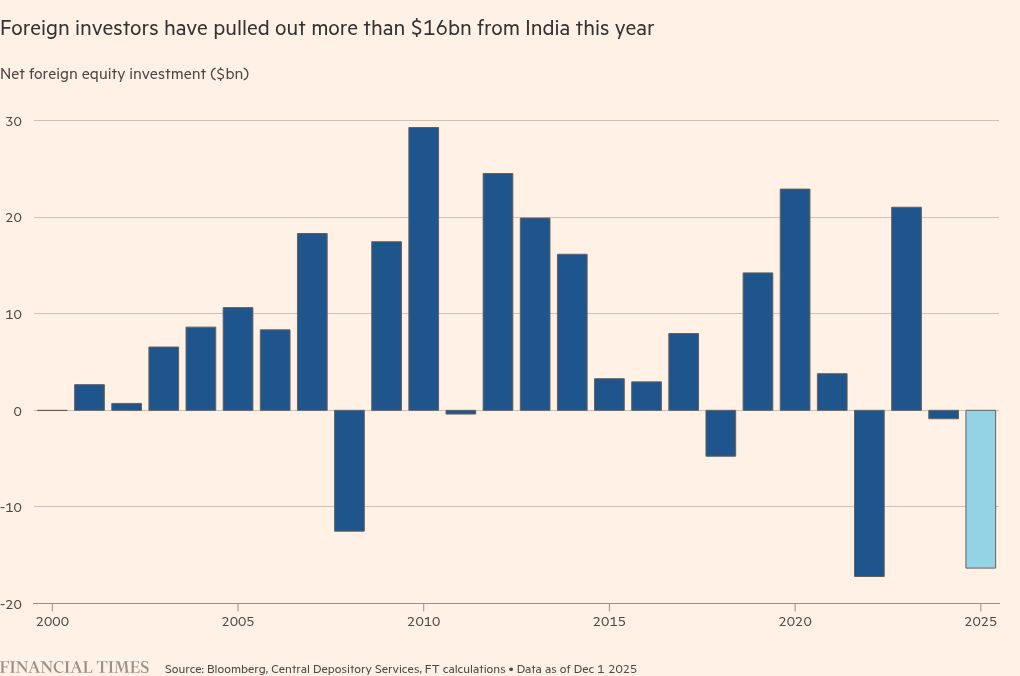
The government has been using the FDI numbers to counter the pressure it is facing over a year of record outflows from foreign portfolio investors. The narrative is that while the money leaving India (FPI) is funds invested for the short term, what is entering the country (FDI) is intended for the long term. But scratch the surface and a different reality emerges. Data from the Reserve Bank of India shows that net FDI inflows for April to September were only $7.7bn, which implies while $50.4bn came in, $42.7bn also went out — a not insignificant sum. Typically, such outflows are in the form of disinvestment by foreign companies in India and repatriation of funds generated here. It also includes investments abroad by Indian companies.
The central bank has indicated it is not too concerned and the outflows are “a sign of a mature market where foreign investors can enter and exit smoothly”. That is all well and good but if the Indian market is a good investment, foreign investors would ideally want to keep their money here even if they have the option to take it out easily.
All of this is made worse by the fact that outflows by foreign portfolio investors have been relentless. The first half of this fiscal year has seen net outflows of $4.1bn, as global investors sold Indian stocks. In the same period last year, FPIs had brought in $20.8bn. The big impact of this is on the rupee, which has fallen to 90.73 against the dollar now, and is the worst-performing Asian currency.
This year, bereft of a trade deal with the US, the government has unleashed several reforms in the domestic market in order to try to put the “ease” in ease of business. We will know in a few months if they will also help keep foreign capital in India.
Do you think India’s FDI outflows are a matter of concern? Let me know what you think. Hit reply or email us at indiabrief@ft.com
Recommended stories
Australia is reviewing firearms laws after gunmen killed 15 people at a celebration of Hanukkah, the Jewish festival of light, at Sydney’s Bondi Beach.
Jensen Huang, who has managed to win over Donald Trump, is the FT’s person of the year.
Hedge funds are piling into commodities in search of fresh sources of returns.
The EU plans to scrap the 2035 combustion engine ban.
The rules of reality-based dressing, according to my colleague Robert Armstrong.
Going nuclear
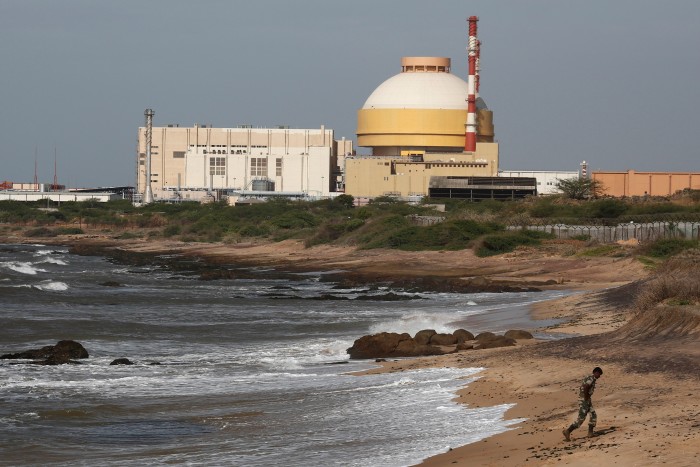
The government looks all set to open the atomic and nuclear power sector to private investment. The bill, which has reportedly been cleared by cabinet, is likely to be introduced in parliament before the current session ends on Friday.
The Sustainable Harnessing of Advancement of Nuclear Energy for Transforming India act, or Shanti (meaning “peace” — the administration just cannot resist the temptation of a catchy acronym, and I can empathise), will usher in significant reforms to the tightly controlled nuclear power sector in India. The broad framework for this was laid down earlier this year during finance minister Nirmala Sitharaman’s budget speech, in which she had detailed the government’s ambition of generating 100GW of nuclear power by 2047 and mentioned amendments to laws for “an active partnership with the private sector”. The government also wants to invest in research and development of small module reactors, with a goal of at least five such reactors developed locally by 2033.
This is an ambitious plan. India’s current nuclear capability is 8.8GW generated from 25 reactors. To expand to 100GW by 2047 would mean adding 4GW every year. Setting up these facilities will be especially challenging considering India’s population density, the general fear of living near nuclear facilities, and public concern about safe disposal of waste. The Kudankulam nuclear plant in Tamil Nadu, for example, took more than 25 years to be operational and has consistently been in the headlines for clashes with the local community.
The 4GW a year addition becomes even more difficult considering the bill is only being introduced now; it will have to go through several steps before it gets passed. And after that would begin the next challenge of finding suitable locations to set up these plants. By then, the target for annual addition would have climbed even higher.
However, there is no dearth of interest from private players, according to industry insiders I spoke to. As a reform, this move signals India’s commitment to renewables, which is especially critical now considering the boom in data centres, which we discussed in this newsletter last week. But if passed, safety and implementation difficulties will be the real challenges.
Go figure
India’s trade gap narrowed last month, despite Trump’s tariffs. Official data shows that exports (including those to the US) have picked up, while imports of gold, silver and coal declined.
$24.5bn
November deficit
$41.7bn
October deficit
10%
MoM rise in exports to the US
My mantra
“I measure productivity on any given day by how happy my clients are with the advice I’m giving. It’s a feeling, not a figure.”
Devarajan Nambakam, co-head, India investment banking, Goldman Sachs

Each week, we invite a successful business leader to tell us their mantra for work and life. Want to know what your boss is thinking? Nominate them by replying to indiabrief@ft.com
Quick question
Do you think India’s elected representatives are doing their best to be productive and effective in parliament? Tell us here.
Buzzer round
On Friday, we asked: Which company’s chief executive declared a “code red” this month because competitors were catching up with its technology?
The answer is Sam Altman’s OpenAI.
Ram Teja was first with the right answer, followed by Aniruddha Dutta, Ranjan Kumar Sinha, PV Kannan, and Mahithi Pillay. Congratulations!
Your view
On Tuesday, I wrote about big US technology companies setting up their data centres in India and wondered whether this was entirely in the country’s best interest. India Brief reader Venkat Madala had this to say:
We are a nation of more than one billion people, and every day we are generating massive amounts of data from mobile phones, banking, government services, online shopping etc. But our level of digitisation is still only around 25-30 per cent. This means we are producing data but we are not fully using it. Most of this data is not being processed, analysed or converted into meaningful insights that can drive decisions. This is where the real opportunity lies.
Edited for length and clarity
Thank you for reading. India Business Briefing is edited by Tee Zhuo. Please send feedback, suggestions (and gossip) to indiabrief@ft.com.