Jimmy Lai, the Hong Kong pro-democracy media tycoon, is facing life in prison after being found guilty of national security and sedition offences, in one of the most closely watched rulings since the city’s return to Chinese rule in 1997.
The 78-year-old has been in jail since late 2020 on remand and serving several protest-related sentences totalling almost 10 years. Monday’s conviction, in which judges called him a “mastermind” of conspiracies designed to destabilise the Chinese government, could see him given an extra life sentence.
Lai had been charged with one count of conspiracy to publish seditious publications and two counts of conspiracy to foreign collusion, under the city’s punitive national security law (NSL), introduced in 2020, and a British colonial-era sedition law that has seen renewed use in recent years by authorities.
“There is no doubt in our mind that the first defendant never wavered in his intention to destabilise the governance of the CCP [Chinese Communist party], and despite the enactment of the national security law, he was intent on continuing, though in a less explicit way,” high court judge Esther Toh told the court on Monday, reading out a written judgment.
The next court date is 12 January, and Lai has an opportunity to appeal.
Rights groups were quick to condemn the verdict, with the Committee to Protect Journalists calling it a “sham conviction” and “a disgraceful act of persecution”.
”The ruling underscores Hong Kong’s utter contempt for press freedom, which is supposed to be protected under the city’s mini-constitution, the Basic Law,” said Asia-Pacific director of committee, Beh Lih Yi.
“Jimmy Lai’s only crime is running a newspaper and defending democracy. The risk of him dying from ill health in prison increases as each day passes — he must be reunited with his family immediately.”
Amnesty International’s China director, Sarah Brooks, said the verdict’s predictability didn’t make it “any less dismaying”, while Elaine Pearson, Asia director at Human Rights Watch, called the conviction cruel and a travesty of justice.
“The Chinese government’s mistreatment of Jimmy Lai aims to silence everyone who dares to criticise the Communist Party,” Pearson said.
Prosecutors accused Lai of using his media outlet, Apple Daily, and foreign political connections to lobby for governments to impose sanctions and other punitive measures on Chinese and Hong Kong authorities. They argued he showed “unwavering intent”, and that the alleged collaborations were “long term and consistent”, beyond the introduction of the NSL.
Three Apply Daily entities – Apple Daily Limited, Apple Daily Printing Limited, and AD Internet Limited – which were co-accused with Lai, were also found guilty of the two foreign collusion charges.
Judge Toh, referring to Lai, said on Monday: “We are satisfied the first defendant was the mastermind of the conspiracies charge in counts one, two and three.”
“We are also satisfied … that he made use of the various platforms of Apple Daily with the full agreement and knowing assistance of the corporate defendants which made them parties to those conspiracies.”
Lai had pleaded not guilty to all charges, telling the court he “hoped against hope” that the US president, Donald Trump, would stop Beijing imposing its national security law on the city, but that he never tried to influence foreign policy or ask foreign officials to take concrete action on Hong Kong.
A frequent criticism of the Hong Kong authorities’ national security prosecutions – including Lai’s – is that they at times appear to apply it retrospectively, even though it is not supposed to be applied that way. However, messages and meetings from before the law was imposed formed a major part of the prosecution against Lai.
In its judgment the court said it was “very clear” to them that Lai “had harboured his hatred and resentment for the [People’s Republic of China] for many of his adult years”, and had been thinking about how the US could apply leverage towards China from long before the national security law was introduced.
“The only reasonable inference we can draw from the preponderance of the evidence, is that the first defendant’s intention – pre or post NSL – was to seek the downfall of the CCP, even though the ultimate cost was the sacrifice of the people of the PRC [People’s Republic of China] and HKSAR [Hong Kong Special Administrative Region].”
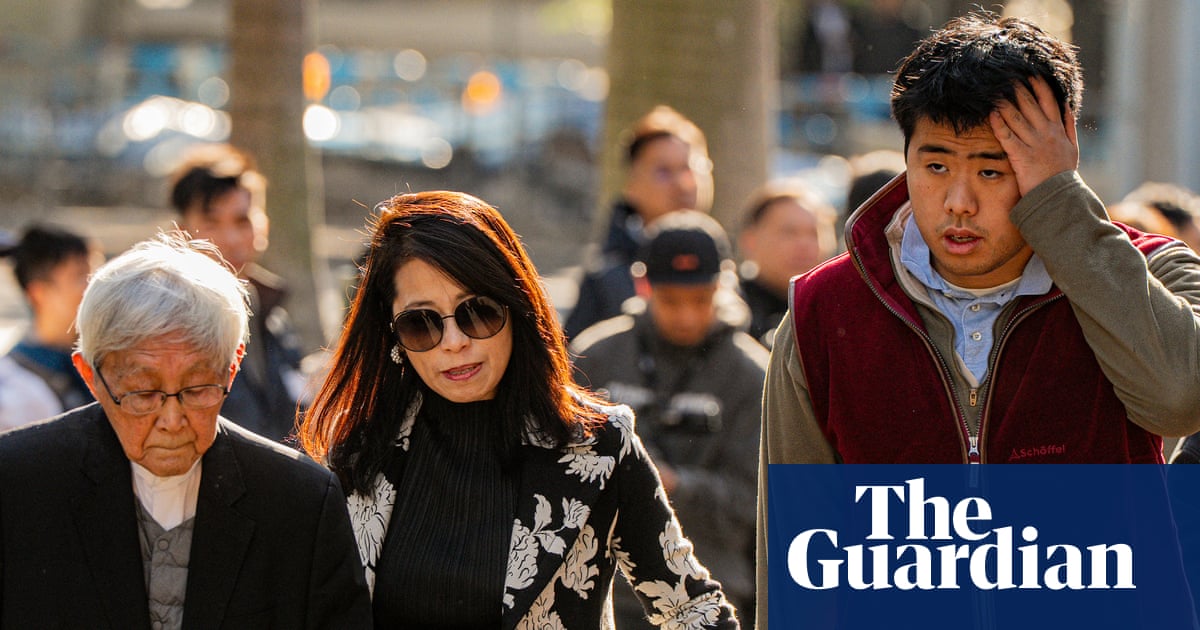
On Monday, there was a large police presence – uniformed and in plain clothes – outside the West Kowloon district court, as well as a large media gathering. The queue for the public appeared smaller than on previous key moments, such as the day Lai gave testimony, and big days for other cases like that of the Hong Kong 47, which drew hundreds of people.
Two supporters in the queue held bright red apples, to represent the now-shuttered Apple Daily newspaper which Lai founded.
Lai’s national security trial had lasted more than two years. During that time the Hong Kong government had laws rewritten to limit bail rights and restrict foreign lawyers from defending Lai.
Final arguments were delivered in August.
Lai’s family have repeatedly raised concerns about his ailing health, as he languished in solitary confinement, allegedly subjected to “petty” efforts designed to demoralise him. Hong Kong authorities repeatedly rejected the accusations.
Supporters and observers had queued outside the West Kowloon district court on Monday, some arriving the previous night to gain entry to the court complex. Passersby noted widespread allegations that some people were often paid by pro-Beijing groups to reserve seats that might otherwise be taken by supporters and international observers. None of those in the queue would speak to the Guardian.
Simon, an older Hong Kong man, said he wanted to support Lai and his wife, Teresa, by being here.
He and a friend were holding bright red apples, to represent the now-shuttered Apple Daily newspaper which Lai founded and which stands as his co-accused.
Lai’s conviction comes just weeks before an expected visit to Beijing by UK prime minister Keir Starmer. Lai is a British citizen, and the UK government has called his trial a politically motivated prosecution.
Sentencing will be delivered at a later date.