Unlock the Editor’s Digest for free
Roula Khalaf, Editor of the FT, selects her favourite stories in this weekly newsletter.
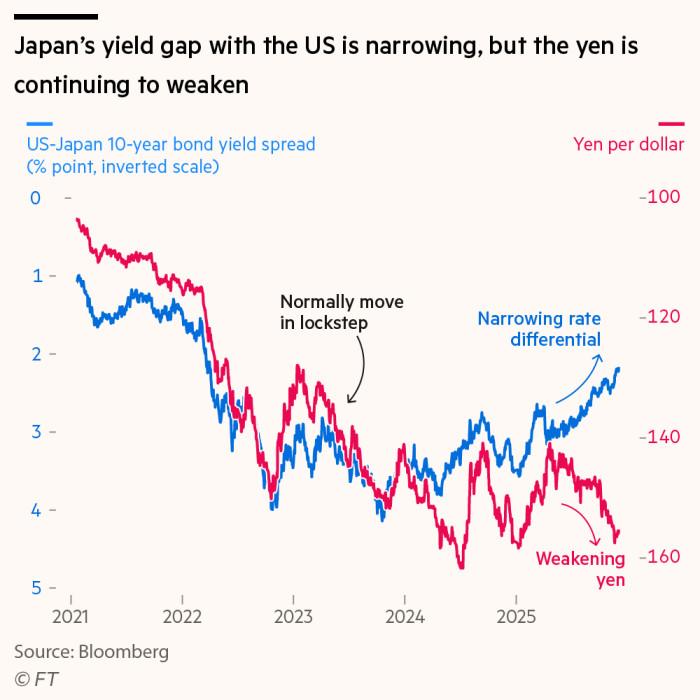
Good morning. As a rule, movements in the yen/dollar exchange rate track changes in the interest rate gap between Japan and the US. This follows economic logic: a widening rate differential attracts capital to the higher-rate country, driving up the value of its currency. So, for example, the yen weakened against the dollar throughout 2022 as the US Federal Reserve aggressively raised its policy rates, while the Bank of Japan held tight close to zero.
Strikingly, though, the standard pattern has flipped into reverse since April.
The Fed has begun easing rates, while the BoJ is at last allowing rates to rise. The yield on the 10-year Japanese sovereign bond is nearing 2 per cent and recently hit its highest point since 2007, while the 10-year US Treasury has hovered just above 4 per cent for months. Yet instead of appreciating, the yen continues to weaken against the dollar. It appears the higher yields are not enticing Japanese investors to sell their overseas holdings and bring the money back home. In real trade-weighted terms, the yen is at its lowest level since the 1970s, according to Jonas Goltermann at Capital Economics.
What gives? Elias Haddad of Brown Brothers Harriman argues the BoJ’s cautious normalisation approach, which repeatedly delayed rate increases, has been a drag on the yen this year. “Concerns over fiscal profligacy and debt sustainability is another factor in the recent yen weakness, which has also lifted long-term JGB yields to record highs,” he notes.
The yen could return to the old patterns next year. The BoJ is expected to raise rates this month and a cut is likely at the Fed’s December meeting. “The data argues for increased interest rates. Economic activity is relatively firm, and looser fiscal policy leaves room for the BoJ to resume normalisation. This combo is bullish for the yen,” Haddad adds.
Still, the path ahead will be challenging for Japan’s central bank, which has to also weigh the rising burden from interest payments as the yield curve steepens. Let us know your thoughts: unhedged@ft.com.
Good reads from Unhedged:
Hakyung: A shortage of love
Katie: Judge not, lest you be judged
Rob: The central bank black hole
FT Unhedged podcast
Can’t get enough of Unhedged? Listen to our new podcast, for a 15-minute dive into the latest markets news and financial headlines, twice a week. Catch up on past editions of the newsletter here.