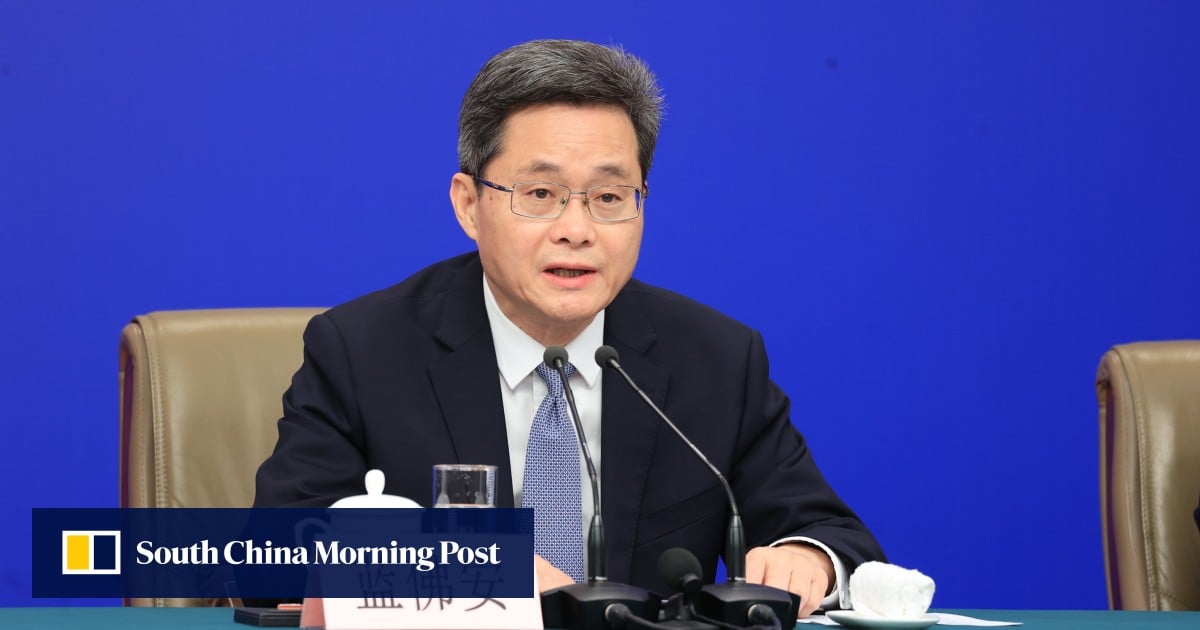
Lan’s remarks came ahead of the central economic work conference, the annual meeting held in December where the Chinese leadership reviews that year’s performance. While Beijing typically does not set specific fiscal targets at the gathering – leaving those for the annual legislative meetings in March – it usually signals the direction of future policy.
Advertisement
In March this year, China set its deficit ratio at about 4 per cent, up 1 percentage point from the previous year, with the amount reaching 5.66 trillion yuan (US$800.5 billion). It also unveiled 4.4 trillion yuan in local government special-purpose bonds.
On Tuesday, Huatai Securities said it expects the fiscal deficit ratio to remain at 4 per cent in 2026, with more than 5 trillion yuan in local government special-purpose bonds and up to 2 trillion yuan in special treasury bonds. The firm also projected a 5 per cent overall growth target for next year.
Advertisement
In the editorial, the finance minister called the ban on new hidden debt a “hard rule” and said Beijing would push to build a unified regulatory framework for local borrowing while cracking down on illegal financing and fake “debt-swap” manoeuvres that hide underlying risks.
“We will strictly ban the creation of new local financing platforms or the distortion of existing ones,” he wrote, adding that preventing and resolving local government debt risks would remain a top priority next year.