Unlock the Editor’s Digest for free
Roula Khalaf, Editor of the FT, selects her favourite stories in this weekly newsletter.
India’s Supreme Court has called on New Delhi to clarify how it measures air quality in one of the world’s most polluted cities, as critics claim authorities spray water near monitoring stations and cap measurements to influence the readings.
From late October New Delhi is blanketed in a toxic haze for several months, with fireworks from Diwali, the festival of lights, mixing with smoke from farm fires, fumes from cars, industrial emissions, construction sites and power plants to muddy the air.
In its latest request for evidence in a four-decade long case on the impact of pollution brought by activists who say it is harming their health, the Supreme Court asked the city government to clarify what devices it used to measure the air and how they worked.
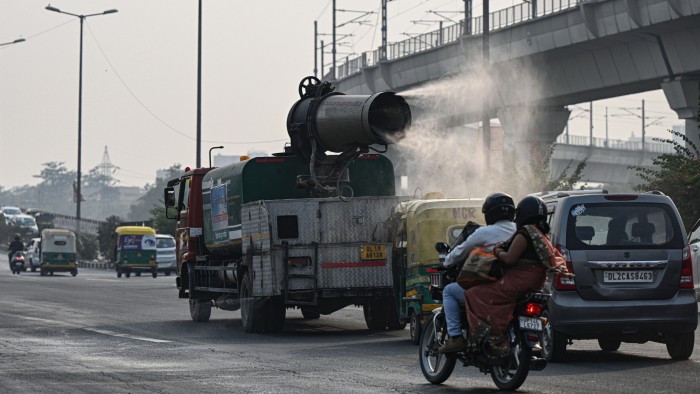
It also referred to the recent government practice of spraying water near pollution monitoring stations, which many residents believe is designed to influence pollution readings. India’s chief justice Bhushan Ramkrishna Gavai said that the city’s air quality has continued to worsen and that “a long-term solution needs to be worked out”.
India’s solicitor-general Aishwarya Bhati told Supreme Court judges that the monitors used in Delhi are some “of the best in the world” and that water was sprinkled across the city as part of an action plan to fight pollution.
The long-running case reflects mounting anger over pollution levels and whether they are being measured correctly.
New Delhi’s air quality index, which measures levels of deadly pollutants such as very small particles, routinely soars above 400 in November, a level considered “hazardous” for the capital’s 30mn people.
But different organisations offer different measures.
While India’s Central Pollution Control Board says Delhi’s 24-hour average AQI since Diwali has been 400 at worst, Swiss group IQAir — whose app is also used by many city residents — often records higher readings.
On October 21, for example, the day after Diwali, the CPCB recorded an AQI of 351 while IQAir registered 723.
Confusing matters further, the CPCB caps its readings at 500 — something questioned by residents.
“Every country has their own air quality index, and their own standards,” said Gufran Beig, a meteorologist with the National Institute of Advanced Studies, who founded Safar, the government’s air monitoring system.
At 500 “you have reached the peak threshold of deteriorating health symptoms due to air quality. Beyond that, if the value increases, then it is not going to make much of a difference” however “it will only create anxiety to the people by seeing the numbers in thousands and others, so that is why they cap it at 500,” Begin said, though he acknowledged that the system needs to be overhauled.
An analysis by the Centre for Research on Energy and Clean Air of data released last month by the Institute for Health Metrics and Evaluation said “ambient particulate matter pollution remains the single largest risk factor for deaths in Delhi” accounting for nearly 15 per cent of all deaths in 2023.
India’s CPCB and Delhi Pollution Control Committee did not reply to requests for comment.
But officials at DPCC told reporters in early November that the capital’s AQI readings had improved this year, adding that there is “a misconception that if we sprinkle water near monitoring stations pollution levels will come down — that’s not true”.
Many activists remain angry at the perceived manipulation, though. The government “is not even doing it on the sly, they are doing it brazenly,” said Vimlendu Jha, a Delhi-based environmentalist.
“All attempts right now are to minimise the problem, to fudge the data, to normalise an AQI of whatever number. Every attempt right now is to mislead, misrepresent and minimise,” said Jai Dhar Gupta, leader of the activist group My Right to Breathe, who earlier this week was detained by the police during protests.
He added: “We’re going to be dead anyway. Might as well go out protesting. You can’t breathe in this city.”