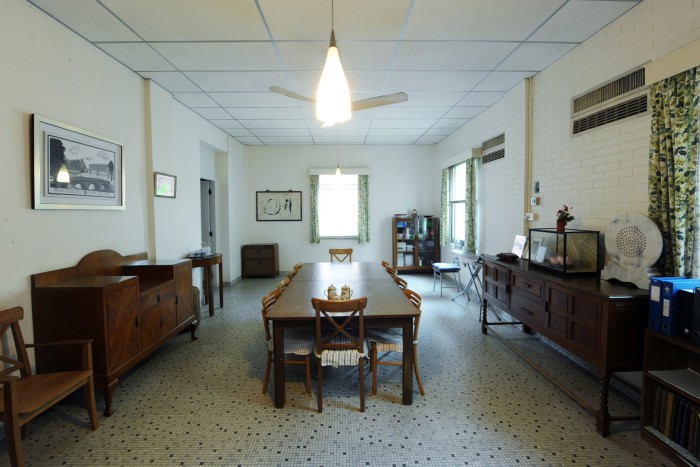
A mouldy basement in a colonial-era bungalow was the setting for a pivotal moment in the formation of modern Singapore and the emergence of one of the world’s richest nations.
“The room was in a hot, uncomfortable part of the house facing the setting sun, and even with three wide-open doors and a powerful ceiling fan whirring it could become extremely muggy,” Lee Kuan Yew, the city-state’s founding leader, recalled in his 1998 autobiography.
“But if the atmosphere was soporific, we were not.”
The meetings in the 1950s hold legendary status in Singapore and have made the fate of 38 Oxley Road — now semi-derelict — one of the country’s most hotly disputed subjects.
This month, the government announced its intention to turn the property into a national monument — in contravention of Lee’s calls for his former home to be demolished and in defiance of public opinion.
The debate over the future of the property is about more than whether Lee’s wishes are respected, according to experts. It symbolises how Singaporeans view the city-state’s transition from a developing country to one of the world’s richest and whether it continues to cling to its founder’s legacy.
Singaporeans had until this week to voice their objections with the National Heritage Board, which is now set to make a final decision on whether to preserve the property.
“We will keep all options open and strive for a solution that will unite us as a country, rather than allow this to become a point of contention or division in our society,” acting culture minister David Neo said in response to questions in parliament.
Unlike his fellow postcolonial leaders, Lee opposed self-aggrandisement. When asked about memorials in his honour, he often referred to Percy Bysshe Shelley’s “Ozymandias”, saying his legacy should be a successful state rather than monuments.
Though Lee maintained until his death in 2015 that the house be razed, in 2011 he wrote that, “if 38 Oxley Road is to be preserved”, it should be “let out for people to live in. An empty building will soon decline and decay.”
The government has argued that the house was the first headquarters of Lee’s People’s Action party, which has ruled Singapore continuously for more than six decades and has long regarded the bungalow as its spiritual home.
“Mr Lee Kuan Yew has such a cult of personality around him that when people think of Singapore they think of him,” said Joel Skadiang, manager at Black Dot Research. “The Lee family is so powerful in Singapore that everyone has an opinion about it.”
A poll by Black Dot last year found that more than 60 per cent of respondents said the government should not be involved in deciding the fate of the house, while a similar majority said it should be razed. Just 13 per cent were against demolition.
Skadiang said he believed the issue was a lightning rod for government critics to highlight other grievances such as immigration, job insecurity and the high cost of living.
“Criticisms over 38 Oxley Road is something that a lot of people latch on to when they have a wider set of complaints about the government,” he said.
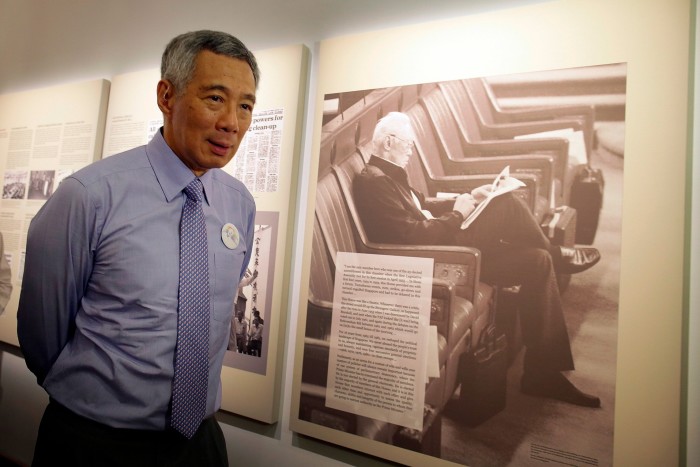
The debate has also pitted Lee’s two surviving children in a bitter dispute that has resulted in the younger son, Lee Hsien Yang, being granted political asylum in the UK. He had been in self-imposed exile in London since 2022 following a criminal investigation by the Singaporean authorities.
Lee Hsien Loong, the eldest sibling who was Singapore’s prime minister from 2004 to 2024, has backed preserving the home, though has recused himself from parliamentary debates on the matter.
Lee Kuan Yew’s only daughter, Lee Wei Ling, had continued to live in the house until her death last year.
Lee Hsien Yang, who is the registered owner of the property, has argued that his father’s wishes should be respected and has applied for it to be demolished.
“There has been an attempt to peddle a narrative that my father changed his mind, which is rubbish,” Lee Hsien Yang told the Financial Times. “Nobody buys that.”
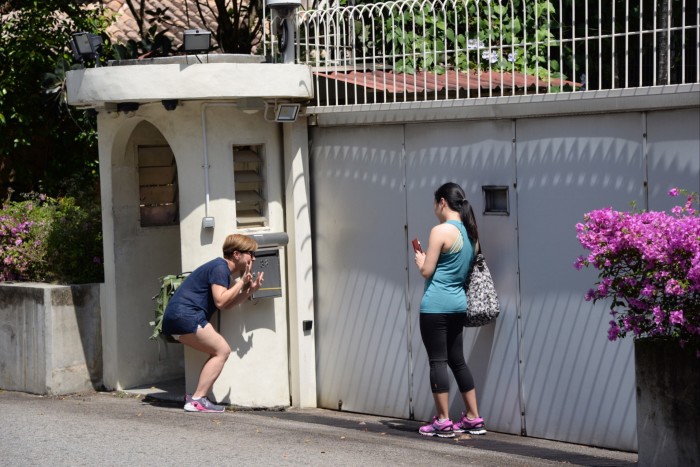
The single-storey bungalow was built in an Anglo-Indian style on the site of a former nutmeg plantation in 1898, in an area popular with middle-class Europeans.
It shares architectural features more common among the homes of wealthy expatriates nearby, including lofty ceilings to allow air circulation, a tiled roof reflecting Chinese influence and broad verandas. It served as a venue for furniture auctions in its early years before being abandoned when Japan invaded in 1942.
In 1945, Lee rented the property for 80 Straits dollars a month before buying it for 35,000 Malaya and British Borneo dollars after Singapore gained independence in 1965, according to documents reviewed by the FT. He added a high metal fence and guard posts for security.
Neo said this month that the government would respect the wishes of Lee and his wife to protect the family’s privacy by removing traces of their living space from the inside of the property. He said only the basement, where political discussions in the run-up to independence took place, would be preserved.
But Lee Hsien Yang noted the basement had been renovated in the 1970s, decades after its moment of historical significance.
“The house is nothing like it was in the 1950s — are they really going to reinstate it to what it looked like then?” he said.
On a recent visit to 38 Oxley Road — which sits behind a row of crimson bougainvillea, a short walk from a glitzy shopping district and the presidential palace — a neighbour who requested anonymity said that, while he respected Lee’s wishes, he believed the property should be open to the public.
“If you ignore for a minute how important LKY was and view him as an ordinary citizen, it is only natural that the government has the final say over such matters,” he said. “This is Singapore, after all.”