Unlock the Editor’s Digest for free
Roula Khalaf, Editor of the FT, selects her favourite stories in this weekly newsletter.
The writer is chair of Rockefeller International. His latest book is ‘What Went Wrong With Capitalism’
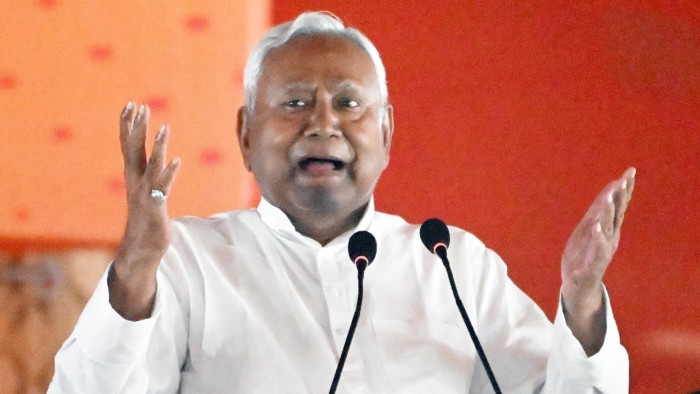
In his latest campaign the once earthy and easily accessible chief minister of Bihar morphed into the Joe Biden of India, rolled out for speeches but otherwise cloistered behind aides alarmed by his gaffes, blank stares and memory lapses. Only Nitish Kumar, 74, won, despite more obvious infirmities than Biden.
After covering Indian national and state elections every year for the last 30, this was my sixth trip to Bihar, where abject poverty scars the lush, marshy landscape. I was expecting Kumar’s health and stalled progress to be major issues. Instead, I found deeply traditional Kumar backers still grateful for all their long-standing chief minister has done for them. They consider it rude to discuss his health, much less vote him out. The opposition treads lightly. And the national press largely joined this conspiracy of respectful silence.
Before Kumar took power two decades ago, this landlocked state of 135mn people was known as “the place civilisation forgot”, a dark and lawless “Jungle Raj”. In his first five-year term Kumar imposed a semblance of order, built roads and bridges. In his second he brought electricity to the countryside.
But in his last two terms, Kumar failed to take the next step and create jobs. Around the city of Purnia, the top “industry” is processing fox nuts — by hand, cracking them with mallets, and roasting over open fires. Two out of three Bihari families have at least one member who has left the state to find work.
After we saw touts paying children to wade neck-deep into a garbage-filled pond, groping around for mud fish as their mothers looked on, one of my travel companions went home. If Bihar were a country it would be the world’s 12th poorest, behind Liberia.
That Kumar won anyway says much about the clash of hope and resignation in India. The gap between average incomes in the poorest and richest states — Bihar and Telangana — is six to one. The comparable gap is roughly four to one or less in Brazil, China, the US and other major nations.
During Kumar’s first decade, Bihar’s average income started to catch up to the rest of India, but has fallen back since. Kumar responded by making the most statist of Indian states more so. Total government spending is 34 per cent of state GDP, nearly double the average. Half goes to social spending, and Kumar won in good part by promising more, with new spending amounting to another 3 per cent of state GDP.
Across India, this is the norm. Candidates vie to see who can offer the most generous freebies, but Bihar can least afford it. Facing one of the highest deficits in any state, it can’t fund new outlays without cuts elsewhere, including roads and factories. The problem: prioritising relief today retards development tomorrow.
In one way, modernity has deepened this “welfare trap”. India has digitised delivery of government services, cutting out the intermediaries who used to steal the bulk of transfer payments. But politicians now use this network to speedily deliver cash to voters, a practice widely seen as virtual vote buying.
Just before polls opened, Kumar’s government started sending a payment of 10,000 rupees to one woman from every family in Bihar. That’s around $110, but huge against Bihar’s average annual income of 70,000 rupees. Offered as “seed money” for small businesses but with no oversight, women told us they plan to spend it on immediate needs such as goats or gifts for festivals.
Along with his main ally, the Bharatiya Janata party of Prime Minister Narendra Modi, Kumar crafted this offer to women as a way to break traditional voter loyalties, based on religion or caste.
Modi is also in his mid-seventies but still his energetic, acerbic self. We saw him speak in the town of Nawada, where he reminded Bihar that the same Yadav clan which presided over the Jungle Raj runs the main opposition party, the Rashtriya Janata Dal. Struggling to widen its base, the RJD made offers too big for voters to believe, including one government job for every family.
Kumar’s win reflects a global trend. As developed democracies turn hostile to incumbents, their developing peers are turning the other way. In India, seated leaders were losing 70 per cent of state elections before the 2000s. They’ve come back since, winning more than half of these contests this decade. Respect for elders, an almost spiritual acceptance of slow progress and increasing incumbent control over the machinery of state all help explain how a Joe Biden figure could win in India.