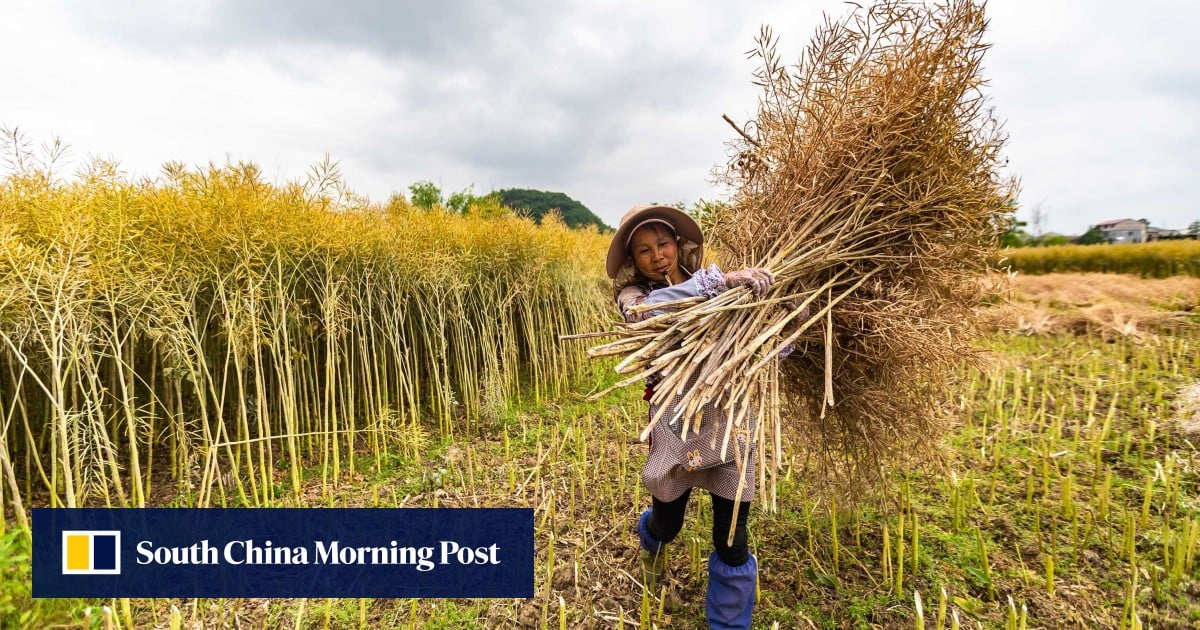
Rapeseed is China’s foremost oil producing crop that has an outstanding salt-tolerant ability.
The move is the latest evidence of Beijing’s self-sufficiency drive, which is believed to profoundly influence the world’s major farm produce exporting nations.
China imported 1.06 million tonnes of rapeseed oil last year, a fall of 50.7 per cent from a year earlier, government data showed. Russia accounted for around half of the total imports, followed by one fifth from Canada.
Xi, who has long called for the rice bowl to be firmly held in the hands of Chinese people, visited saline land in the northern province of Hebei in mid-May, calling for better use of such land to enhance the country’s food security.
China’s northeast, northwest and coastal regions, the upper-middle stream of the Yellow River and the North China Plain are the five saline areas that match the climate condition to grow rapeseed.
In an academic journal published in November on MDPI, Li Qing – an associate professor in management at Dalian Polytechnic University – said “rapeseed has a long history of planting in China” and its oil is one of the world’s three most prominent edible oils that plays “a significant role” in the Chinese edible oil market.
“Improving the efficiency of rapeseed planting and the rapeseed industry will help ensure the overall safety of the Chinese edible oil supply structure and maintain the crucial strategic significance of the self-sufficiency of rapeseed oil,” she added.
James Keeley, an honorary associate at the University of Sussex’s Institute of Development Studies, said that China has invested substantial resources in developing saline and alkaline tolerant crops “for many years”, and therefore “breakthroughs like this in field research” are expected.
China is dependent on overseas markets for key crops used in the production of edible oils (notably soybeans)
“China is dependent on overseas markets for key crops used in the production of edible oils (notably soybeans). However, there are many steps between field research and widespread uptake across a number of provinces,” he explained.
“The price would also need to be competitive with imported soybean oil, and there is also consumer preference to consider.”
Chinese scientists said last year that they had created a salt-tolerant soybean species that could reduce the country’s dependence on imports from the likes of Brazil, where soy production is driving deforestation.
Highlighting it is unclear whether the current progress made on rapeseed can be replicated in other crops, Keeley said that it is possible to identify genes and mechanisms through long-term crossbreeding that can regulate salinity and alkalinity tolerance.