The Chinese foreign ministry gave no indication whether Qin directly talked about the hi-tech export bans. The Japanese statement also made no mention of the semiconductor issue.
Still, the phone conversation marked a further step up in Beijing’s counter-attack as Washington tries to forge a united front with allies – particularly advanced chip tool makers Tokyo and Amsterdam – to remove China from the international technology supply chain.
On Monday, Qin spoke with his Dutch counterpart, Wopke Hoekstra, and said the Netherlands should “jointly safeguard the stability of the global supply chain [and] promote an open and orderly international trade environment instead of a divided and chaotic one”.
Last week, Tokyo and Amsterdam cut a deal with US President Joe Biden’s administration to tighten export controls to limit Beijing’s access to machines used to make advanced chips, according to Bloomberg, which cited people familiar with the negotiations.
In October, the Biden administration made sweeping updates to its export controls to inhibit Beijing’s ability to acquire high-end US chip technology and equipment, and blocked US citizens from working for certain firms.
It has been argued that Washington’s success depends on a unified stance from its key allies. The Netherlands is the home of ASML, which has a global monopoly on the world’s most advanced lithography systems, while Japanese firms Nikon and Tokyo Electron also make similar but less advanced equipment.
Japanese Foreign Minister Yoshimasa Hayashi speaking in Tokyo on January 23. Photo: Kyodo
Without naming the US, the Chinese foreign ministry said on Tuesday that a “certain country has been pursuing its selfish agenda at the expense of countries that it calls allies and friends”.
“It has deliberately blocked and suppressed Chinese companies and forcibly pushed for industrial relocation and decoupling,” ministry spokeswoman Mao Ning said at a press conference.
During their conversation on Thursday, Qin urged Japanese authorities to play cautiously on major issues like Taiwan and in the military field, and to stop the provocations of Japanese right-wing forces over the disputed Diaoyu Islands in the East China Sea, which Tokyo claims as the Senkaku Islands.
He also called on Japan to adhere to the principle of “being mutual partners and not posing threats to each other”.
Hayashi stressed Japan’s concerns over “the importance of peace and stability in the Taiwan Strait”, the situation of the East China Sea and China’s increased military activities, including cooperation with Russia around Japan, according to the Japanese foreign ministry.
He also raised Japan’s concerns about the South China Sea, Hong Kong and Xinjiang, and urged Beijing to lift import restrictions on Japanese food products imposed after the 2011 Fukushima nuclear crisis and ensure a “transparent, predictable and fair” business environment for Japanese firms.
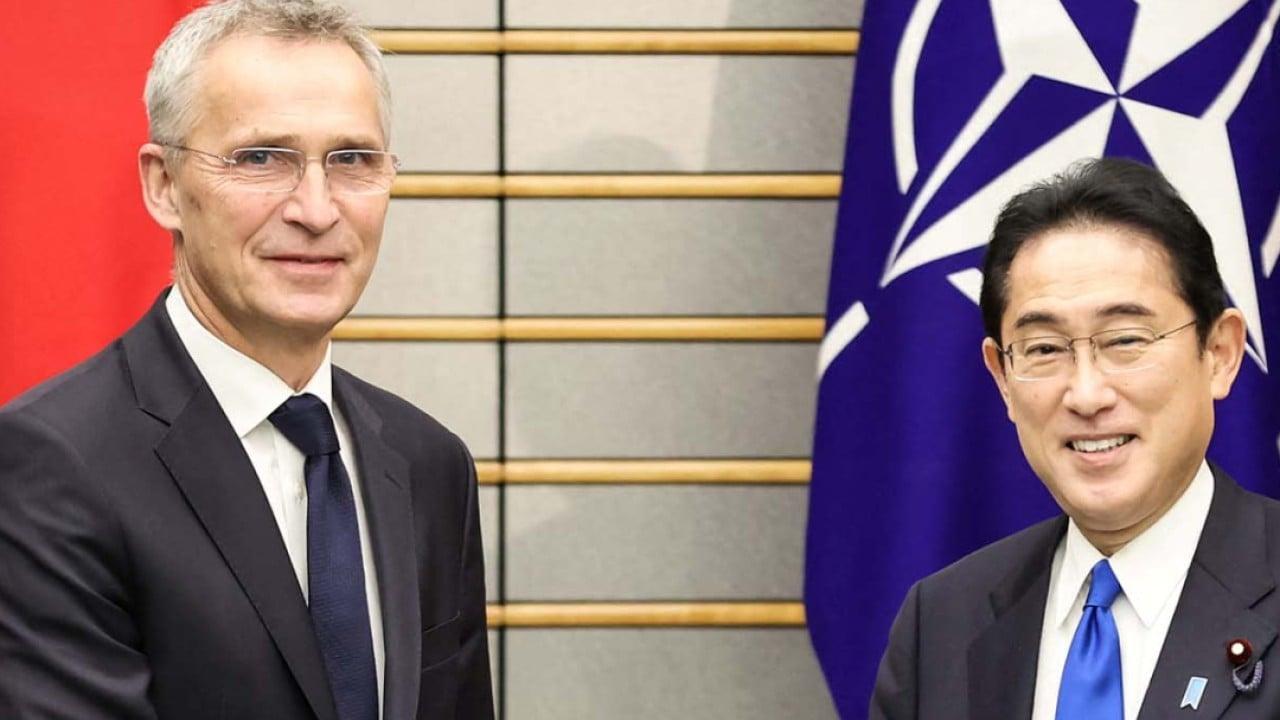
The exchange came after Tokyo and Nato earlier this week pledged to strengthen their cooperation, citing “an authoritarian pushback against the international rules-based order” from Beijing and Moscow.
Nato chief Jens Stoltenberg said on Wednesday in Japan that it was important for the military alliance to enhance deterrence towards China’s “unwelcoming certain military activities … particularly in Taiwan”.
Japanese Prime Minister Fumio Kishida and US President Joe Biden held talks at the White House on January 13. Photo: Kyodo
Japan and the US pledged to strengthen their security ties during Japanese Prime Minister Fumio Kishida’s visit to the White House last month.
In its revised national security strategy documents in December, Japan’s cabinet upgraded China to “an unprecedented and the greatest strategic challenge” and blamed Beijing for “intensifying its military activities in the sea and airspace surrounding Taiwan”.
Qin and Hayashi also talked about the war in Ukraine and said they would continue close coordination on North Korea, according to the Japanese statement.