“Unlike the rigid robotic arms commonly used on space stations, this one is designed more like an elephant’s trunk or an octopus tentacle. It can bend smoothly along its length, making it more flexible and better able to adapt as it approaches a target.”
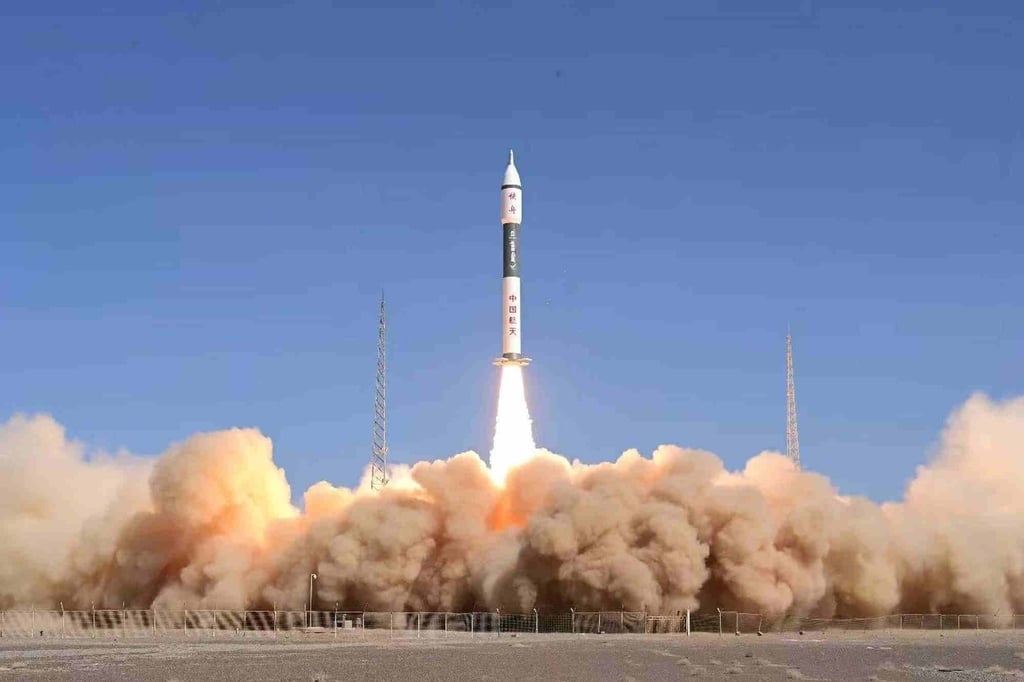
The satellite, jointly developed by Hunan University of Science and Technology and Suzhou Sanyuan Aerospace Technology, will run a series of simulated refuelling tests, validating the full process from approach and identification to docking and mock transfer.
Advertisement
According to the report, Hukeda-2 will also test a potential solution for Earth’s increasingly crowded orbits, with a device on board that can inflate into an ultralight sphere with a diameter of about 2.5 metres (8 feet).
By dramatically increasing atmospheric drag, researchers hope satellites that otherwise would take decades to fall back and burn up will be able to re-enter the Earth’s atmosphere within a year, it said.
Advertisement
With growing numbers of megaconstellations, like SpaceX’s Starlink, such technologies are set to play a key role in extending satellite lifespans, managing orbital space more efficiently and lowering the cost of operating in space, the report noted.
According to Cheng Lei, head of research and development at Sanyuan Aerospace, in-orbit refuelling technology “could transform the space economy”.