The artist Shahzia Sikander is behind the wheel of a slush-splattered SUV on a bitter-cold afternoon, driving along winding roads towards the property she is renting in upstate New York. The Hudson Valley has become an increasingly popular rural base for artists in recent years, but finding this particular home and studio felt a bit like fate for the Pakistani-American.
The two structures, she explains en route, were built by Marcel Breuer for the mid-century abstract painter Sidney Wolfson, who convinced the Bauhaus-trained architect to incorporate a silver-hued trailer into the house’s cantilevered design. That charming eccentricity would excite virtually any contemporary artist, but the provenance has even deeper resonance for Sikander, whose meticulously executed paintings blend ancient Asian techniques with contemporary themes of gender, geopolitics and social justice — and references ranging from the Muslim veil to cowboy boots.

Breuer was born to a Jewish family in Pécs, Hungary, and grew up not far from the 16th-century Mosque of Pasha Qasim, a domed landmark that was converted to a Catholic church after the Ottomans were driven out of the ancient city. It’s the type of cultural mélange that Sikander sees reflected in Breuer’s light-filled, geometric designs — and in her own life story. Born in Lahore, Pakistan, in 1969, and raised Muslim, she attended a Catholic school there, moved to the US in the early 1990s and has continued to criss-cross the globe for months or years at a time — from Japan to Laos to Italy — in the interest of deepening her multidisciplinary practice, which spans painting, drawing, mosaic, glass, video and sculpture.
“For me, it’s very much been multiple places and multiple geographies, multiple histories, all the time,” says Sikander, pulling into her snowy driveway.
Her fascination with the connections between seemingly disparate locales and histories is also at the heart of her latest piece, “3 to 12 Nautical Miles”, the title of which references the shifting boundary between a nation’s coastline and international waters. An animation of hand-painted images, the work will be shown in a loop on the facade of the Hong Kong museum M+ nightly from March 23. It’s the fifth annual joint commission between M+ and Art Basel Hong Kong, which opens a few days later.
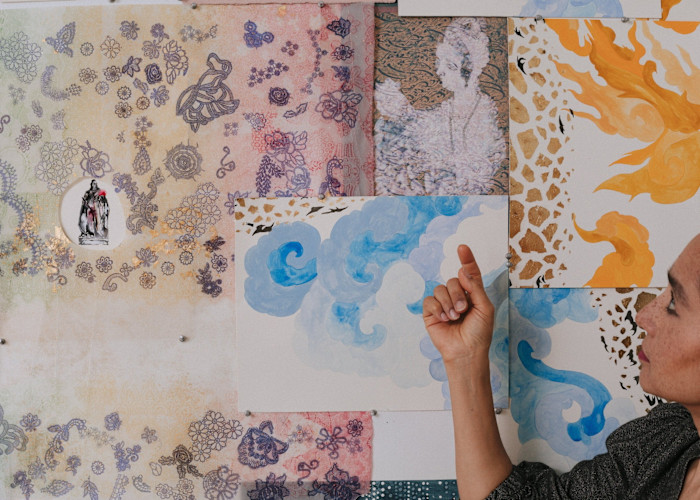
Inside the studio, which features a soaring ceiling and views of the wooded property, she opens the file on her laptop. Sikander takes the history of Hong Kong and the surrounding region as her subject, delving into the redistribution of power brought on by the deterioration of both the Qing dynasty and the Mughal empire and the related fortunes of the East India Company and the British empire.
“Political decline in one region enables exploitation by another,” she says. “It’s not separate historical developments; they are interconnected. As the Mughal power is eroding, the East India Company fills that vacuum, and it gains territorial control in India, and then it turns regions into sites of large-scale opium cultivation. Everything is being mobilised and weaponised to support the British global trade.”
The nine-minute video is a kaleidoscope of vibrantly hued, intricately detailed images in Sikander’s signature style, which honours and subverts the traditional south and central Asian tradition of miniature painting. The piece opens with a glowing sun-like disc, known as a shamsa in Islamic art. “It’s the idea of light that passes through, which I love, this symbol of illumination,” she says.
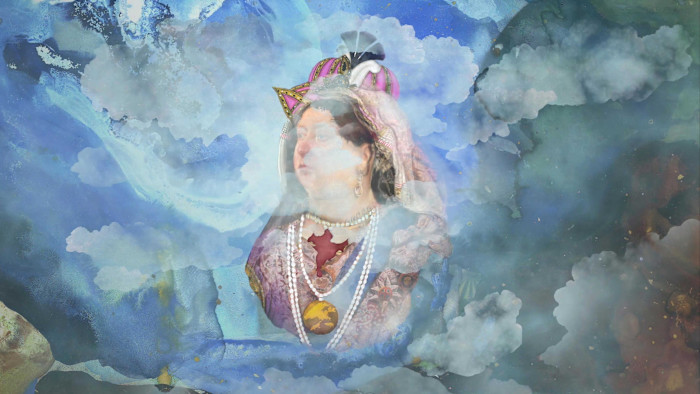
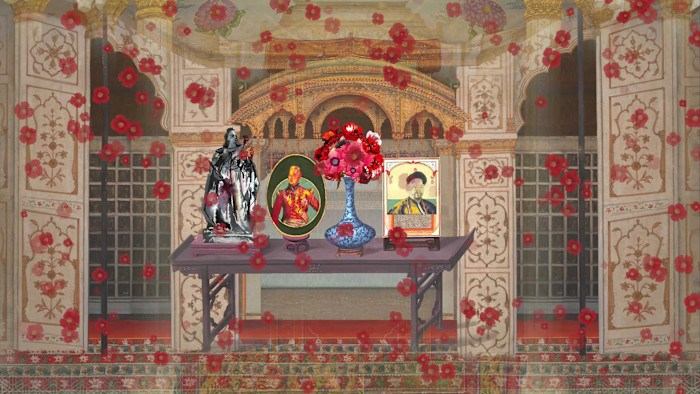
Images then dissolve, form, evolve and migrate around the screen: a forest; an entwined lion and dragon, evoking the East India Company and the Qing dynasty, respectively; sampan boats; Queen Victoria wearing a medallion of Hong Kong and a map of India on her chest.
Bright red poppies swirl across the screen. “The poppy carries more of the violent entanglement of pleasure, addiction and empire,” Sikander says, adding that the flower, which produced opium in India that the British then foisted on the Chinese, presented the opportunity to “collapse beauty and devastation into a single image”.
Despite the scale of the M+ screen — the museum’s facade is covered in thousands of LEDs — Sikander began “3 to 12 Nautical Miles”, as she does all her animations, by hand-painting scores of small works on paper in ink, gouache and watercolour. Next came digital scans and a storyboard. Her digital collaborator of more than 20 years, Patrick O’Rourke, then handled the technical side of choreographing movement.
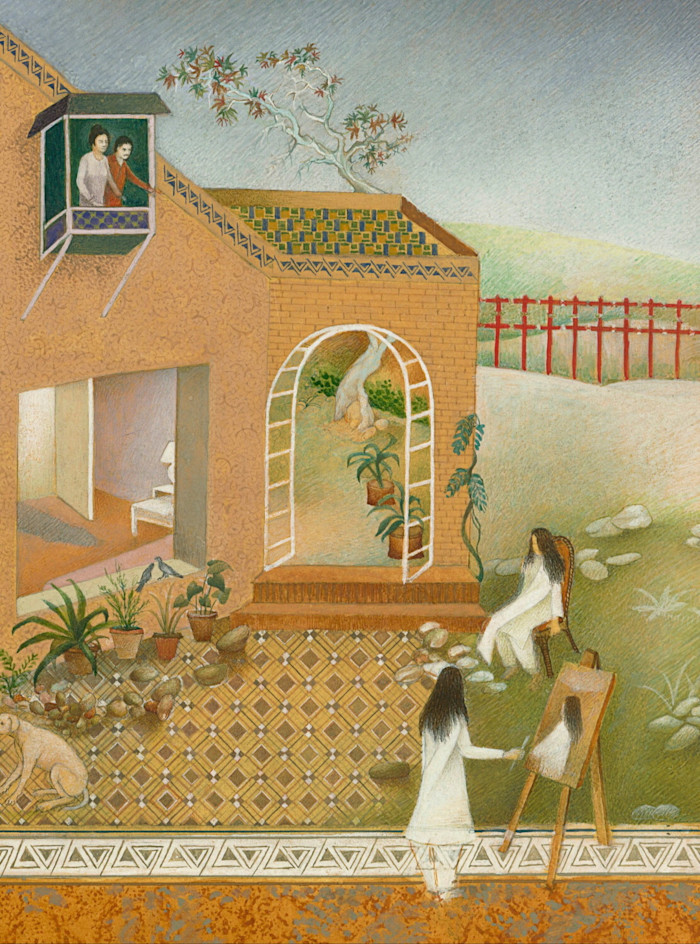
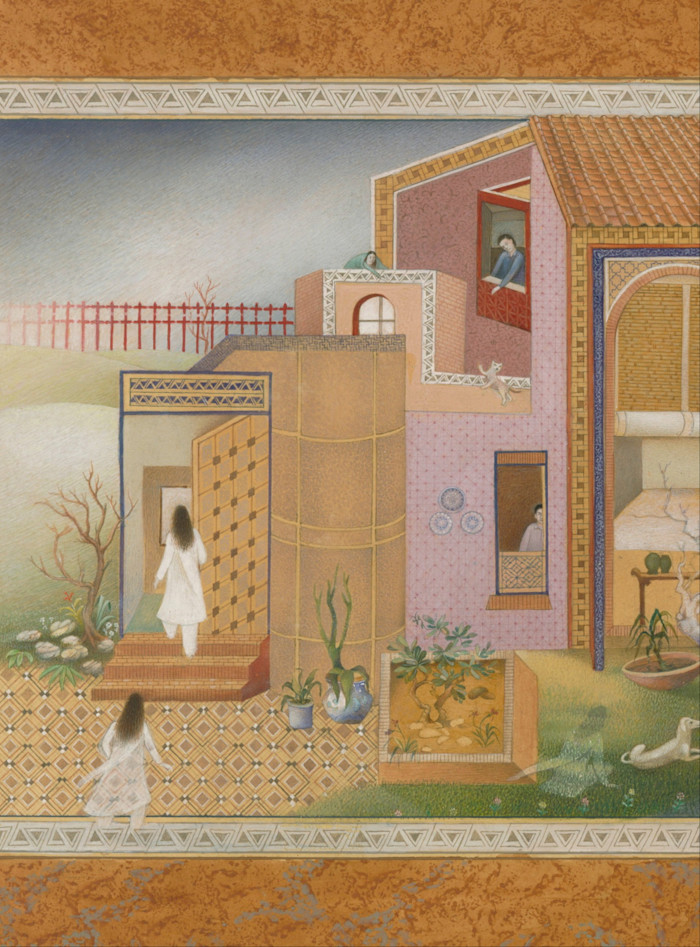
When Sikander first became interested in miniature painting — as a student at the National College of Arts in Lahore in the late 1980s — it was so out of fashion as to be considered kitsch. “I wanted to understand its complex history in the European scholarship, because a lot of white men had written books on miniature painting,” she says.
What she discovered was that the colonial-era dismantling and exporting of the original manuscripts had diminished opportunities for Asians to view their own cultural heritage. Important works were more likely to be in London or New York than Lahore or Mumbai. The Metropolitan Museum of Art, for instance, holds 78 (of 258) illustrations from the Shahnameh of Shah Tahmasp, a lavish and revered 16th-century Iranian manuscript. “The more I dug, the more I became interested in the histories of provenance and dismemberment,” she says.
Sikander is now widely credited with modernising the genre of miniature painting. But, as can happen, she also feels her inventiveness has at times become lost in translation. “In the US, I had the burden of being the draughtsman and not the thinker,” she says, lamenting that, in the eyes of those unfamiliar with the history of miniature painting, the craftsmanship can overshadow her conceptual rigour.
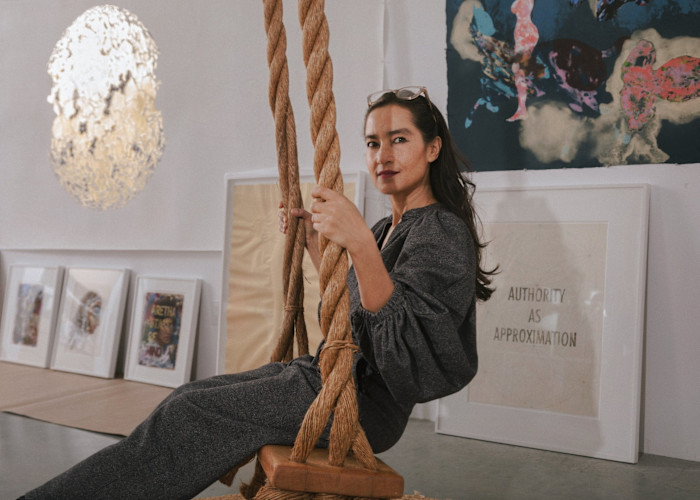
She first came to the US in 1992 for an exhibition at the Pakistani embassy in Washington, DC. Her work had met with great fanfare back home, but she didn’t sell a single work from the show. Still, she took the opportunity to tour art schools and ended up enrolling at the Rhode Island School of Design for her MFA.
The Drawing Center in New York put her in a show, and she was included in the prestigious Whitney Biennial, which ran concurrently in 1997. Her early recognition also included a MacArthur Fellowship (known as the “genius grant”) in 2006. But Sikander maintains that the 9/11 attacks in the US and subsequent Islamophobia in the west “othered” her. She felt shunned by galleries and walked away from a commission for a mural in the Manhattan headquarters of Skadden Arps after the law firm asked her to remove the figure of a goddess holding weapons. Just getting visas with a Pakistani passport proved difficult.
“In such a black-and-white culture, if you’re in between, then you’re often on the side,” she says.
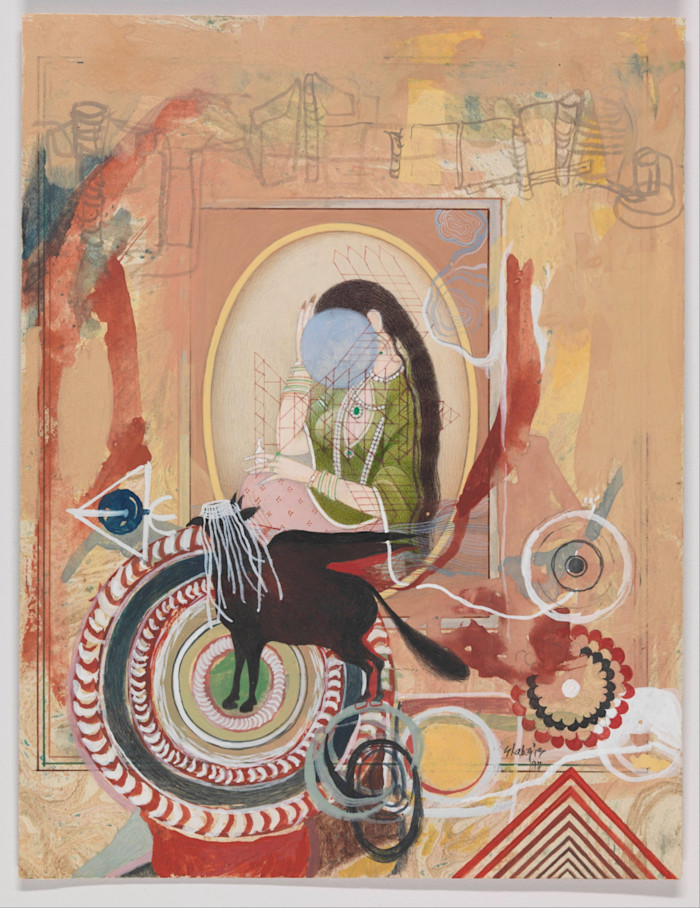
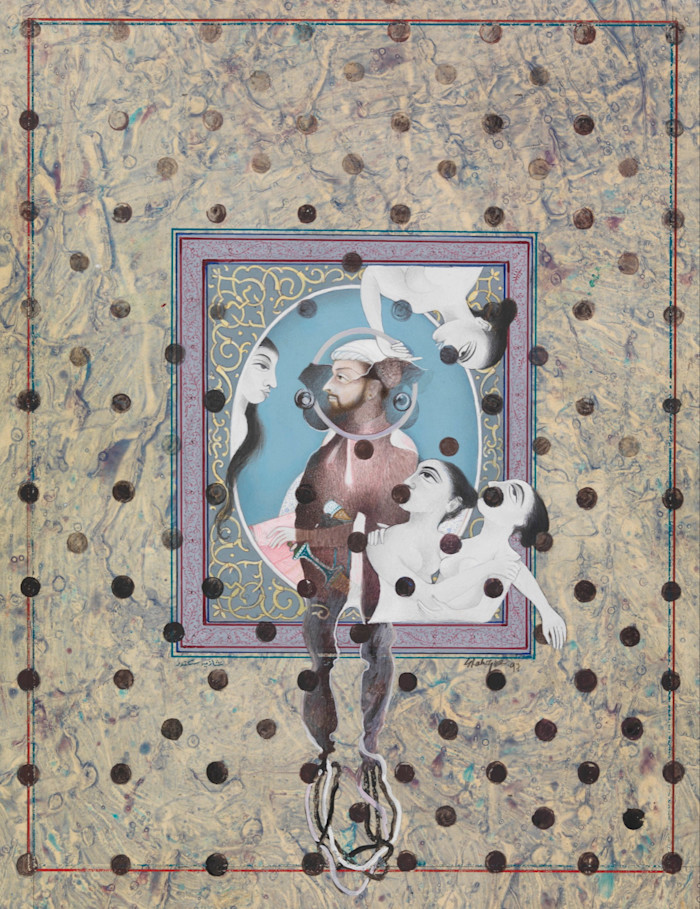
Nevertheless, Sikander has continued to earn accolades for her boundary-pushing projects. Last year she collaborated with neuroscientist and Alzheimer’s specialist Scott Small for “The Book of Lightness and Forgetting” (2025) which explores the benefits of not remembering, through his text and her images. The book is designed like an accordion file, enabling the reader to shift drawings from slot to slot, like information passed through the brain. Her best known piece in recent years is “Witness” (2023), an 18ft-tall bronze sculpture of a woman with roots for limbs, braids that spiral like a ram’s horns and the kind of lace collar favoured by the late Supreme Court Justice and women’s rights champion Ruth Bader Ginsburg.
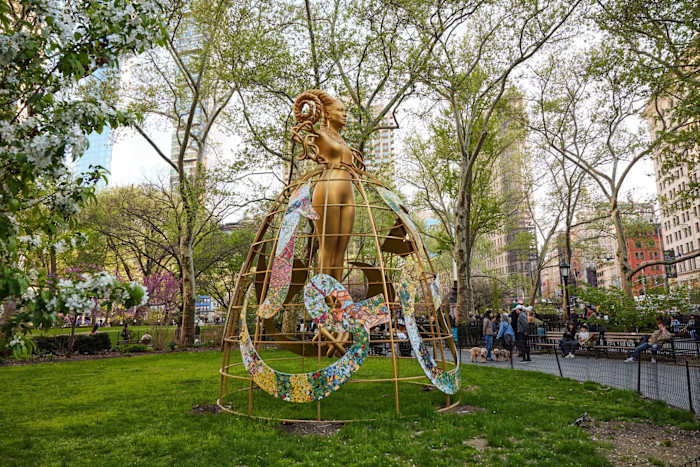
First installed in Manhattan’s Madison Square Park, “Witness” later travelled to the University of Houston, where rightwing protesters called it a “Satanic abortion idol”. After a vandal decapitated the sculpture with a hammer, Sikander adamantly refused to have it repaired. It is now sitting in storage, but she hopes that one day an institution will present it as it is: still beheaded, bearing witness.
“Something like that has happened in my work — I’ve carried the erasure of feminine narratives,” Sikander says. “But then it actually physically happening was almost like this weird circle.” She pauses. “It’s happening at a time when rhetoric is very heightened, and it’s the kind of fissures that it’s maybe unearthing. But anytime there’s association with representation of the feminine, and optics of power, when boundaries are bleeding, there’s this fear.”
Perhaps it was meant to be, a little like getting the chance to occupy the Breuer buildings. The isolation up here may be idyllic, and the distractions few, but Sikander still spends most of her time in New York City, where her teenage son attends school. “I cannot imagine being in nature like this all the time,” she admits. “I love the city. As soon as the sun goes down here, I’m like, itching.”
March 23-June 21, mplus.org.hk
Find out about our latest stories first — follow FT Weekend on Instagram, Bluesky and X, and sign up to receive the FT Weekend newsletter every Saturday morning