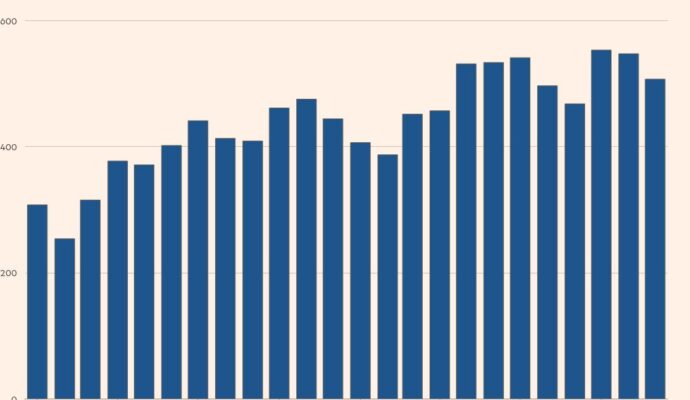
Good morning. News to start: Donald Trump has warned that Nato faces a “very bad” future if US allies fail to assist in opening up the Strait of Hormuz, in an interview with the FT that sent a blunt message to European nations to join the US president’s war effort in Iran.
That came hours after India’s foreign minister told me that negotiating with Tehran was the right approach to restart shipping through the critical waterway.
Today, S Jaishankar tells me more about how the EU-India relationship can deepen, and Laura reports on a warning from the energy markets that Brussels should abandon any plans of capping gas prices.
Getting comfortable
India and the EU should develop a “natural inclination to compare notes” and co-operate on global issues, the country’s foreign minister has said, in a pitch for deeper strategic alignment between Brussels and New Delhi.
Context: The EU and India are the world’s second and fourth largest economies. A trade deal signed in January was billed as the largest ever for either side and came as Trump’s attitude on the transatlantic relationship as well as China’s rise as an economic rival have pushed Europe to seek closer ties with more third countries.
“We really created the foundation . . . for this relationship to move to a much more serious, much higher level,” Jaishankar told the FT, who is visiting Brussels to attend today’s council of EU foreign ministers.
“If you look at the poles of a multi-polar world, and the poles are pretty obvious, the relationship between India and EU actually had the most room for growth,” he said. “There’s a lot that we can do which has unrealised potential.”
Jaishankar will meet the bloc’s 27 foreign ministers over lunch, during a meeting expected to be dominated by the war in the Middle East. While his invitation was agreed months ago, he said the conflict was a good example of a crisis where the EU and India could be co-ordinating closer.
“I want to create this culture of comfort and confidence between us,” he said. “I would still say we don’t still have that level of comfort, that instinctive, you know: ‘Something is happening in the world, where are you, where [are] we, what can we do, what do you think?’”
“I think that’s very much reciprocated by my 27 EU colleagues. We want to sort of create that level of . . . I would say, a chemistry, a natural inclination to compare notes,” he said.
Jaishankar said India was also keen on working with the EU on critical minerals supply, deepening a defence and security arrangement into potential industrial co-operation, and possible initiatives on mobility such as making it easier for skilled workers to move between India and the EU.
“When I look at all the [EU] members, I think at least one of the issues on which they are fully united is the need for stronger, deeper ties with India,” he said.
Chart du jour: The price ain’t right
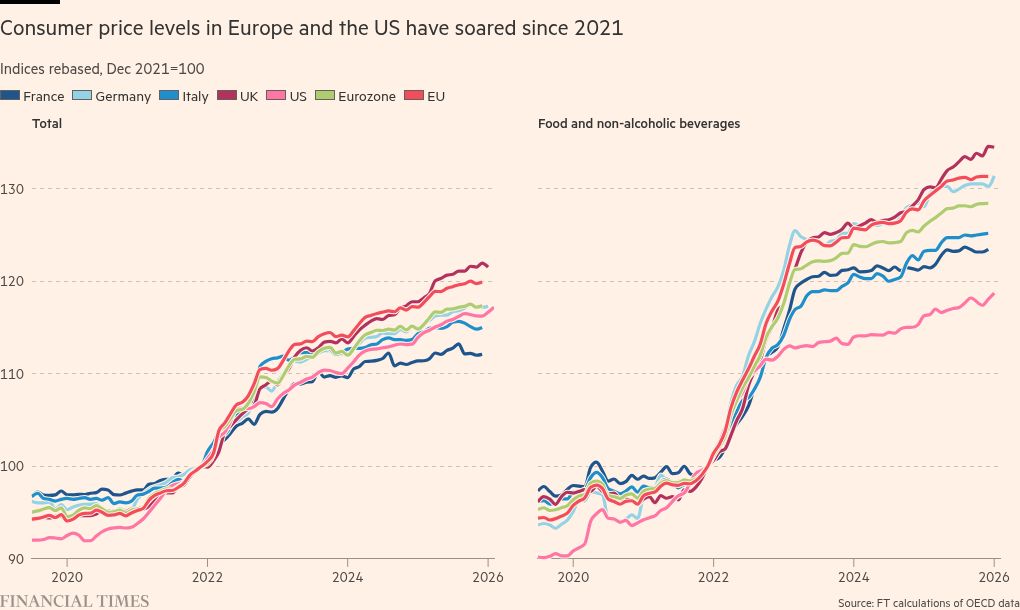
The European Central Bank will give its first formal verdict on the threat posed by the Iran war this week, as fears of resurgent inflation are dulling hopes of interest rate cuts.
Cap in hand
A coalition of energy market players has written to the European Commission warning about the pitfalls of introducing a gas price cap to tackle escalating prices, writes Laura Dubois.
Context: The Commission last week floated the idea of capping natural gas prices to relieve consumers from the rising energy prices caused by the conflict in the Middle East.
A coalition of energy traders, producers and financial market associations involved in commodities have written to the European Commission warning that could destabilise markets further.
“Such an intervention could compromise Europe’s energy security, disrupt the functioning of its energy markets and carry significant risks to financial stability, without delivering sustainable price relief for consumers,” states the letter seen by the FT, which was signed by the Federation of European Securities Exchanges and 10 other organisations.
“Europe’s ability to secure natural gas, and particularly LNG, depends on a clear and credible price signal,” they warn. “If wholesale prices were artificially constrained below global market levels, LNG cargoes would likely be diverted to other regions, risking short-term supply disruptions and long-term damage to Europe’s reputation as a dependable trading partner.”
They point out that while Brussels introduced a “market correction mechanism” during the gas crisis sparked by the Ukraine war, it was never activated because prices dropped again. They also add that concerns about it at the time such as “increased volatility, higher margin calls and a shift of trading into less regulated markets . . . remain fully relevant today”.
“Weakening the price signal now could have consequences well beyond the current period of high prices,” write the organisations.
The EU’s energy ministers are meeting today to discuss how to address the market crisis.
What to watch today
Now read these
Bellwether: Marine Le Pen’s far-right party racked up gains in the first round of France’s municipal elections, in a harbinger of next year’s presidential vote.
Orbán’s riches: Hungarian premier Viktor Orbán presents himself as a man of humble roots. But an expedition to his Hatvanpuszta estate indicates otherwise.
24% pay rise: UniCredit’s Andrea Orcel was paid €16.4mn last year, drawing level with UBS’s Sergio Ermotti as Europe’s best-paid bank boss.
Are you enjoying Europe Express? Sign up here to have it delivered straight to your inbox every workday at 7am CET and on Saturdays at noon CET. Do tell us what you think, we love to hear from you: europe.express@ft.com. Keep up with the latest European stories @FT Europe