Good morning. Crude oil continues its rollercoaster ride, with prices breaching $100 again yesterday. The International Energy Agency has warned that oil markets are suffering “the largest supply disruption in history”, which is bad news, especially for oil-poor Asian countries, which are trying to find ways to reduce their fuel consumption. Will the war threaten India’s “Goldilocks” economy? The FT’s new South Asia bureau chief Michael Stott has hit the ground running.
In today’s newsletter, will the chaos in the country’s gas supply become a crisis soon? But first, India begins to warm up to Chinese investments.
Welcome back
India this week announced a relaxation of the curbs it had placed on Chinese investments in the country, signalling a broad welcome to its neighbour’s companies and investors. But the fine print suggests that the door is barely ajar.
Tuesday’s announcements, which came after several weeks of swirling rumours, specify that companies with up to a 10 per cent stake held by entities in China (and other countries that share a land border with India) will get automatic approval for investment. The rest will continue to need an official thumbs-up, although the government has promised to cap approval times to 60 days for key sectors such as electronics, silicon wafers and solar cells. These details suggest a certain degree of wariness on New Delhi’s part.
Still, the decision is a big departure from the government’s previous stance. In 2020, it announced that all investments from countries sharing a land border with India, including China, would need prior approval. This also applied to investing entities whose beneficial owners were Chinese. The move was presented as a way to prevent opportunistic acquisitions of Indian companies by Chinese groups during the Covid-19 downturn. But it also came amid rising geopolitical tensions, including repeated military skirmishes along the border.
The easing of curbs illustrates the difficult balance India now has to strike between geopolitics and the economy. While the changes mostly benefit foreign portfolio investors with Chinese backers, India also needs access to critical inputs in various sectors. In particular, the Modi government has to fuel its ambition for manufacturing to reach 25 per cent of the economy — now still languishing at 16 per cent after a decade of pursuing this goal. Second, despite frosty relations, India’s dependence on Chinese goods has grown in the past few years. Trade with China has increased from $86.4bn in 2021 to $127.7bn last year, much of it imports by India. The tariff chaos unleashed by US President Donald Trump has further muddied the waters, with all countries, including India, struggling to secure supplies of rare earths and other minerals.
The opposition has expressed its criticism about this turnaround, but, economically, it does make cynical sense to seek warmer ties with Beijing. Yet New Delhi seems to be doing so only in fits and starts. Official figures indicate that foreign direct investment from China, which peaked at about $500mn in 2015, was only $250mn on average in the years leading up to 2020. Any inflow now is good news, especially since the rupee is getting battered. The rise in oil prices because of the war, added to the longer-term trend of consistent outflows in foreign portfolios and net FDI, has weighed on the currency. Yesterday, the rupee was 92.12 to the dollar.
What remains unclear is India’s stance on China. Are they now friends? The economic imbalance makes an equal relationship impossible. For now, India seems to be proceeding with caution, and some suspicion.
Do you think Chinese companies are keen to invest in India? Hit reply or email me at indiabrief@ft.com
Recommended stories
How a US official’s deleted post sent oil markets on a wild ride.
‘Sitting ducks’: oil tankers trapped in Gulf as Iran widens attacks on shipping.
The US has launched new probes into the EU and other trade partners.
The banks that funded Jeffrey Epstein despite red flags: JPMorgan and Deutsche Bank.
Inside the labs training China’s humanoid robots.
Oracle prepares for job cuts as it hails efficiencies from AI coding tools.
Gassed out
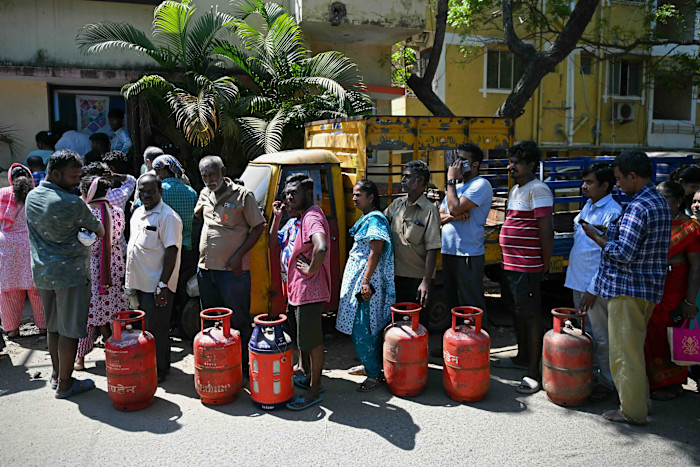
India is struggling with a shortage of gas as the Iran war chokes flows from the Middle East. Faced with the looming energy crisis, the government has decided to prioritise household users over industrial consumers for now.
While officials say consumers should only need to wait three days or less for liquefied petroleum gas cylinders, the reality on the ground seems to be different, with long lines witnessed in several parts of the country. Restaurants are among the worst-affected businesses, having been forced to limit their service, remove fuel-intensive dishes from their menus and in some instances shut down altogether until supplies resume. This affects millions of people, most significantly migrant labourers who rely on roadside shops for their daily subsistence. As is usually the case with any disruption, India’s poor are the first to bear the brunt. Even the dead have not been spared: I spoke to officials in the Pune municipality, who said they were struggling to source fuel for gas-based crematoria.
A resumption in supply from Qatar, which is the main source of gas for India, will take time even after the military hostilities in the Middle East end. Reliance Industries said it had responded to a government call to step up domestic production by maximising LPG production at its Jamnagar facility. Officials say domestic output has increased 25 per cent since Sunday. In November last year, India also concluded an LPG deal with the US, diversifying some of its supply chain.
India imports nearly 60 per cent of its LPG needs. At more than 20mn tonnes a year, it is the second-largest consumer of LPG in the world. In the past decade, the Modi government has, rightly, expanded the availability of gas cylinders, tightened the subsidy programme and encouraged households to transition from biofuels to LPG for cooking. But it has fallen short on expanding domestic production and storage facilities, resulting in an ever-increasing reliance on imports. At present, the country can store less than half its monthly imports.
This month’s events have unceremoniously brought home the risks of this lapse. Beyond the impact on families, sectors such as fertilisers, petrochemical processing and power plants are only receiving a fraction of the supplies they need. Unless there is an early cessation of hostilities and a resumption of imports, India is headed towards a gas crisis.
Have you been affected by this gas shortage? Hit reply or email me at indiabrief@ft.com
Go figure
Tech companies are proving to be a safe harbour in the US stock market, rising 1.5 per cent since the market close on February 27 — the eve of the US-Israeli bombardment — despite every other sector in the index dropping.

Read, hear, watch
The British documentarian (and accidental rapper) Louis Theroux is everywhere now, promoting his new show on Netflix, where he goes inside the “manosphere” to investigate the rise of ultra-masculinity and related misogyny. I have yet to watch the show, but I enjoyed listening to him on a couple of podcasts, particularly Dish and The Romesh Ranganathan Show. He is also the subject of this (bizarre) profile.
I was excited to read that the Wordle creator has a new puzzle. It’s based on the cryptic crossword, something I am (kinda, sorta) getting better at, and was really excited to try, but I must confess it left me a little underwhelmed. Give it a whirl and tell me what you think.
Buzzer round
Which tech company that was started in 1993 and is fuelling the AI boom has the following unofficial motto: “Our company is thirty days from going out of business.”
Send your answer to indiabrief@ft.com and check Tuesday’s newsletter to see if you were the first to get it right.
Quick answer
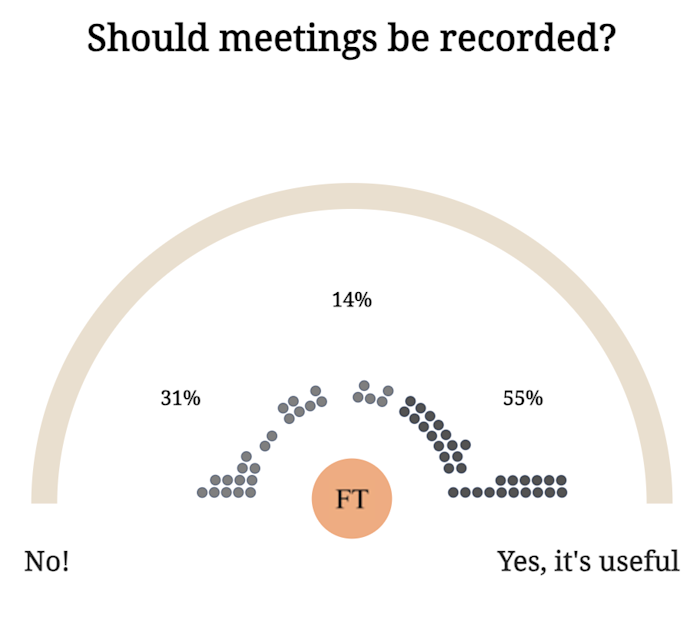
On Tuesday, we asked if you like your meetings recorded? Here are the results. About 55 per cent of you think it’s useful. What?!
Thank you for reading. India Business Briefing is edited by Tee Zhuo. Please send feedback, suggestions (and gossip) to indiabrief@ft.com.