Unlock the Editor’s Digest for free
Roula Khalaf, Editor of the FT, selects her favourite stories in this weekly newsletter.
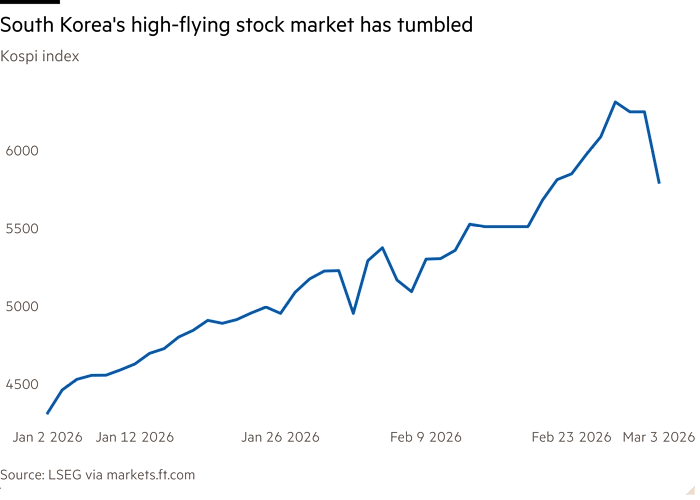
South Korean equities plunged 12 per cent on Wednesday in a record one-day drop, as the world’s best-performing market this year bore the brunt of a big sell-off in Asian markets over fears of a prolonged conflict in the Middle East.
The high-flying Kospi benchmark has fallen nearly 20 per cent since Friday after rising nearly 50 per cent in the first two months of this year. Investors fear the intensifying war in the Middle East could harm the world’s eighth-largest oil importer.
“Investors are trying to take profits from one of the best-performing markets year to date,” said Jason Lui, head of Asia-Pacific equities and derivatives strategy at BNP Paribas, noting that some were pricing in a “more severe disruption scenario”.
The heavy sell-off was driven by declines in market heavyweights Samsung Electronics and SK Hynix, the world’s two largest memory chipmakers, which account for nearly 40 per cent of the Kospi index. They have dropped about 20 per cent each since the war broke out.
Shares across east Asian economies that depend heavily on energy imports fell sharply on Tuesday as oil prices continued their rise.
Japan’s Topix fell 3.7 per cent, while Taiwan’s Taiex slumped 4.4 per cent. In China, the Hang Seng index and CSI 300 lost 2 per cent and 1.1 per cent respectively.
Brent crude climbed 2.5 per cent to $83.40 a barrel.
Foreign investors have sold a net Won5tn ($3.4bn) worth of Kospi shares so far this week. The Kospi 200 volatility index surged to the highest since March 2020.
The heavy foreign selling piled pressure on the Korean won, which slid 2.5 per cent over two days and briefly fell past Won1,500 to the dollar on Tuesday to its weakest level since the global financial crisis.
“Given that Korea is a big oil importer, higher oil prices will have a worrisome impact on the country’s macroeconomy including inflation, exchange rates and growth, if the war is not over in a week or two,” said Jongmin Shim, an equity strategist at CLSA.
He also blamed the heavy sell-off on the unwinding of leveraged stock purchases by retail investors, who had emerged as the main drivers of the rally this year.
The sharp fall has pushed many retail investors into panic mode.
“I’m having a meltdown. I’ve never seen a freefall like this in my decades of stock investing, even when a war broke out,” said Song Mi-kyung, a 60-year-old housewife. “There is not much I can do other than just wish for a quick recovery.”
The Bank of Korea said on Wednesday it would closely monitor the market to take measures in case of “excessive moves” in the currency.
Lawmakers from South Korea’s ruling party said they would meet the country’s top financial regulator on Thursday to discuss measures to stabilise the stock market.
Analysts fear further pressure on the won as Seoul has promised to invest $350bn in the US as part of its trade deal with Washington aimed at reducing high American tariffs.